
How to Start a Clipping Agency: The Complete Playbook

The opportunity hiding inside someone else's long-form content
Every podcaster, streamer, YouTuber, and keynote speaker is sitting on hours of recorded content they never repurpose. It never reaches short-form audiences on TikTok, Instagram Reels, or X. That gap between raw footage and published clips is where a clipping agency operates.
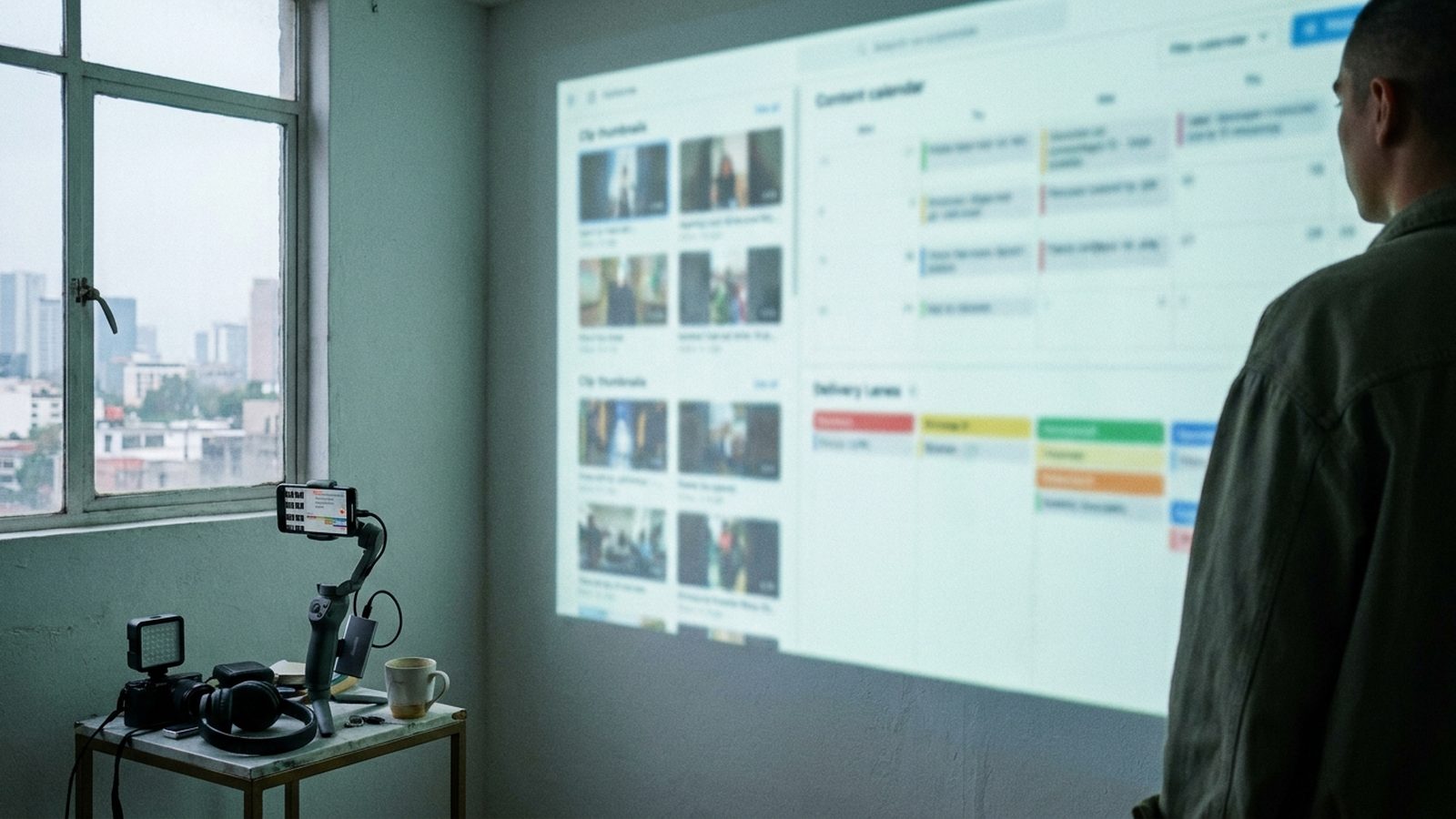
Clipping agency workflow
Choose creators or brands with long-form content supply
Turn source videos into repeatable short-form outputs
Standardize quality, speed, and review rules
Show which clips earned views, leads, or sales
Starting a clipping agency means you become the person (or team) who watches the long content, pulls the best moments, formats them for each platform, and publishes consistently on behalf of clients. Done well, it's a recurring-revenue service business with low startup costs, scalable processes, and real demand from creators who are time-poor but content-rich.
This guide covers how to build one from your first client to a systemised agency, including where AI is genuinely changing the economics of the model.
What a clipping agency actually does
A clipping agency is not a general social media management agency. The core product is short-form video clips extracted and optimised from existing long-form content. The typical workflow:
- Client sends (or gives access to) a raw recording -- podcast episode, YouTube video, Twitch VOD, webinar, interview
- Your team or tool identifies the highest-value 30-90 second moments
- Each clip is trimmed, captioned, aspect-ratio corrected (usually 9:16 for vertical), and branded
- Clips are scheduled and published to TikTok, Instagram Reels, YouTube Shorts, and/or X on behalf of the client
- Performance data informs which clip styles to prioritise going forward
The value to the client is straightforward: they keep making the long-form content they're already making, and you make sure it also works on the short-form platforms eating up audience attention.
Step 1: Define your niche -- don't try to clip everything
The clipping agency market has matured quickly. A generic "we clip stuff" pitch is weak. Niching by content type or client vertical gives you stronger positioning, better word-of-mouth, and faster skill development. Consider:
- Podcasters and audio-first creators -- huge volume, often no video editor on staff
- Business coaches and consultants -- recurring content, willing to pay for consistent output
- Streamers and gaming creators -- high raw footage volume, a culture of clips already exists
- Corporate thought leaders and executives -- LinkedIn and X clips from keynotes and panels
- E-commerce brands and TikTok Shop affiliates -- product content that needs constant reshaping for different placements
Creators like @ekkomedia have noted publicly that fan-made clips consistently outperform official marketing content in views and engagement. The reason: authentic moment-selection beats polished brand production. If you can bring that organic sensibility to a professional workflow, you have a real edge.
Pick one vertical to start. Build case studies there. Then expand.
Step 2: Build your core tech stack
You don't need expensive gear to start. You need reliable software and clear processes. Here's a working starter stack:
| Function | Tool options | Notes |
|---|---|---|
| Video editing | CapCut, DaVinci Resolve, Adobe Premiere | CapCut is fast for short-form; Premiere for client-grade output |
| AI clip identification | Opus Clip, Descript, Munch | AI highlights cut manual review time substantially |
| Captions / subtitles | Captions app, Submagic, CapCut auto-captions | Auto-captions with manual QA is the standard workflow |
| Scheduling & publishing | Later, Buffer, or autonomous agents like GEN | Publishing consistency matters as much as clip quality |
| Client delivery / comms | Notion, ClickUp, Slack | Clients want visibility; a simple dashboard prevents churn |
| Asset handoff | Google Drive, Frame.io | Frame.io is better for approval workflows |
The tools matter less than the process you build around them. Document every step early, even before you have staff. Your first hire will thank you.
Step 3: Price your service correctly from day one
Underpricing is the most common mistake new clipping agencies make. Here's a realistic framework:
Per-clip pricing
Charging per clip (typically $30-$80 per finished, published clip depending on complexity and your market) suits clients with inconsistent output volumes. It's easy to explain but creates income volatility for you.
Monthly retainer pricing
A retainer model -- e.g. "up to X episodes per month, Y clips each, published across Z platforms" -- is more predictable and the right target structure for an agency. Entry-level retainers for a single creator with modest output typically start in the $500-$1,500/month range; larger operations or brands with higher volumes can support significantly more.
What's included in the price
Be explicit. Does your retainer include:
- Clip selection and moment identification
- Editing and captioning
- Thumbnail or cover frame design
- Caption copywriting (the text post, not just the subtitle)
- Scheduling and publishing
- Monthly performance reporting
Each of these is a legitimate line item. Many agencies lose margin by including everything and never articulating the value of each component.
Step 4: Land your first three clients
You don't need a website to get your first client. You need proof of output and a direct outreach strategy.
The "free pilot" approach
Identify three creators in your chosen niche whose content you already consume and respect. Watch their last few long-form videos. Clip three genuinely strong moments from each -- using your full workflow, captions, correct aspect ratio, everything. Send those clips to the creator cold, with a short note explaining what you did and what you'd offer as a monthly service.
This costs you a few hours, shows your work is real, and removes the "will this actually work?" friction from the sales conversation. Several clipping agency founders have documented this exact approach working on the first or second attempt.
Warm network first
If you know any podcasters, coaches, or content creators -- even people with modest audiences -- offer them a trial month at a reduced rate in exchange for a written testimonial and permission to use clips as portfolio work. A real case study showing "before: 0 short-form posts per week / after: 5 per week" is more persuasive than any pitch deck.
Positioning on social
Creators like @davidzakwan built significant audiences by publicly sharing practical knowledge about content creation. Posting your own behind-the-scenes content -- showing your clip selection process, explaining why you chose a particular moment, sharing platform-specific formatting tips -- positions you as an expert before a prospect even gets on a call with you.
Step 5: Build a repeatable production workflow
Once you have two or three paying clients, the constraint shifts from getting clients to delivering without burning out. Process discipline is what separates agencies that scale from ones that plateau at the founder's personal capacity.
Intake and briefing
Every new client should complete a brief covering: their tone of voice, clips they like (from themselves or others), platforms they prioritise, any content they want excluded, and their preferred review cadence. This brief is your reference for every edit decision. If a client says "that's not quite right," revisit the brief first -- often it needs updating, not the editor.
Batch processing
Review and log all of a client's raw footage in one sitting. Export all clips in one session. Caption all clips in one session. Publish in one scheduled batch. Context-switching between clients mid-task kills efficiency. Time-block by task type, not by client.
Quality control checkpoints
Before anything goes to a client (or publishes directly), every clip should pass a simple checklist: correct aspect ratio, no cut-off words in captions, no awkward start/end frames, hook appears within the first two seconds, audio levels consistent. A two-minute QA pass prevents embarrassing errors and client churn.
Step 6: Scale -- people, automation, or both
Scaling a clipping agency has historically meant one thing: hire more editors. That model still works, but the economics are changing fast.
Hiring editors
Offshore editors on platforms like OnlineJobs.ph or Contra can be cost-effective for high-volume, lower-complexity work. Build a detailed style guide and example library before hiring -- you need to train against a documented standard, not your personal intuition on any given day. Expect to spend real time on quality feedback in the first month before output becomes consistent.
AI-assisted clipping
Tools like Opus Clip and Munch identify high-engagement moments using transcript analysis, speaker energy, and topic density. They don't replace editorial judgment -- AI tools regularly surface technically "quotable" moments that are boring out of context -- but they cut the time spent scrubbing through footage significantly. Use them as a first-pass filter, not a finished product.
Autonomous publishing agents
The newest category is tools that handle the entire downstream workflow: trend monitoring, caption writing, scheduling, and publishing across platforms without manual intervention. Tools like HeyGen and Arcads have shown what's possible when AI takes on repetitive content production tasks. Autonomous social media agents, including GEN, go further -- monitoring what's trending on TikTok, Instagram, and X and publishing on behalf of accounts without a human touching the publish button. For a clipping agency, this matters because your bottleneck usually isn't editing; it's the coordination overhead of scheduling dozens of clips across multiple client accounts at the right times.
Creators like @buildwithtacha have shown publicly what happens when you remove the traditional agency layer from production -- using AI to build and ship product demos without a team. The same logic applies to clipping: the agencies that grow over the next few years will be the ones that use AI to keep headcount lean while growing output volume.
Step 7: Retain clients and reduce churn
Client retention is worth more than client acquisition at every stage of an agency's growth. A client who stays for 12 months at $1,000/month is worth more than landing three new clients you lose in 90 days.
The main reasons clipping agency clients churn:
- Inconsistent output -- missed clips, late delivery, irregular publishing cadence
- Declining quality -- clips that worked in month one feel stale; no evolution of style
- No performance conversation -- client has no idea if any of this is working
- Communication gaps -- client feels out of the loop, starts micro-managing, eventually leaves
Counter each with a system: delivery SLAs you actually hit, a monthly "what's working / what we're testing" call, a basic performance dashboard (views, follower growth, engagement rate trends), and proactive updates whenever anything changes -- including when a platform algorithm shifts in a way that affects strategy.
The clipping agency business model at a glance
| Stage | Clients | Monthly revenue range | Key constraint |
|---|---|---|---|
| Solo founder | 1-3 | $1,000-$4,500 | Personal production capacity |
| Small team | 4-10 | $4,000-$15,000 | Editor quality consistency |
| Systemised agency | 10-30+ | $15,000-$50,000+ | Operations, sales, retention |
These ranges reflect realistic market rates and typical agency economics -- not guarantees. Your niche, market, and operational efficiency will determine your actual numbers.
Common mistakes to avoid
- Clipping for the wrong metric. Long clips that are technically complete aren't good clips. Good clips have a hook, a payoff, and leave the viewer wanting more. Train your eye on what makes people stop scrolling, not what makes the content feel "complete."
- Ignoring platform-native behaviour. A clip optimised for TikTok is not the same as one for LinkedIn. Trends on TikTok peak and fade within days -- what worked last week may feel stale today. Build platform-specific templates and stay actively observant.
- Taking on too many clients too fast. Quality degrades, delivery slips, clients leave. Controlled growth with strong retention beats fast growth with high churn every time.
- Not owning the publishing relationship. If you're just sending files and the client publishes themselves, you're a freelance editor, not an agency. Own the publish. It's stickier, more valuable, and harder to replace.
- Underinvesting in your own content. As @sabrina_ramonov and others have documented, building a public presence around your expertise compounds your inbound pipeline over time. Your agency's own social output is a sales asset.
Frequently asked questions
Do I need video editing experience to start a clipping agency?
Basic video editing skills help, but you don't need to be a professional editor. Tools like CapCut and AI-assisted platforms like Opus Clip make it possible to produce competent clips without deep editing knowledge. What matters more early on is editorial judgment -- knowing which moments are worth clipping -- and the ability to build a reliable process. You can hire or contract editors once you have paying clients.
How many clips should I deliver per client per month?
It depends on how much long-form content the client produces and how many platforms you're managing. A practical starting point for a podcaster releasing one episode per week might be five to ten clips per episode -- meaning 20-40 clips per month. For a client posting daily long-form video, the volume is much higher. Scope this clearly in your contract and price accordingly.
Should I charge per clip or on a monthly retainer?
For ongoing clients, retainers are almost always better for both parties. The client gets predictable costs and consistent output; you get predictable revenue and less time spent on invoicing and renegotiation. Per-clip pricing makes sense for one-off projects or clients testing your work before committing to a retainer.
What platforms should a clipping agency cover?
At minimum: TikTok, Instagram Reels, and YouTube Shorts -- all use vertical 9:16 format, so the same clip can be repurposed across all three with minor adjustments to captions and hashtags. X and LinkedIn are useful add-ons for business-oriented clients. Don't try to cover every platform in your entry-level package; add platforms as upsells once the core service is running smoothly.
How do I find clients for a clipping agency?
Start with your own network -- anyone creating long-form content who isn't consistently posting short-form clips is a potential client. Cold outreach with a pre-made sample clip (clipped from their existing content) is one of the most effective first-client strategies. Beyond that, LinkedIn outreach to podcasters and coaches, posting educational content on your own social channels, and referrals from early clients are the most reliable acquisition channels.
Is AI going to replace clipping agencies?
AI is changing the workflow significantly -- it cuts the time spent identifying and rough-cutting clips -- but editorial judgment, client relationships, and platform strategy still require human input. The agencies most at risk are those competing purely on low-cost execution. The ones that will do well are those using AI to handle repetitive tasks while investing human attention in strategy, quality control, and client outcomes. The best position right now is to be an agency that uses AI well, not one that ignores it or gets replaced by it.
What makes a clip perform well on short-form platforms?
The first two seconds determine whether anyone watches the rest. A strong hook -- a surprising statement, a counterintuitive claim, a moment of genuine emotion -- is the single most important element. After that: clean captions (most people watch without sound), a natural end point that creates curiosity or resolution, and formatting that fits the platform's norms. Studying what clips actually perform well in your client's niche, not just what looks good in an editor, is an ongoing skill to develop.
Where to go from here
Starting a clipping agency is achievable with low capital and a few strong early clients. The model rewards people who combine editorial taste with operational discipline, and increasingly, who use the right tools to remove manual overhead from publishing and distribution.
The path: pick a niche, build a process, price confidently, land your first three clients with pre-made sample work, then focus on retention while you layer in automation. The agencies that scale well are rarely the ones with the most editors -- they're the ones that built systems allowing them to publish more for clients without proportionally more effort.
If you want to go deeper on the content side, explore how to build a professional clipping workflow or the AI tools changing short-form content production.
This article is published by GEN (gen.pro), an autonomous AI social-media agent that watches trends, creates content, and publishes to TikTok, Instagram, and X automatically -- one of several tools referenced in this guide as relevant to clipping agency operations.