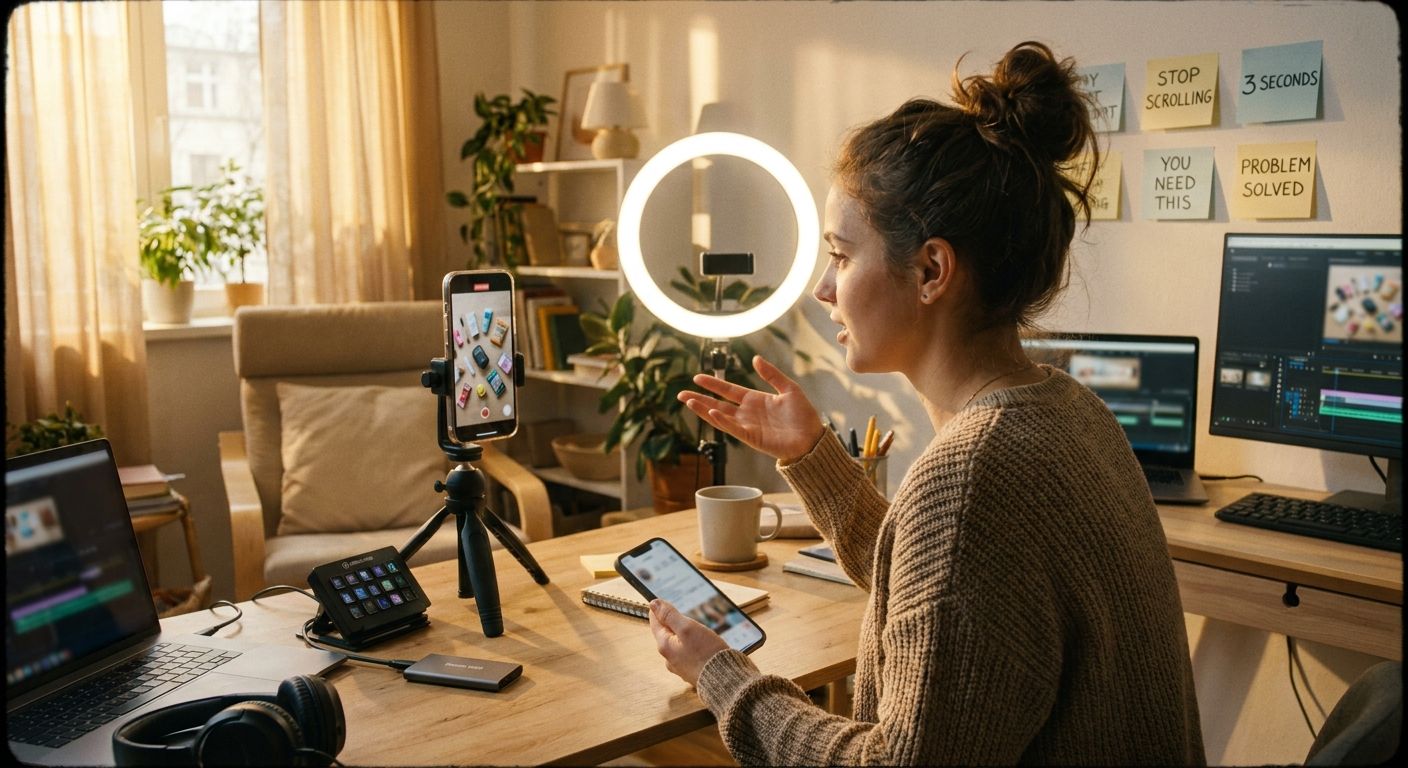
Top 10 Hooks to Try for Productivity Content (With Templates)


Your first three seconds are burning -- here's what actually works
Most productivity content fails at the hook, not the advice. The creator has something genuinely useful to share, but the opening is so generic -- "Here are my top tips for being more productive" -- that no one stays to find out. These 10 hook templates fix that. Each one is built around a real pattern that makes viewers feel the payoff before they've committed to watching.
From hook choice to posted variation
Identify the specific frustration or result your viewer already feels -- not the topic, the emotion.
Choose from the 10 templates below. The hook type should mirror the viewer's mindset: curiosity gap, identity threat, or fast result.
Deliver the hook in your first spoken sentence or on-screen text. The payoff or contradiction must land before second five.
The same core content with a different hook opening often performs completely differently. Treat hooks as a variable, not a fixed choice.
Winners vs. losers: the real difference in productivity hooks
- Winners -- surface the result or the contradiction in the first sentence, so viewers know immediately why they should care
- Winners -- speak to a feeling the viewer already has ("you've tried time-blocking and it still isn't working")
- Losers -- open with a topic ("today I'm talking about productivity"), not a tension
- Losers -- bury the interesting part two sentences in, after viewers have already scrolled
- Losers -- rely on hashtags or video length to carry reach. Reach is not conversion; the hook is
Creators like @viralwithcarla and @anna_rooke both use an "adaptable opening premise" -- a first line that immediately frames the viewer's situation before they've decided to commit. That pattern runs through the strongest productivity content right now.
10 hook templates for productivity creators
-
The failed attempt hook
Template: "I tried [popular method] for [timeframe] and here's what nobody tells you."
Why it works: It signals experience over theory. Viewers who've tried the same thing feel seen and stay for the real answer.
For productivity: Pomodoro, time-blocking, Notion setups -- any method with hype and a gap between promise and reality.
Loser pattern avoided: "Here are my productivity tips" (no stakes, no tension) -
The identity challenge hook
Template: "If you think you're bad at staying focused, this is actually why."
Why it works: It reframes self-blame into a systemic explanation. Viewers feel defensive, then curious.
For productivity: Pair with environment design, dopamine cycles, or task-switching science.
Loser pattern avoided: Generic "discipline tips" that blame the viewer without offering a model -
The counterintuitive result hook
Template: "Doing less actually made me [specific outcome]."
Why it works: Productivity content is saturated with "do more" -- doing less is the pattern interrupt.
For productivity: Themed work days, task batching, intentional rest blocks.
Loser pattern avoided: Hustle-framed content that sounds like every other creator -
The "what top performers actually do" hook
Template: "The [top 1%] of [creators/founders/students] don't do what you think."
Why it works: It creates a credibility gap. Viewers want to know what they're missing.
For productivity: Morning routines, system design, tool stacks -- things where expert behavior diverges from common advice.
Loser pattern avoided: Listicles that present generic tips as novel -
The specific time claim hook
Template: "This [single change] saved me about [X hours] every week."
Why it works: Time is concrete. Viewers immediately calculate the value against their own week.
For productivity: Automation, templating, inbox rules, AI tools -- anything with a measurable time cost.
Loser pattern avoided: Vague "work smarter, not harder" framing with no mechanism -
The process reveal hook
Template: "Here's exactly what my [morning/deep work/end-of-day] looks like, step by step."
Why it works: "Exactly" signals specificity. Viewers bored of advice want to see a real operating system.
For productivity: Film the actual routine -- like @onelane_studios does with their morning routine format -- not a talking-head recap of it.
Loser pattern avoided: Describing a routine in the abstract instead of showing it -
The common mistake hook
Template: "Stop doing [common habit] -- it's the reason your focus is broken."
Why it works: "Stop" is a pattern interrupt. It assumes the viewer is already doing the thing, which creates instant personal relevance.
For productivity: Notification habits, multitasking, reactive inboxes, to-do list structures.
Loser pattern avoided: "How to improve your focus" (no accountability, no urgency) -
The tool upgrade hook
Template: "I switched from [old approach] to [new approach] and my output changed."
Why it works: Comparison is native to how people evaluate decisions. Showing a before-and-after system is more compelling than advocating for one tool alone.
For productivity: Notion to Linear, paper to digital, manual scheduling to AI agents.
Loser pattern avoided: "Best productivity apps" roundups with no personal stakes -
The "if I started over" hook
Template: "If I was building my productivity system from scratch, I'd only do these [N] things."
Why it works: The "from scratch" framing signals the creator has already cut the noise. Viewers get the distilled version without the trial and error.
For productivity: System design, habit stacking, tool minimalism.
Loser pattern avoided: "Ultimate guide" framing that overwhelms rather than focuses -
The relatable failure hook
Template: "I had [X] tasks on my list and finished [almost none of them]. Here's what I changed."
Why it works: The failure makes the solution feel hard-won, not theoretical. Viewers trust the advice more because they've seen the cost of getting it wrong.
For productivity: Works especially well for creators building audience trust, not just authority.
Loser pattern avoided: Expert-only positioning that reads as distant and untested
Turn one source video into 3-5 posts
- Watch the source video and extract the core tension -- the one thing the viewer was feeling before they watched it. Write that down in a single sentence.
- Identify the mechanism -- what does the video actually explain or show? Strip the hook and the outro; what's the middle?
- Write three hooks using different templates above -- try one identity challenge, one counterintuitive result, one process reveal. Same body content, three different first sentences.
- Cut a short-form version, a list version, and a talking-head version -- each format favors a different hook style. Match them.
- Schedule variations at least 72 hours apart and watch which hook drives saves and shares (not just views). That signal tells you which tension your audience actually feels.
An agent like GEN can automate this loop -- detecting which hook pattern is trending in your niche this week, scripting the three variants, and queuing them for test. The manual version of this process takes a few hours per idea; the automated version runs in the background while you film.

Frequently asked questions
How many hook variations should I test per piece of content?
Two to three is the practical minimum. One hook gives you no comparison signal. Four or more dilutes your own feed and confuses algorithmic clustering. Test the same body content with two distinct hook openings spaced a few days apart, then double down on whatever drives saves.
Should the hook be spoken, on-screen text, or both?
Both, aligned. When your spoken first sentence and your text overlay say different things, viewers bounce. When they reinforce the same tension, retention holds. Direct-to-camera while stating the hook generally outperforms text-only for productivity content because it carries authority alongside the words.
Do these hooks work for written content, not just video?
Yes -- templates 1, 3, 7, and 10 translate directly to LinkedIn posts or newsletter subject lines. The underlying mechanic (tension before resolution, identity before advice) is platform-agnostic. Adjust the format, keep the structure.
When should I NOT lead with a hook from this list?
When your audience already knows you well and trusts your judgment, a softer "here's what I've been working on" opener can outperform a tension-first hook because it leans on relationship rather than pattern interruption. These templates work best for growing accounts where the viewer has no prior reason to stay.
Start here: Pick the hook template that matches the frustration you hear most in your comments. Write two versions of your next video's opening line, film both, and use the first 72 hours of save-rate as your signal. That feedback loop -- not the hook list itself -- is what actually moves the needle.