AI Social Media Scheduler: Why Autonomous Agents Beat Timed Posts
A scheduler queues posts. An autonomous agent runs the account.
If your current "AI social media scheduler" still requires you to write the content, approve every caption, and manually select posting times, it isn't autonomous -- it's a calendar with a text box. The operators saving the most time right now have moved past scheduling tools entirely and into agent-based systems that close the full loop: trend detection -> content creation -> platform-native formatting -> publish.
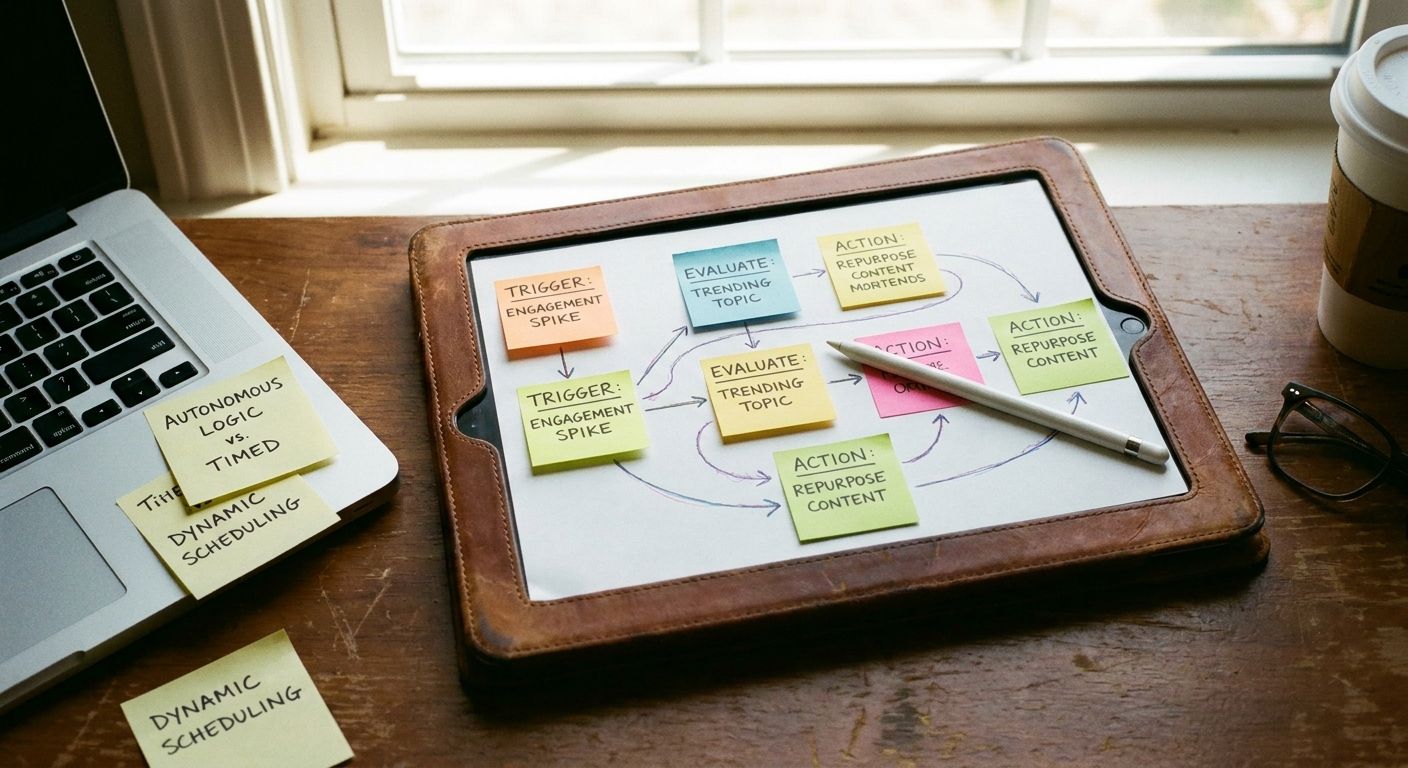
How a true autonomous agent closes the loop
Agent watches TikTok, Instagram, and X surfaces continuously--TikTok trends often peak and collapse within 48-72 hours, so detection speed is the entire edge.
Agent writes captions, selects formats, and adapts tone per platform--not one post copy-pasted across channels, but genuinely different creative for TikTok vs. X vs. Instagram.
Posts go live without a human approval gate. The agent handles scheduling logic, optimal timing windows, and cross-platform sequencing.
Engagement signals feed back into the next content cycle, so the agent self-calibrates rather than repeating a static strategy.
TL;DR -- what separates a scheduler from an agent
- Scheduler: queues content you wrote, at times you picked
- AI-assisted scheduler: suggests captions, still requires human review and approval
- Autonomous agent: monitors trends, generates platform-native content, publishes, and iterates without a per-post approval loop
- The real cost of the first two: a team posting daily across three platforms can easily burn 6-8 hours a week on reformatting, caption edits, and scheduling logistics alone -- before a single creative decision is made
Why "AI-assisted" schedulers still leave most of the work on you
Tools like Buffer, Later, and Hootsuite added AI caption generators. They're genuinely useful for the writing step, but the architecture hasn't changed: you still supply the brief, review the output, resize the asset, and hit publish. The AI is a co-pilot, not a pilot.
The smarter operators -- creators like @dombavaro and @sabrina_ramonov -- are building around a different model: workflow automation stacks or agent runtimes that handle the entire content loop. @sabrina_ramonov has documented using Claude-based co-work setups to manage content pipelines she describes as outperforming n8n/Make.com approaches specifically because the LLM handles context and judgment calls, not just templated transformations. @theaiimpact went further and built a full system inside Claude Code covering brand onboarding, content generation, and publishing in a single agent workflow.
The recurring insight across these setups: the bottleneck isn't writing speed, it's decision latency -- the gap between a trend emerging and your post going live. An agent running 24/7 with publish permissions collapses that gap to near zero. A human-gated scheduler cannot.
The actual architecture difference
| Capability | Traditional scheduler | AI-assisted scheduler | Autonomous agent (e.g. GEN) |
|---|---|---|---|
| Trend detection | ❌ Manual | ❌ Manual | ✅ Continuous monitoring |
| Content creation | ❌ Human-written | ⚠️ AI suggests, human approves | ✅ Agent generates end-to-end |
| Platform reformatting | ❌ Manual resize/rewrite | ⚠️ Partial | ✅ Native format per platform |
| Publish without approval | ✅ (queue only) | ❌ Requires sign-off | ✅ Fully autonomous |
| Feedback loop | ❌ None | ❌ None | ✅ Performance signals feed next cycle |
How to evaluate any "AI social media scheduler" before you buy
- Ask: does it watch trends, or does it wait for you to supply a topic? If you're still writing briefs, the AI is a writing assistant, not an agent.
- Test the reformatting layer. Paste one piece of content and see if it produces genuinely different outputs for TikTok, Instagram, and X -- or just the same text with minor edits. Real reformatting changes structure, not just length.
- Check for a publish API, not just a draft queue. A tool that can only stage drafts still requires a human touchpoint. True automation requires live platform API connections with OAuth-level publish permissions.
- Look for a feedback loop. Does the tool ingest engagement data to inform future content? Without this, you're automating output but not learning.
- Measure total operator time, not just "time saved on captions." The relevant metric is: hours from trend spotted to post live, and total weekly hours your team spends touching content at all.
Where GEN fits in this stack
GEN is a fully autonomous social media agent, not a scheduler with AI bolted on. It monitors TikTok, Instagram, and X for emerging trends, generates platform-native content against your brand voice, and publishes -- without a per-post approval step. The architecture is closer to what @maverickgpt describes as "hiring an agent that runs your social account 24/7" than to a traditional scheduling tool.

For founders or agency operators running multiple accounts, the gain isn't faster caption writing -- it's removing the human-in-the-loop requirement entirely while keeping brand coherence. That's a harder engineering problem than scheduling, and it's the one GEN is built around.
If you're evaluating content repurposing workflows alongside scheduling, the same agent loop applies: one asset detected or created, reformatted and distributed across platforms without manual intervention per channel.
Frequently asked questions
What's the difference between an AI social media scheduler and an autonomous AI agent?
A scheduler -- even with AI caption features -- still requires human input at the content creation and approval stage. An autonomous agent like GEN monitors trends independently, generates and reformats content for each platform, and publishes without requiring per-post sign-off. The distinction is whether a human is in the loop for every piece of content, or only for high-level strategy.
Is fully autonomous publishing safe for brand accounts?
It depends on the agent's brand-voice guardrails. The risk isn't autonomous publishing per se -- it's autonomous publishing without tight brand configuration. Agents that ingest your tone guidelines, content categories, and hard exclusions (topics to avoid, competitor mentions, etc.) can maintain brand safety at scale. The setup investment is front-loaded; the ongoing risk is lower than it appears because the agent isn't improvising, it's executing inside defined parameters.
Can an AI agent replace a social media manager entirely?
For high-volume, trend-reactive content -- yes, substantially. For strategy shifts, brand pivots, crisis response, or community management, a human is still required. The practical operating model: the agent handles execution and daily publishing volume; the operator handles quarterly strategy and edge cases. Most teams running this model find the human role shifts from content production to content direction.
How do autonomous agents handle platform algorithm changes?
Agents built on continuous trend monitoring adjust format and timing as signals change, rather than waiting for a human to notice performance dropping. That said, major algorithm overhauls (like TikTok's periodic ranking changes) still require a human strategy review -- no agent auto-adapts to a fundamentally new ranking signal without updated configuration.
Bottom line: if you're spending more than a few hours a week on scheduling logistics and reformatting, you've outgrown a traditional AI scheduler. The question is whether your tool closes the full loop or just handles one step of it.