Top 10 Hooks to Try for Skincare Creators (With Templates That Actually Convert)

The right hook is worth more than the right product
Skincare content lives or dies in the first two seconds. A post about a $12 toner with a sharp hook will outperform a post about a cult $180 serum with a generic opener. Most creators know this and still open with "Hey guys, today I'm going to show you..."--then wonder why their saves are flat. The 10 templates below are the structures behind skincare posts pulling consistent views and saves right now, with the weak pattern each one replaces.
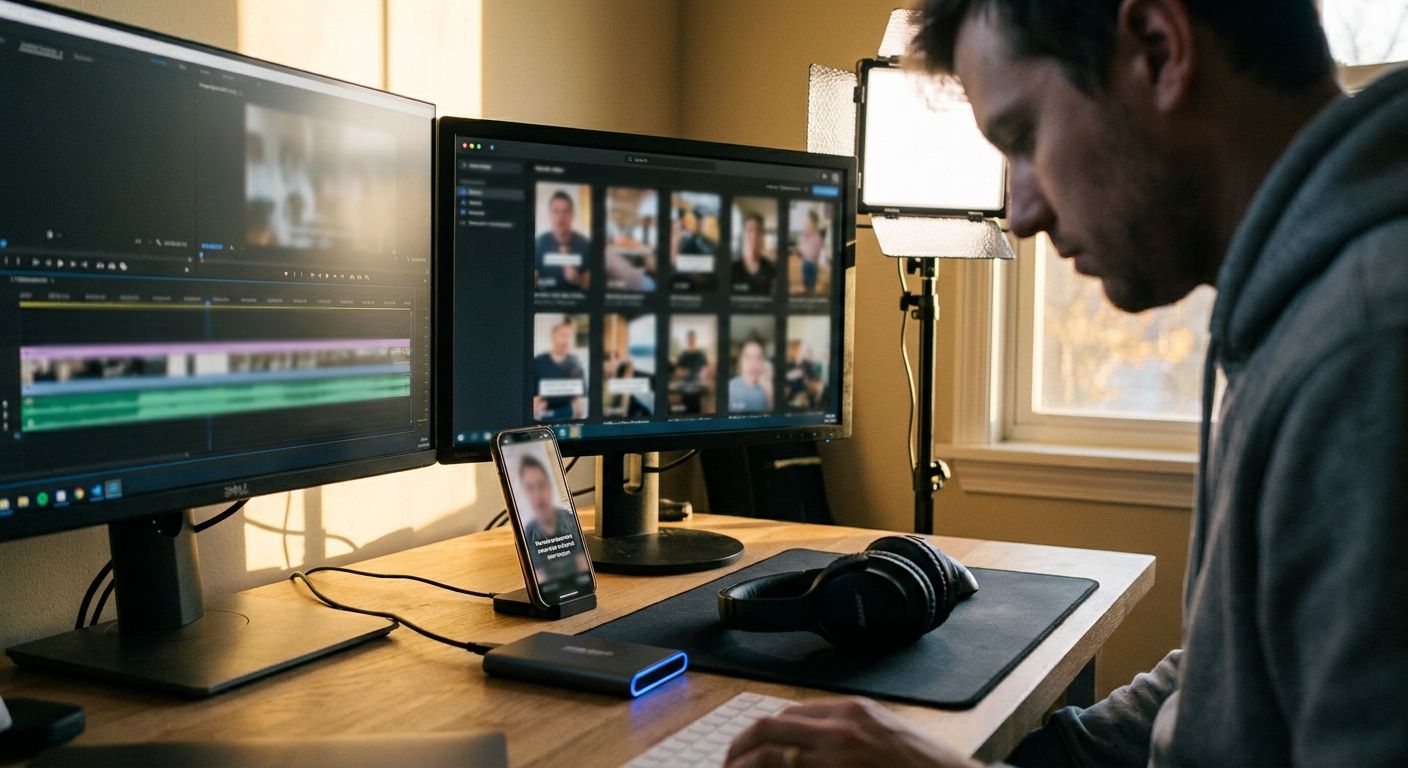
From hook to conversion: the skincare post operating model
The viewer decides to stay based on the promise--not your face, your setup, or your brand deal disclosure.
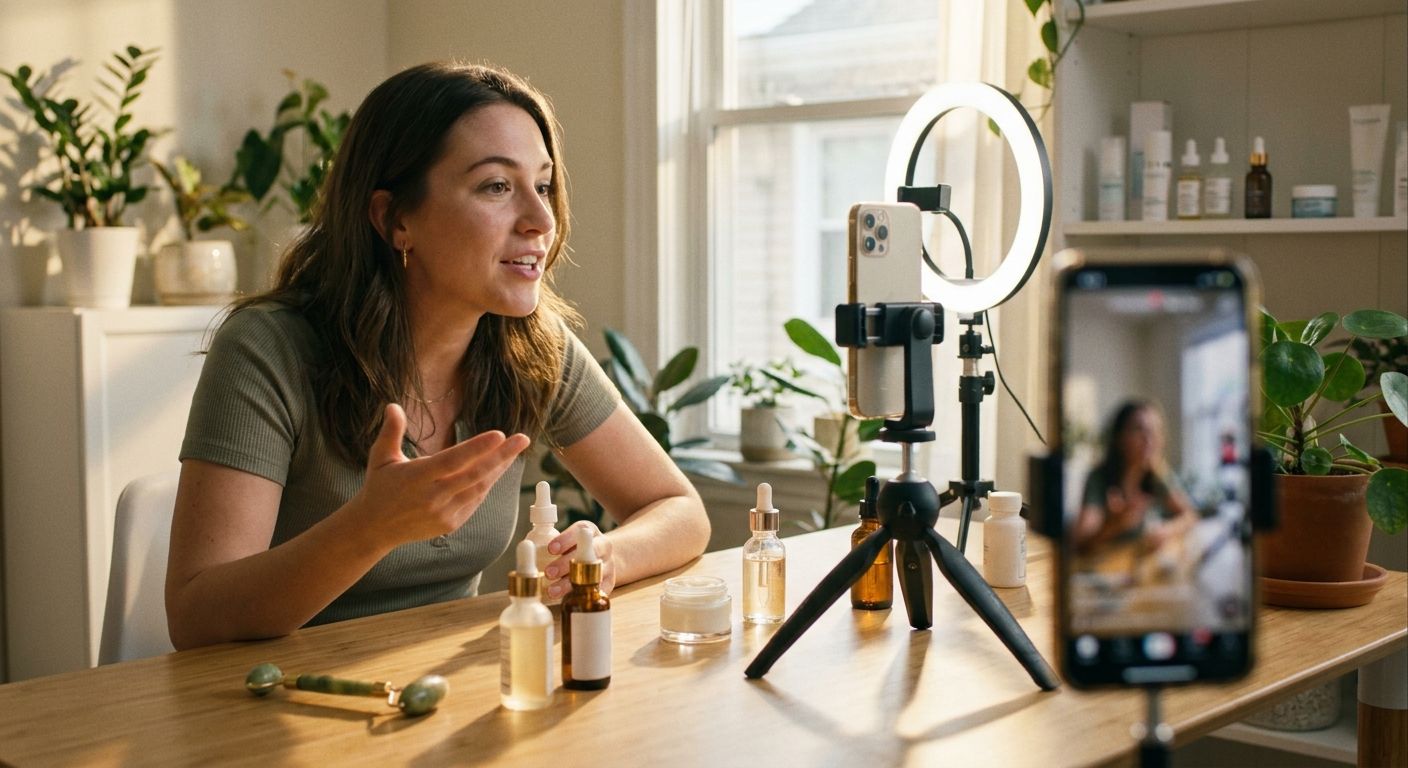
Direct-to-camera application, tight close-ups on texture and skin--anything that lets the viewer mentally place themselves in the result.
Before/after, skin close-up, or a specific verbal confirmation. Saves spike when the viewer gets exactly what the hook promised.
One filming session -> TikTok, Reels, Shorts, and X clip. Most creators leave 80% of their reach on the table by posting once and moving on.
Winners vs. losers: the skincare content split
| Winner pattern | Loser pattern |
|---|---|
| Opens with the result or a specific claim ("People don't believe my age") | Opens with a greeting or product name drop |
| Shows product texture, application, and skin close-up on camera | Green-screen or text-only with no visible skin or process |
| Genuine, unrehearsed enthusiasm--sounds like a real person | Flat, scripted read; ad-copy cadence |
| Payoff delivered before or by the midpoint | Payoff buried at the end, after a long setup |
| One specific problem, one specific fix | Five-step routine dump with no single focal point |
| Save-worthy: a recipe, ingredient list, or protocol the viewer can reuse | Discount-code CTA as the only reason to engage |
Real-world anchor: @akmerimaerinmarie's "Now they don't believe my age" post pulled over 2.2M views and 77K+ saves. The hook is a social-proof claim with zero product mention--the product is the answer to the implied question. @ofeemi7's DIY mask post cleared 1.1M+ views and 43K+ saves with a specific problem ("reduce inflammation, unclog pores") as the opener. Neither post led with a discount or a routine dump.
Top 10 hooks for skincare creators
1. "People don't believe my [age/skin condition] anymore"
Template: "People don't believe my [age / that I used to have cystic acne / that I ever had dry skin]."
Why it works: Social proof before the product. Curiosity gap opens immediately.
Skincare adapt: Say it direct-to-camera, bare-faced, no filter--then cut to the product or routine.
Loser pattern avoided: Starting with "I've been using [Brand X] for three months and..."
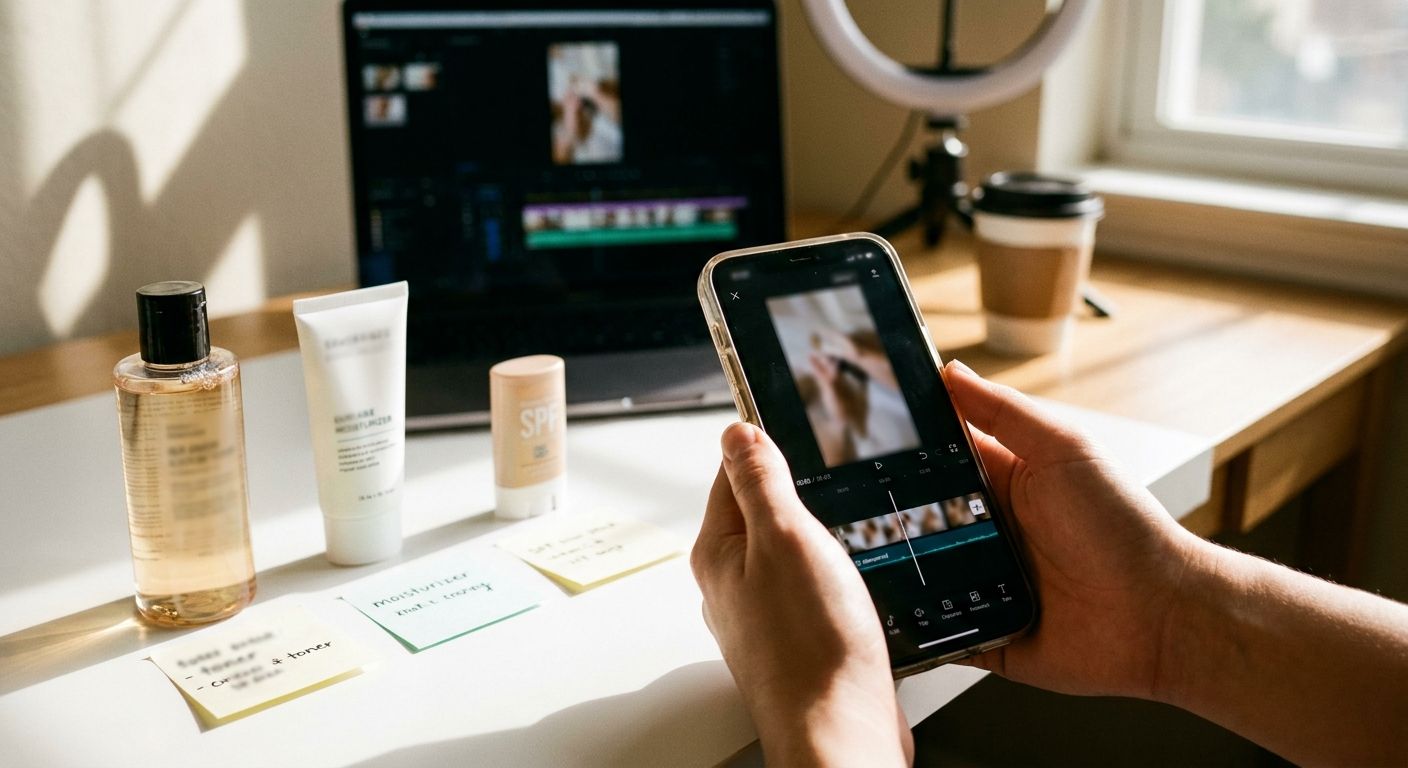
2. "The ingredient derms don't talk about enough"
Template: "The [ingredient / step / product type] that dermatologists don't talk about enough."
Why it works: Authority contrast. Implies the viewer is about to learn something gatekept.
Skincare adapt: Commit to one specific ingredient (azelaic acid, polyglutamic acid, bakuchiol)--not a vague category.
Loser pattern avoided: "Here are my top 10 skincare ingredients." Lists without hierarchy lose viewers fast.
3. "Stop doing [X] if you have [skin type]"
Template: "Stop [double cleansing / using toner / applying SPF this way] if you have [oily / sensitive / acne-prone] skin."
Why it works: Pattern interrupt. The viewer checks whether they're making the mistake.
Skincare adapt: The more specific the behavior, the harder the stop. "Stop over-exfoliating" is weak; "Stop using physical exfoliant after retinol" is sharp.
Loser pattern avoided: "Common skincare mistakes"--too broad to feel personal.
4. "I tried [X] for 30 days--here's what actually happened"
Template: "I used [product / ingredient / routine] every day for [30/60/90] days. Here's what actually happened to my skin."
Why it works: Time-bound experiment signals honest reporting. "Actually happened" primes the viewer for an unfiltered take.
Skincare adapt: Show skin close-ups at day 1, day 15, day 30. The timeline is the proof--don't skip it.
Loser pattern avoided: "My review of [product]"--review framing signals promotional content.
5. "Simple DIY [treatment] to [specific result]"
Template: "Simple DIY [mask / serum / toner] to [reduce redness / unclog pores / brighten dull skin]."
Why it works: Save-bait. Viewers bookmark actionable recipes to use later.
Skincare adapt: Name the active ingredients in the hook, not just the outcome. @ofeemi7's honey-and-clay mask worked because "unclog pores" is specific.
Loser pattern avoided: "My favorite skincare hack"--vague outcome kills the save motivation.
6. "This [product] from [region/brand type] is years ahead"
Template: "This [K-beauty / Japanese / pharmacy] [product] is years ahead of what we have here."
Why it works: Geographic novelty plus a superiority claim. Creates in-group knowledge for the viewer who shares it.
Skincare adapt: Follow @a.closmain's model--lead with the cultural angle, then show the product's texture and application live. Don't just hold the bottle.
Loser pattern avoided: "Underrated skincare products"--too generic, no cultural hook.
7. "Watch what happens when I apply [X] on [skin condition]"
Template: "Watch what happens when I put [niacinamide serum / snail mucin / retinol] directly on [active breakout / dry patch / hyperpigmentation]."
Why it works: Direct demonstration promise. The viewer cannot look away from a skin-reaction clip.
Skincare adapt: Film in good natural light, tight macro shot on the skin. The visual is the hook--not the voiceover.
Loser pattern avoided: Describing a result in text instead of showing it.
8. "The [routine/product] that cleared my skin when nothing else did"
Template: "I tried everything for [years / months]. This [one product / two-step routine] is what finally cleared my [acne / redness / texture]."
Why it works: Exhaustion narrative. Anyone who has cycled through failed skincare immediately identifies.
Skincare adapt: Name the things you tried and failed with--specificity sells the struggle and makes the fix feel earned.
Loser pattern avoided: "My holy grail products"--implies easy wins, not relatable struggle.
9. "Dermatologist-approved vs. what I actually use"
Template: "Dermatologist-recommended [routine / ingredient] vs. what I actually use--and why."
Why it works: Tension between authority and real-world experience keeps viewers watching for the verdict.
Skincare adapt: Don't bash dermatologist advice--reframe as "what works for my specific skin, not the average patient."
Loser pattern avoided: Either pure authority-worship or pure contrarianism. The tension is what makes it watchable.
10. "POV: your skin after [specific habit change]"
Template: "POV: your skin after you [quit [X] / start [Y] / switch to [Z]]."
Why it works: Second-person POV makes the result feel personal to the viewer, not the creator.
Skincare adapt: Pair with a before/after skin shot or a macro texture close-up. The POV frame only works if the visual is strong enough to carry the projection.
Loser pattern avoided: "My skin transformation"--first-person framing loses the viewer-identification effect.
Workflow: one source video to 3-5 posts
Most creators spend more time filming than distributing. A single well-filmed skincare demo can feed a week of content across platforms without re-filming.
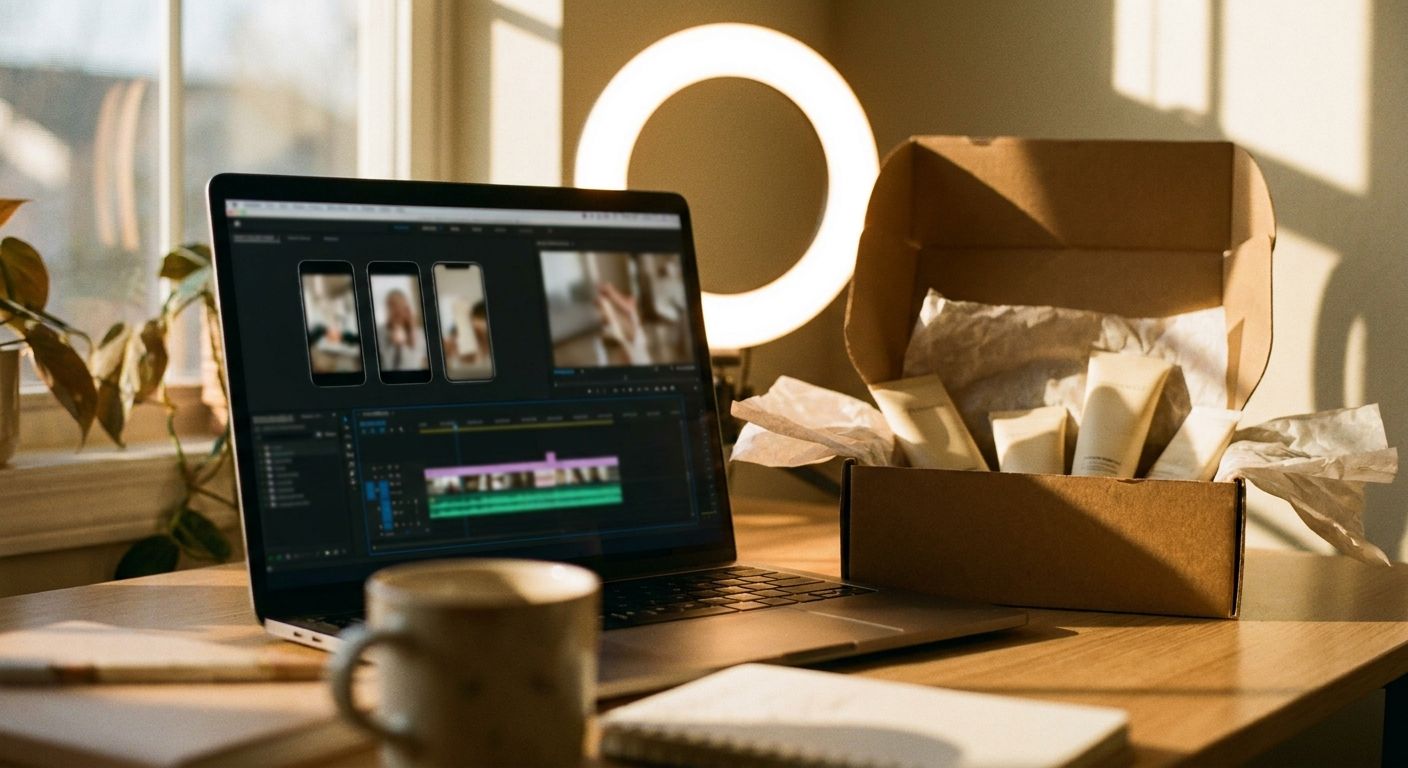
- Film the full demo once. Direct-to-camera application, macro skin shots, before and after. Shoot in natural light. Don't stop to re-record--use the raw takes.
- Identify the hook moment. Which 2-second clip best signals the result? That clip becomes the opening frame on every cut.
- Cut #1 -- TikTok/Reels (full demo): Hook, process, payoff. Keep the genuine reaction in. Remove any segment where you pause to think.
- Cut #2 -- Shorts/X clip (hook + payoff only): Strip the middle process. Lead with the result claim, cut straight to the close-up reveal. Under 30 seconds.
- Cut #3 -- Carousel (Instagram/X thread): Screenshot the ingredient list or the step breakdown as individual slides. Save rates on ingredient carousels run high because viewers bookmark them as reference material.
- Optional Cut #4 -- Reaction/comment reply: Pick one comment from Cut #1 that asks a question, answer it as a follow-up clip. The algorithm reward for reply content is disproportionate to the effort.
Steps 4 and 5--platform-specific formatting, caption rewriting, and scheduled publishing--are where most solo creators stall. An autonomous agent like GEN handles the reformatting and cross-platform scheduling automatically, so the filming session is the only part that requires your physical presence. The repurposing pipeline runs without you queuing each post manually.
Frequently asked questions
Do hashtags and video length affect hook performance for skincare content?
Reach is driven by watch time and saves, not hashtag count or video length. A 60-second video with a weak hook will underperform a 20-second video with a sharp one. Use hashtags to signal topic relevance to the algorithm, not to drive discovery--and keep them to the 3-5 most specific terms for your niche (e.g., #acneprone, #kbeauty) rather than stacking broad tags.
Should skincare creators use text-only or green-screen hooks?
Text-only and green-screen formats work when the information itself is the draw (ingredient breakdown, myth-busting list). For demo and routine content, direct-to-camera with visible skin is consistently stronger--the viewer needs to see the texture, the application, and the result to trust the claim. Default to on-camera; use text/green-screen as a secondary format.
How many hooks should a skincare creator test per month?
Test at least 2-3 distinct hook structures per month, not 2-3 variations of the same structure. Rotating through the social-proof hook, the stop-doing-X hook, and the experiment hook in a single month gives you signal on which frame your audience responds to--rather than optimizing within one lane before you know if it's the right lane.
How does an autonomous AI agent like GEN fit into a skincare creator's workflow?
GEN watches platform trends, generates platform-native captions for each cut, and publishes on schedule across TikTok, Instagram, and X--without manual queuing. For a creator posting 5-7 times per week, scheduling and reformatting alone can consume several hours. GEN removes that layer so the creator's time stays on filming and hook selection, which are the two decisions that actually move the needle.
The takeaway: Pick one hook from this list, film it bare-faced in natural light with a tight skin close-up, and cut straight to the payoff. Then run the 5-post repurposing workflow before you film anything new. Volume without structure is noise; these 10 templates give you the structure.