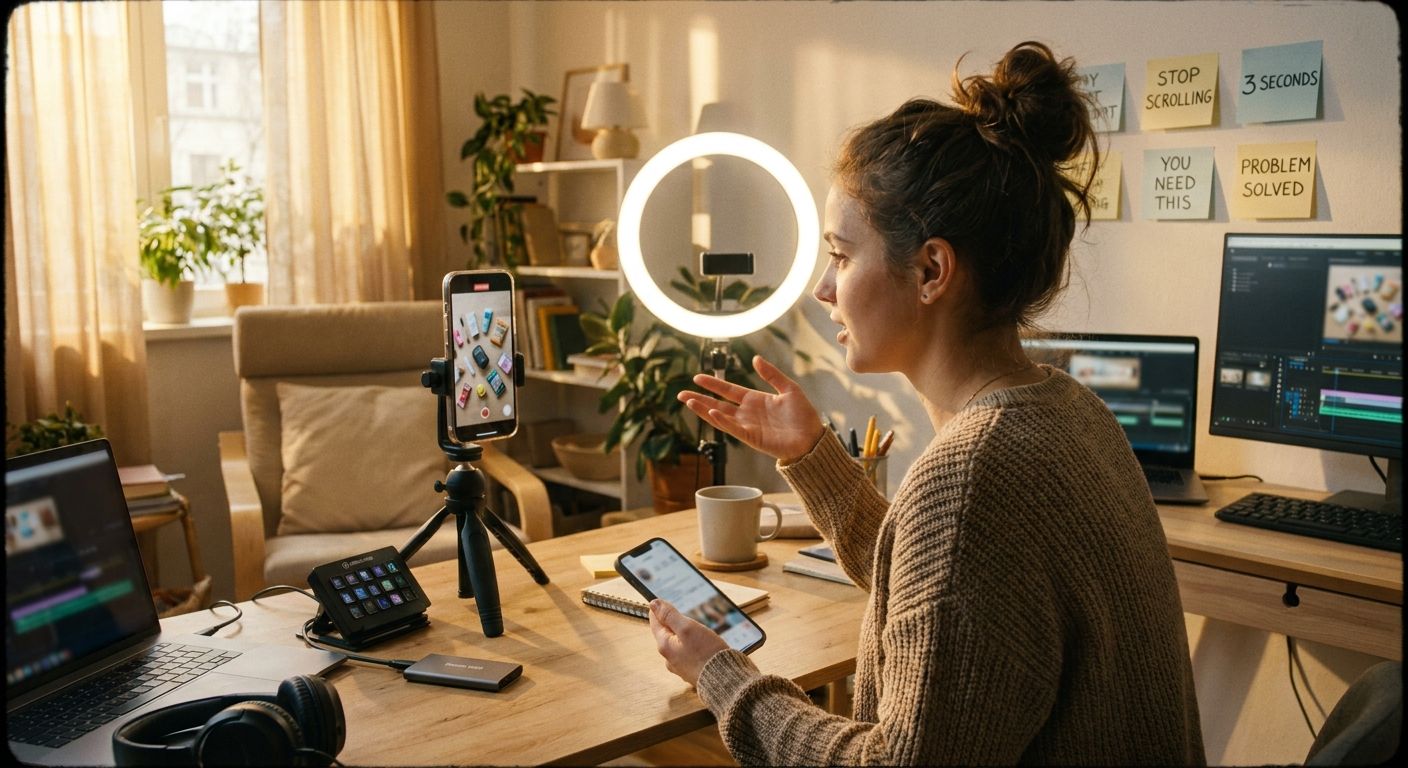
Top 10 Hooks to Try for Beauty Content (With Templates)


Your first two seconds determine everything
Beauty is one of the most saturated content categories on every platform. The only real differentiator at scroll speed is your hook — the first line of your caption, the first frame of your video, the first words out of your mouth. Get it wrong and your save rate tanks, your completion rate collapses, and the algorithm quietly buries the post. Get it right and even a mid-size account can outperform much larger ones on a given post.
Below are 10 hook templates that consistently open strong in beauty content, plus the weak pattern each one replaces.
How a strong beauty hook actually works
Show or say the outcome (clear skin, glass finish, color payoff) before any context — this is why before/after openers outperform explainer intros.
Promise information the viewer doesn't have yet ("the ingredient your cleanser is missing", "why your SPF is pilling"). Curiosity keeps them watching.
Close-up demo or direct-to-camera confession — viewers must see the process or product clearly, not a wide lifestyle shot with the product in the background.
End with something reference-worthy — a ranked list, a layering order, a product dupe — so viewers save rather than just watch once.
Winners vs. losers at a glance
- Winners surface the result in the first frame, demo the product close-up, and sound genuinely curious or excited about what they found.
- Losers open with "Hi guys, today I'm going to talk about...", hide the product until minute two, and rely on a discount CTA or a wall of hashtags to do the heavy lifting.
- Winners treat saves as the signal — they create content worth referencing later (ingredient breakdowns, ranked lists, layering guides).
- Losers chase views with broad topics and no specific payoff, generating watch-throughs but no saves or shares.
- Green-screen/text-only formats underperform in beauty unless the information itself is the draw (ingredient science, ingredient conflict warnings). Skin on camera, product on skin, always wins on first impression.
The 10 hooks: templates, why they work, and what they replace
1. The "finally cracked it" confession
Template: "My skin is finally [result] and here's exactly what changed."
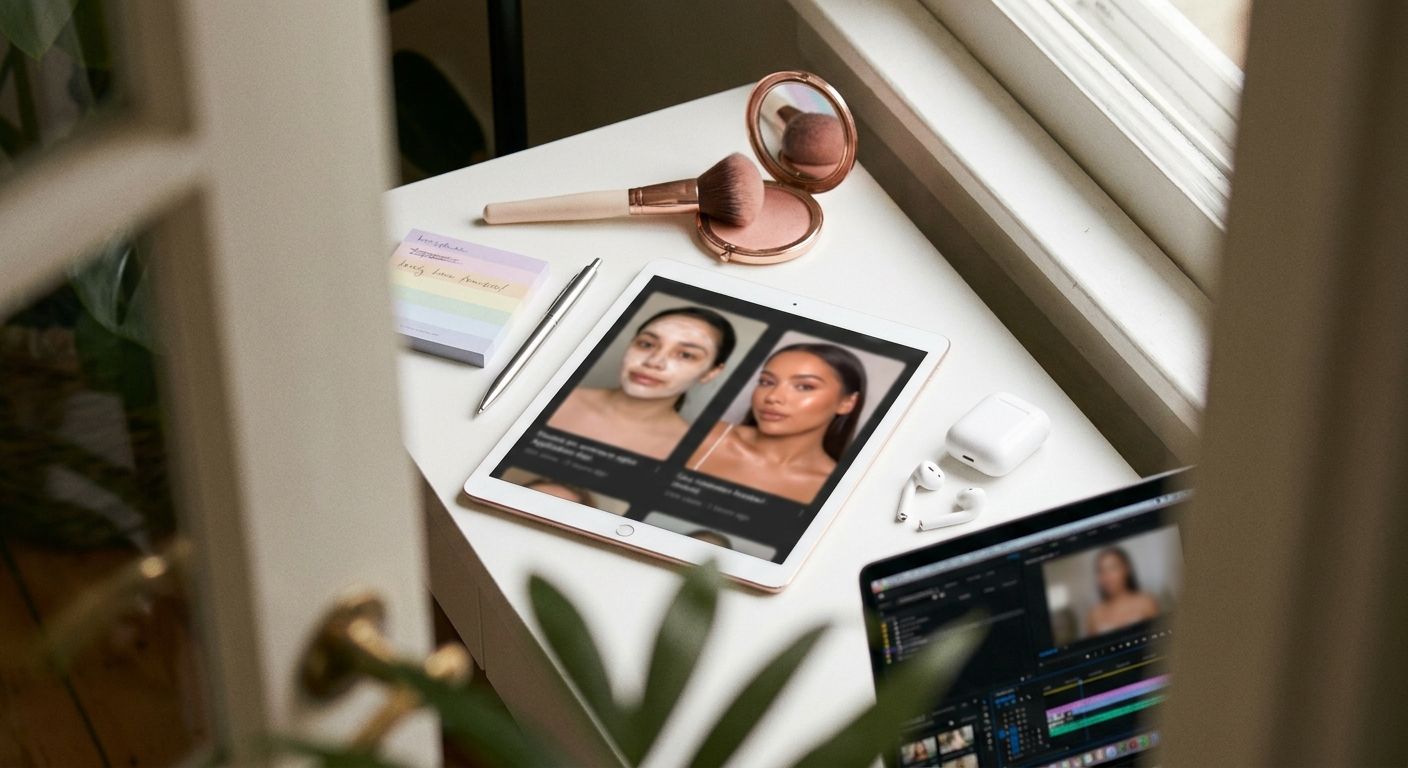
Why it works: Implies a journey, signals a resolution, and promises a reveal. Creators like @ginaseooo use this opening to lead with an earned outcome before listing the products or steps that got them there. High save rate because the list is useful.
Loser pattern avoided: "I've been struggling with [problem]..." — opens on a negative with no promise of a payoff.
2. The blunt contrarian take
Template: "Stop [common habit]. Here's what's actually happening to your skin."
Why it works: Interrupts autopilot scrolling by challenging a default behavior. Works best with a tight close-up of skin texture to ground the claim visually.
Loser pattern avoided: "Did you know that [ingredient] can sometimes cause..." — hedged language kills the stop-scroll.
3. The speed ranking
Template: "Ranking every [product category] I own — worst to best."
Why it works: Ranking formats generate saves because viewers use them as purchase shortlists. Worst-to-best order adds drama and keeps completion high.
Loser pattern avoided: "Some products I've been using..." — no stakes, no reason to watch past the first product.
4. The dupe reveal
Template: "I found the [luxury product] dupe and it's from [unexpected source]."
Why it works: Combines novelty with a clear utility. The unexpected-source element is critical — dupe content without surprise underperforms.
Loser pattern avoided: "Here's a cheaper alternative to [product]." — factual but no intrigue.
5. The ingredient myth-bust
Template: "The reason [widely-used ingredient] isn't working for you — and what to use instead."
Why it works: Speaks directly to a frustrated viewer who has already tried the popular option. High saves because it functions as reference material.
Loser pattern avoided: "Let me explain [ingredient]..." — educational without urgency; no viewer already knows they need this.
6. The routine audit
Template: "I audited my [morning/night] routine and threw out half of it. Here's why."
Why it works: Self-experiment framing. The "threw out half" element creates curiosity about which products failed and why.
Loser pattern avoided: "My current skincare routine" — static, no tension, immediately forgettable.
7. The skin-type reframe
Template: "If you have [skin type], you've been told the wrong thing about [common advice]."
Why it works: Targets a specific viewer segment while challenging received wisdom. Oily-skin content built around "everything you know is wrong" consistently earns strong comment engagement.
Loser pattern avoided: "Tips for oily skin" — broad, no reason to believe this is different from the 10,000 other oily-skin videos.
8. The 30-day result reveal
Template: "I used [product/ingredient] every day for 30 days. Here's what actually happened."
Why it works: Time-bounded experiments feel credible and personal. "Actually happened" signals honesty over a sponsored talking-points delivery.
Loser pattern avoided: "My honest review of [product]" — overused framing, no specificity on the test conditions.
9. The layering-order fix
Template: "You're probably applying your [product] in the wrong order — here's the sequence that actually works."
Why it works: Operational, specific, and immediately actionable. Viewers save because they want to refer back before their next routine. Works especially well for serums, acids, and SPF.
Loser pattern avoided: "How to build a skincare routine" — entry-level framing that doesn't speak to someone who already has a routine but suspects it's wrong.
10. The "I was wrong" update
Template: "I've been recommending [product/ingredient] for months. I was wrong — here's what changed my mind."
Why it works: Vulnerability plus new information. It also surfaces naturally to followers of previous content as a sequel, driving comment discussion and reshares from people who tried the original recommendation.
Loser pattern avoided: "Update on [product]..." — vague, no reason to care unless you already follow the creator closely.
Workflow: one source video to 5 original posts
- Identify the core mechanism. What is the single useful insight in the video — an ingredient conflict, a product ranking, a technique? Strip everything else.
- Hook 1, the confession: Film a direct-to-camera "I finally cracked it" opener using Hook #1. Show your skin, name the mechanism.
- Hook 2, the contrarian: Reframe the same insight as a "stop doing X" warning (Hook #2). Different opening energy, same core content.
- Hook 3, the myth-bust: Pull the ingredient angle and build a standalone myth-bust post (Hook #5). No product required — ingredient credibility is enough.
- Hook 4, the ranking: If the source video mentions multiple products, rank them worst-to-best (Hook #3). This works as a separate post with a tight close-up of each product.
- Hook 5, the update: After 2-3 weeks, film the "I was wrong" or "it worked" follow-up (Hook #10). This recycles your audience's existing familiarity into a new piece of content.
An autonomous agent like GEN can run this loop continuously, watching which hook variant earns the strongest save rate on a given account, generating the next script variation, and publishing without manual reformatting for each platform.
Frequently asked questions
Do these hooks work for both short-form video and caption-led posts?
Yes, with a small translation. For video, the hook is spoken in the first two seconds and reinforced in the opening frame. For caption-led posts (carousels, static), the hook is the first line of the caption before the "more" cutoff. Same template, different delivery surface.
Which hooks earn the most saves vs. the most comments?
Ranking and layering-order hooks (3, 9) drive saves because they're reference material. Contrarian and "I was wrong" hooks (2, 10) drive comments because they invite disagreement. Match your goal to the format: saves feed the algorithm longer; comments spike it faster.
How often should I rotate hook formats?
Run a hook for at least three posts before judging it — one underperforming post doesn't tell you whether the hook failed or the specific topic was weak. Rotate when you've tested the same hook on three different topics and the save/share rate is consistently flat.
Can I use the same hook template back-to-back?
Back-to-back is risky on a small account where every post reaches roughly the same audience. On a growing account with significant new reach each post, repeating a high-performing hook format within two weeks is fine — the audience is mostly different each time.
The immediate action: Pick Hook #1 or Hook #9, write the line before you pick up a camera, and film directly to camera with a close-up of your skin or product. The hook is a creative decision, not a technical one — make it in writing first.