
Top 10 Hooks to Try for Board Games Content (With Templates)

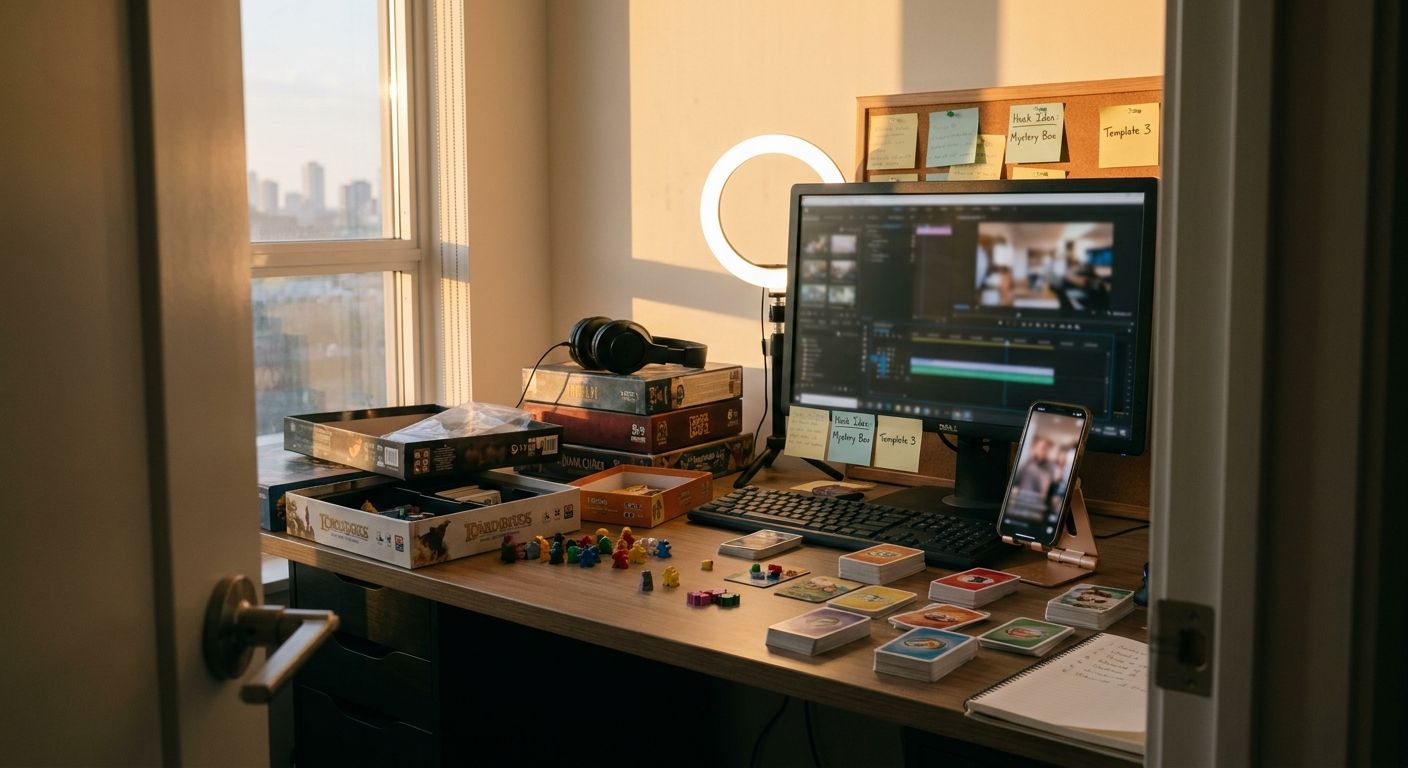
Your board game content is losing viewers in the first two seconds
Most board game posts open the same way: a wide shot of a table, someone reading a rulebook, or a haul laid flat on carpet. None of that answers the viewer's implicit question -- why should I keep watching? The hook is your entire first impression, and in a niche with genuinely passionate audiences, weak openings are the main reason solid content underperforms.
Below are 10 hook templates built specifically for the board game niche -- each with the template itself, the psychological mechanic behind it, how to shoot it, and the lazy pattern it replaces.
From hook to high-performing board game post
Find the most interesting moment in your session -- the betrayal, the comeback, the rules fight -- and lead with that, not the setup.
Match your moment to one of the 10 templates below. The hook determines the format -- debate, reveal, demo, or story.
Cut straight to the board, the components, or the facial reaction. Wide establishing shots kill momentum -- start tight and pull back only if needed.
Re-cut the same session with two different hook openings. An agent like GEN can track which variation holds viewers and flag the pattern for future posts.
Winners vs. losers: what separates high-performing board game posts
- Winners open mid-action (a rule dispute, a component reveal, a dramatic dice roll), make the payoff visible within two seconds, and speak with genuine enthusiasm
- Losers open with "hey guys, today I'm going to talk about...", show a wide table shot first, or lead with a discount/affiliate CTA before any value lands
- Winners give the viewer a reason to stay (unresolved tension, a question, a bold claim) before the three-second mark
- Losers rely on hashtag volume or a long video runtime to do the distribution work that a better hook would do in the first frame
- Creators like @houserulesgames earn strong comment engagement by opening with personal authority and conflict ("as a board game store owner and hockey player...") -- the viewer immediately knows why this person has standing to have an opinion
10 hook templates for board game creators
-
"This game ended a friendship"
Why it works: Relational stakes are universally understood. Conflict gets attention.
How to use it: Open on the exact board state mid-dispute, then cut to your explanation.
Avoids: The generic "let's talk about my favourite game" cold open. -
"Most people play [Game] wrong -- here's the rule everyone misses"
Why it works: Targets existing players with the promise of correcting them. High save rate because viewers want to reference it later.
How to use it: Hold the rulebook or component close to camera, then reveal the misread rule with genuine surprise.
Avoids: A dry rules-explanation video with no tension. -
"I ranked every game in my collection -- [Title] is last and here's why"
Why it works: Provokes disagreement. Comments from fans of that game fuel reach.
How to use it: Start with the controversial bottom pick visible on screen, not a list graphic.
Avoids: A ranking video where every pick is "great in its own way." -
"We tried to teach [Game] to complete beginners -- this is what happened"
Why it works: Story structure with a built-in unknown outcome. Works especially well for notoriously complex games.
How to use it: Film the teach session; open on the most confused or funniest moment, then flash back.
Avoids: Tutorial content that assumes the viewer is already invested. -
"The component quality on this game is [shocking/embarrassing/unreal] -- look at this"
Why it works: Tactile curiosity. Board game buyers care deeply about production value; showing it fast drives saves and shares.
How to use it: Extreme close-up of the component first, then pull back. No table-wide haul shots.
Avoids: Flat-lay unboxing with a voice-over list of what's in the box. -
"Name a better [2-player / party / solo] game. I'll wait."
Why it works: A direct challenge prompts replies, and replies signal algorithm value.
How to use it: Hold the game box to camera with full confidence. Don't hedge.
Avoids: Wishy-washy "some people might prefer..." language in the opener. -
"This mechanic changed how I think about every game I play"
Why it works: Promises a cognitive shift -- appeals to the hobby's intellectual identity.
How to use it: Demonstrate the mechanic with the physical components on camera before you explain it verbally.
Avoids: A talking-head explainer with no board in frame. -
"We played [Game] every day for a week -- here's what broke"
Why it works: Longevity testing is a specific, credible premise. It implies insider knowledge you can only get from repetition.
How to use it: Show the wear, the house rules that emerged, the strategies that broke the balance.
Avoids: A single-session first-impression review dressed up as a deep take. -
"Hot take: [Popular Game] is overrated and [Obscure Game] does everything better"
Why it works: Contrarian framing on a well-known title triggers responses from both sides of the argument.
How to use it: Put both games side-by-side physically. Don't hide the title you're criticising.
Avoids: Vague "underrated gems" content that names games no one has heard of without anchoring to something familiar. -
"Spin the wheel / roll the dice to decide what we play -- then we actually play it"
Why it works: Random-selection formats (seen on accounts like @lana.k.social) generate genuine unpredictability and a self-sustaining content engine -- one mechanic produces endless posts.
How to use it: Film the spin live; the unscripted outcome is the hook. Don't edit out the bad results.
Avoids: Pre-planned content disguised as spontaneous discovery.
Workflow: one game session -> 3-5 posts
- Record the full session -- wide shot for context, tight shots of key moments (rule disputes, dramatic plays, component close-ups)
- Identify three clip types: a conflict moment, a visual payoff (component, board state, reaction), and a teachable rule or mechanic
- Assign a hook template to each clip -- the conflict gets Hook #1 or #6; the component close-up gets Hook #5; the rules moment gets Hook #2
- Cut three standalone posts from those clips, each opening with the assigned hook -- same session, three different entry points
- Add two variations: one contrarian-angle caption (Hook #9) and one challenge post (Hook #6) using B-roll from the same session
An autonomous agent like GEN can watch which of those five variations holds viewers longest and auto-flag the pattern -- so your next session's hook selection is based on actual retention data, not guesswork.

Frequently asked questions
Do these hooks work for solo board game content, not just group play?
Yes -- Hooks #2, #5, #7, and #8 are built for solo creators because they rely on your perspective and the physical game, not on group dynamics. The conflict-based hooks (#1, #6, #9) can be redirected toward creator-vs-the-game ("this campaign nearly broke me") rather than player-vs-player.
Should I use text overlays to reinforce the spoken hook?
Only if the spoken hook alone is ambiguous. Repeating the same words in text and audio doesn't improve retention -- it just adds visual noise. Use text to add a second layer of information (e.g., the game title) rather than echoing what you're already saying.
How often should I rotate hook templates?
Don't repeat the same structural hook in back-to-back posts for the same audience. Running Hook #6 ("Name a better game") twice in a row trains your audience to expect bait -- and the second post performs worse. Rotate at minimum every three posts, and track which templates your audience saves vs. comments on, since saves and comments signal different intent.
Can a content agent like GEN help with hook testing at scale?
That's exactly the use case it's built for. Rather than manually A/B testing two hook versions and waiting a week to compare, GEN can generate script variations from the same source clip, schedule them staggered across platforms, and surface the pattern -- so you're iterating on hooks based on your audience's actual behavior, not category-wide assumptions.
The sharpest takeaway: pick the single most interesting moment from your last session -- the dispute, the reveal, the collapse -- and lead with that. Everything else is context. Get the hook right, and the rest of the post has a chance.