Top 10 Hooks to Try for Skincare Creators (With Templates That Actually Convert)

Ten skincare hook structures to test
Open with the actual question, demonstration, or documented experience the video will explain. These templates are suggestions to test; the evidence here does not establish that a cheaper product or particular opening will consistently outperform another.
From hook to conversion: the skincare post operating model
The viewer decides to stay based on the promise--not your face, your setup, or your brand deal disclosure.
Direct-to-camera application, tight close-ups on texture and skin--anything that lets the viewer mentally place themselves in the result.
Before/after, skin close-up, or a specific verbal confirmation. Saves spike when the viewer gets exactly what the hook promised.
One filming session -> TikTok, Reels, Shorts, and X clip. Most creators leave 80% of their reach on the table by posting once and moving on.
Opening choices to compare
Use a real post or your own documented experience as the example. Verify the original video and metrics before attributing a result to a named creator or hook.
Top 10 hooks for skincare creators
1. "People don't believe my [age/skin condition] anymore"
Template: "People don't believe my [age / that I used to have cystic acne / that I ever had dry skin]."
Why it works: Social proof before the product. Curiosity gap opens immediately.
Skincare adapt: Say it direct-to-camera, bare-faced, no filter--then cut to the product or routine.
Loser pattern avoided: Starting with "I've been using [Brand X] for three months and..."
2. "The ingredient derms don't talk about enough"
Template:“Here is the question I asked about this ingredient.” Explain what the source actually says rather than implying that dermatologists are withholding it.
3. "Stop doing [X] if you have [skin type]"
Template:“Here is what changed in my routine, and what I observed.” Keep personal experience distinct from treatment advice and do not invent a result for the opening.
4. "I tried [X] for 30 days--here's what actually happened"
Template: "I used [product / ingredient / routine] every day for [30/60/90] days. Here's what actually happened to my skin."
Why it works: Time-bound experiment signals honest reporting. "Actually happened" primes the viewer for an unfiltered take.
Skincare adapt: Show skin close-ups at day 1, day 15, day 30. The timeline is the proof--don't skip it.
Loser pattern avoided: "My review of [product]"--review framing signals promotional content.
5. "Simple DIY [treatment] to [specific result]"
Template:“Here is how I made this mask, and what the evidence says about the ingredients.” Do not promise treatment effects such as reduced inflammation or cleared pores without support.
6. "This [product] from [region/brand type] is years ahead"
Template:“Here is how this product differs from the one I normally use.” Demonstrate specific differences rather than asserting regional superiority or citing an unverified creator example.
7. "Watch what happens when I apply [X] on [skin condition]"
Template:“Here is the application process and the result under the same lighting.” Do not imply an ingredient produces an immediate medical or long-term result from a close-up demonstration.
8. "The [routine/product] that cleared my skin when nothing else did"
Template:“Here is my documented experience with this product.” Use a real timeline and avoid presenting an individual experience as proof that a product treats a condition.
9. "Dermatologist-approved vs. what I actually use"
Template: "Dermatologist-recommended [routine / ingredient] vs. what I actually use--and why."
Why it works: Tension between authority and real-world experience keeps viewers watching for the verdict.
Skincare adapt: Don't bash dermatologist advice--reframe as "what works for my specific skin, not the average patient."
Loser pattern avoided: Either pure authority-worship or pure contrarianism. The tension is what makes it watchable.
10. "POV: your skin after [specific habit change]"
Use the POV frame only when it accurately represents what the visual shows. No comparative viewer-identification effect is established here.
Workflow: one source video to 3-5 posts
Most creators spend more time filming than distributing. A single well-filmed skincare demo can feed a week of content across platforms without re-filming.
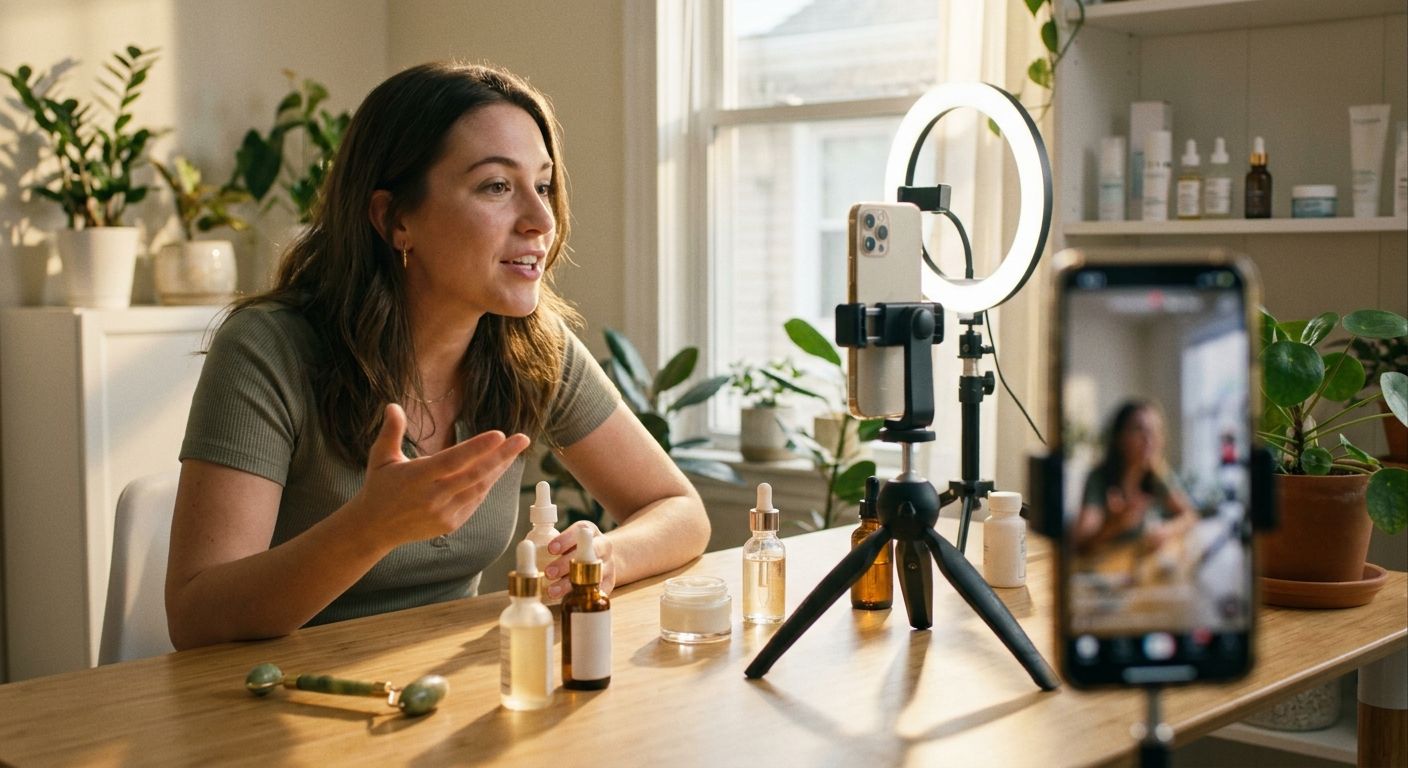
- Film the full demo once. Direct-to-camera application, macro skin shots, before and after. Shoot in natural light. Don't stop to re-record--use the raw takes.
- Identify the hook moment. Which 2-second clip best signals the result? That clip becomes the opening frame on every cut.
- Cut #1 -- TikTok/Reels (full demo): Hook, process, payoff. Keep the genuine reaction in. Remove any segment where you pause to think.
- Cut #2 -- Shorts/X clip (hook + payoff only): Strip the middle process. Lead with the result claim, cut straight to the close-up reveal. Under 30 seconds.
- For a carousel, show one readable step or source per slide. Measure saves rather than assuming an ingredient list receives a high save rate.
- For a reply video, answer a genuine question from a prior post. No disproportionate algorithmic reward is established here.
Separate filming from captioning, formatting, and publishing. GEN can support content ideas, production, and publishing; unattended multi-post repurposing is not established by this article.
Frequently asked questions
Do hashtags and video length affect hook performance for skincare content?
Use the platform’s available analytics to assess openings, length, and interactions. No fixed hashtag count or universal 20-second versus 60-second advantage is established here.
Should skincare creators use text-only or green-screen hooks?
Use the format that makes the actual demonstration or evidence clearest. No controlled comparison establishes that direct-to-camera always beats text or green-screen.
How many hooks should a skincare creator test per month?
Test at least 2-3 distinct hook structures per month, not 2-3 variations of the same structure. Rotating through the social-proof hook, the stop-doing-X hook, and the experiment hook in a single month gives you signal on which frame your audience responds to--rather than optimizing within one lane before you know if it's the right lane.
How does an autonomous AI agent like GEN fit into a skincare creator's workflow?
Define the production and publishing steps you want help with, then inspect the supported workflow. No fixed weekly time saving or unattended queuing capability is established here.
The takeaway: Pick one hook from this list, film it bare-faced in natural light with a tight skin close-up, and cut straight to the payoff. Then run the 5-post repurposing workflow before you film anything new. Volume without structure is noise; these 10 templates give you the structure.
Sources & Research
For skincare hooks, GEN’s documented video-analysis workflow can inspect the opening claim, application sequence, visible result, and source context. Treat a personal demonstration as an individual experience rather than a clinical finding; creative variations should preserve what the footage and supporting evidence actually establish.
Primary web sources checked for the statements retained in this guide: