Top 10 Hooks to Try for Budgeting Content (With Templates)


Your hook is where budgeting content dies — here are 10 that actually hold attention
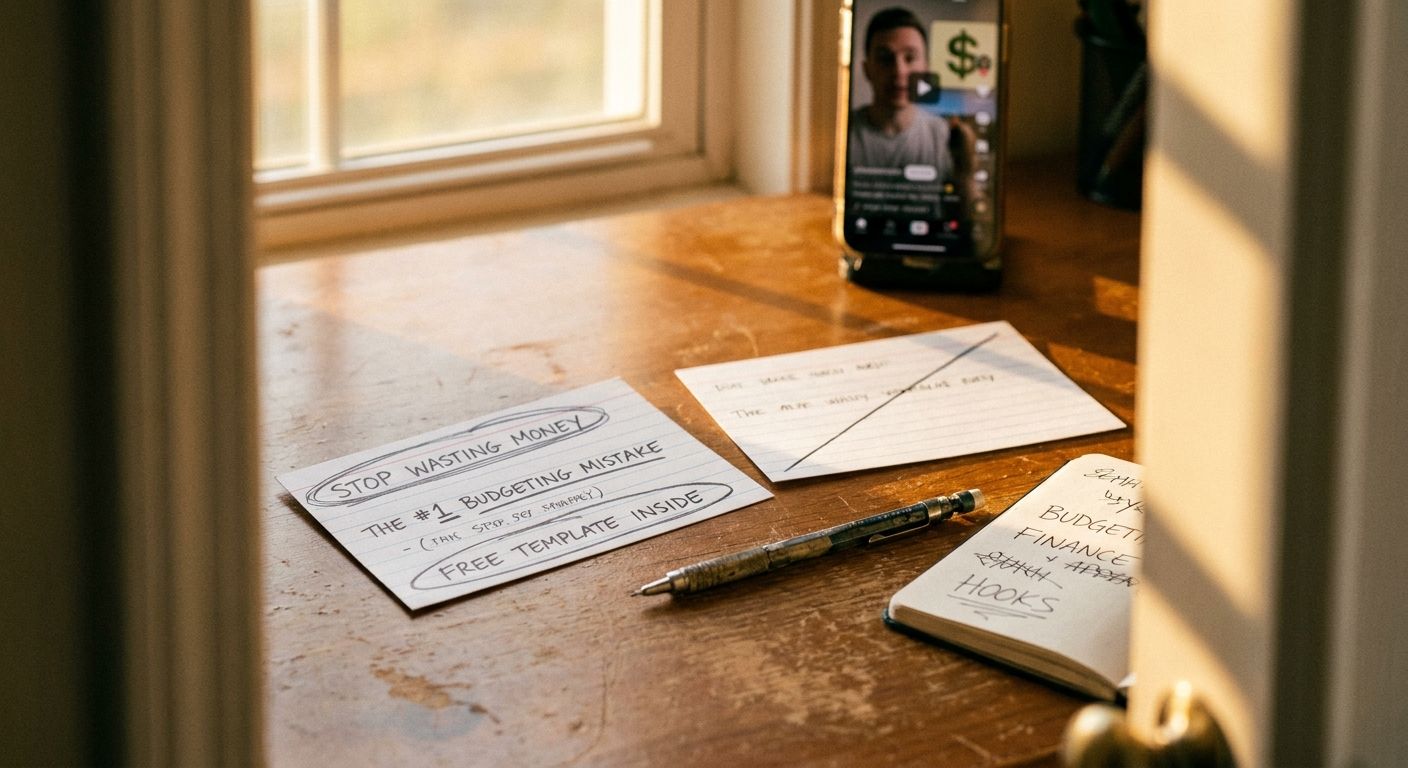
Budgeting is a high-intent niche: people genuinely want to change their finances. But most creators lose viewers in the first two seconds with a generic opener that signals "I've seen this before." The fix isn't a longer video or more hashtags — it's a hook that makes the viewer feel like this one is different. Below are 10 hook templates, why each one works, and the weak pattern each replaces.
How a strong hook compounds into account growth
Viewer-specific tension or curiosity lands in the first two seconds — before a single word of setup.
Strong retention signals push the algorithm to distribute the post further — regardless of hashtag count.
Viewers save budgeting content to revisit — saves are a stronger signal than likes in this niche.
Rotate hook patterns across posts to find which frame your specific audience responds to fastest.
Winners vs. losers in budgeting hooks
- Winners show the viewer the result (or the tension) before any setup; use a specific number, scenario, or identity signal; make the payoff obvious within seconds.
- Losers open with "today I'm going to show you..."; lead with a brand name or product before establishing stakes; bury the interesting part after 10 seconds of context.
- Winners sound like a real person who actually does this, not a financial services explainer.
- Losers rely on hashtag volume or video length to compensate for a weak opener.
- Saves beat likes here. Budgeting viewers bookmark content to act on later. A hook that signals "keep this" (a template, a method, a revelation) outperforms one that just generates passive views.
The 10 best hooks for budgeting content
-
"I used to [bad habit] every month -- here's the exact system I replaced it with."
Why it works: Confession plus system equals credibility without lecture. Viewers who share the habit stay for the fix.
Adapt it: "I used to overdraft every month -- here's the exact envelope system I replaced it with."
Loser pattern it avoids: Starting with "budgeting is important" -- obvious and skippable. -
"Here's what our [month] budget actually looks like -- the full breakdown."
Why it works: Real-life specificity. Creators like @abng.ss use monthly cash-stuffing walkthroughs to drive high save rates because viewers treat them as reusable reference content.
Adapt it: Replace "month" with your current month; show physical cash or a spreadsheet immediately.
Loser pattern it avoids: Vague "how I budget" with no tangible artifact on screen. -
"If you're living paycheck to paycheck, stop scrolling -- this is why."
Why it works: Direct identity call-out. It names the viewer's exact situation before they've decided whether to keep watching.
Adapt it: Swap "paycheck to paycheck" for any specific pain state: "always broke before the 20th," "can't explain where your money went."
Loser pattern it avoids: Broad appeal hooks that try to speak to everyone and land with no one. -
"Number [X]: the rule I wish someone told me at [age/stage]."
Why it works: The numbered-list format signals a complete, scannable payoff. @lizbettalksmoney's numbered allowance content drives strong save behaviour because viewers want the full list.
Adapt it: "Number 3: the rule I wish someone told me when I got my first salary."
Loser pattern it avoids: A single tip dressed up as a whole video -- no structural reason to watch to the end. -
"Watch me stuff [dollar amount] into envelopes for [month] -- in real time."
Why it works: Process visibility. The cash-stuffing niche, observed in creators like @abng.ss, works because watching the physical act of organising money is satisfying and shareable.
Adapt it: Works for digital budgeting too -- show yourself categorising in a spreadsheet or app in real time.
Loser pattern it avoids: Talking-head explanation with nothing happening on screen. -
"The [specific category] budget that saved me [concrete outcome]."
Why it works: Specificity over generality. "Grocery budget" outperforms "my budget" because it matches the viewer's exact search intent.
Adapt it: "The dining-out budget that finally stopped my overspending."
Loser pattern it avoids: Generic "how I save money" with no category anchor. -
"She's been doing this since she was [age] -- wait until you see it."
Why it works: The hook makes you invest in a person before you know the topic. @lizbettalksmoney uses this family-story frame to pull non-finance viewers into allowance content.
Adapt it: Swap the subject for your own story -- "I started this at 22 and it changed how I think about every purchase."
Loser pattern it avoids: Leading with the method instead of the person. -
"Most people budget wrong -- here's what they miss."
Why it works: Contrarian premise. It creates instant status anxiety (am I doing it wrong?) and positions you as the corrective voice, without being condescending if the payoff is specific.
Adapt it: "Most people track spending wrong -- they focus on the wrong category."
Loser pattern it avoids: Validating what the viewer already believes instead of challenging it. -
"I'm going to show you my [method name] in 60 seconds -- steal it."
Why it works: Explicit permission to copy. "Steal it" is a save trigger -- viewers immediately think "I should save this to use later." Works especially well with visual methods (envelopes, binders, spreadsheets).
Adapt it: "I'm going to show you my zero-based budget setup in 60 seconds -- steal it."
Loser pattern it avoids: Long-form walkthroughs that bury the actionable part. -
"Haul + budget check: did I stay on track this week?"
Why it works: Accountability framing. It blends two high-traffic content types (haul plus budgeting) and creates a recurring format viewers return to. @miaahazelwood's haul content drives strong share behaviour because the accountability angle makes it feel honest rather than promotional.
Adapt it: Make it a weekly series -- the recurring format trains your audience to come back.
Loser pattern it avoids: One-off hauls with no financial framing, which attract the wrong audience.
Workflow: one source video to 3-5 original posts
- Identify the core mechanism. What is the one thing the source video actually demonstrates? (A method, a reveal, a transformation.) That's your spine.
- Extract the hook variant. Apply three different hooks from the list above to the same mechanism -- contrarian, confession, and numbered-list versions of the same content.
- Change the visual format. If the original is a talking-head, shoot a process version (hands on envelopes or spreadsheet). If it's a haul, add an explicit budget check overlay.
- Shift the identity target. One version for someone starting out, one for someone earning more and still overspending -- same method, different opening line.
- Schedule variation, not repetition. Post the hook variants across different days. An agent like GEN can monitor which hook pattern drives the highest save rate for your specific audience and auto-suggest the next variation, closing the feedback loop without manual analysis.
Frequently asked questions
Which hook type works best for budgeting specifically?
Identity call-outs and process-visible hooks (cash stuffing, real-time breakdowns) consistently drive saves in this niche -- which is the metric that matters most for budgeting content. Saves signal intent to act, not just passive viewing.

How often should I rotate hook patterns?
Don't repeat the same hook structure back-to-back. Rotate through at least three different patterns across your next ten posts, then check which format generated the most saves and comments -- not just views.
Can these hooks work for both short-form and longer videos?
Yes, but the function shifts. On short-form, the hook must land in under two seconds of audio and visuals simultaneously. For longer formats, use the same hook as your opening line, then restate the payoff at the 30-second mark to retain viewers who were borderline.
Do I need a large following for these hooks to work?
No. Hook strength determines initial distribution more than follower count. A strong hook on a small account gets pushed to new audiences; a weak hook on a large account stalls. Consistent testing matters more than audience size.
Start with hooks 2, 5, and 9 -- they're the most format-flexible and the fastest to film. Test all three in your next week of posts, track saves as your primary signal, and build from what your specific audience actually bookmarks.