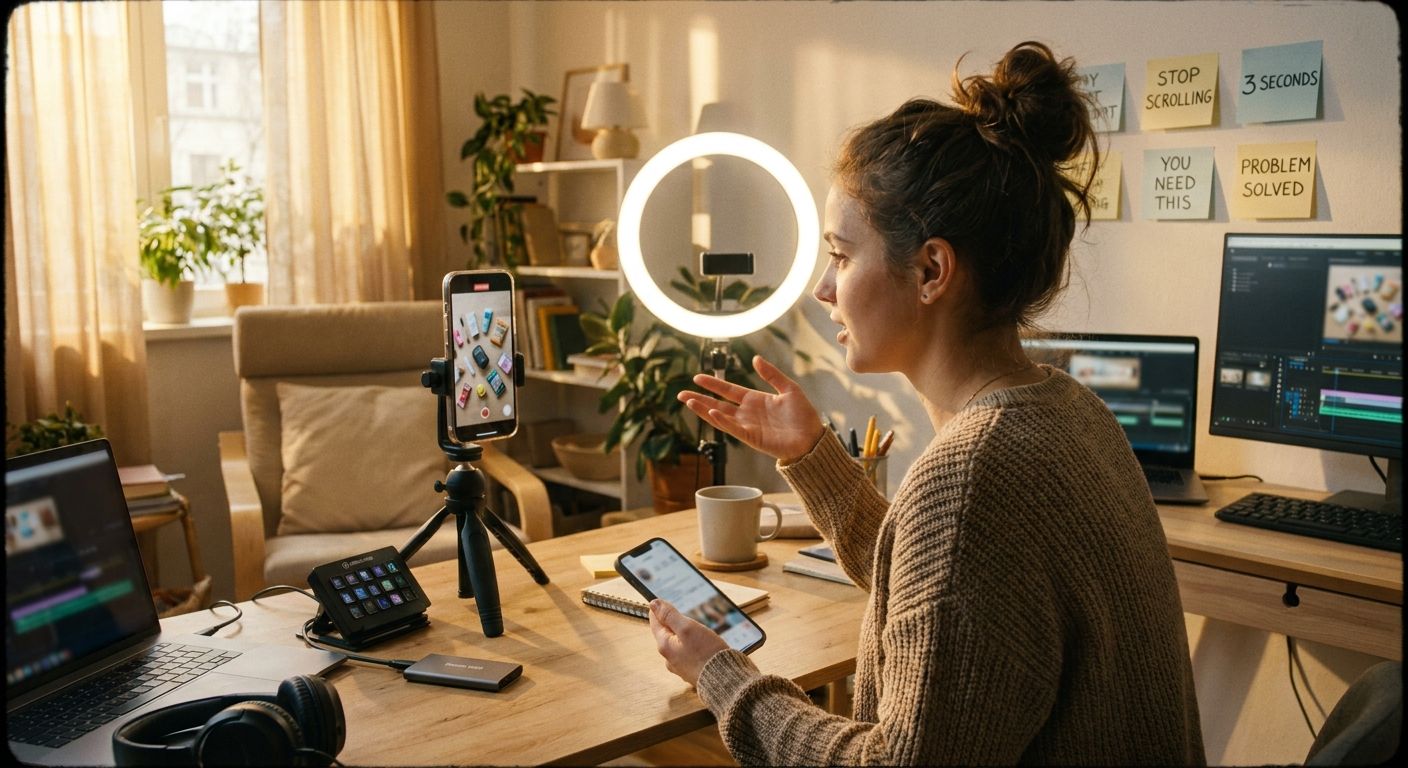
Top 10 Hooks to Try for Gut Health Content (With Templates)


Most gut health hooks fail in the first two seconds -- here's what wins instead
The gut health niche is crowded with creators who open on "this changed my life" and wonder why watch-time drops. The problem isn't the topic -- digestive health is one of the highest-save niches on short-form right now. The problem is the hook pattern: generic premise, delayed payoff, no reason to stay. Below are 10 hook templates that flip that pattern, drawn from what's actually performing from creators like @thestomachdoc and @dr_eddmo.
Hook -> Hold -> Payoff -> Save Loop
Name a specific symptom, food, or counter-intuitive claim. Make stopping feel more costly than watching.
Show the mechanism -- the why behind the claim. Visible process (cooking, demo, body diagram) outperforms text-only.
Deliver the actionable result -- a recipe step, a swap, a habit. Give them the thing they stayed for.
End on a reference point -- a list, a ratio, a name to remember -- that makes saving feel necessary.
Winners vs. losers in gut health content
- Winner: names a specific symptom in the first line ("if raw apples leave you bloated...")
- Winner: shows the process on camera -- chopping, cooking, close-up texture
- Winner: gives the mechanism, not just the conclusion ("heat changes pectin structure")
- Winner: ends with something worth saving -- a ratio, a swap, a short ingredient list
- Loser: opens with "I've been on a gut health journey..." (delayed payoff)
- Loser: leads with a CTA or discount before the value lands
- Loser: green-screen text wall with no visible food, product, or body
- Loser: generic promise ("fix your gut!") with no mechanism
10 hook templates for gut health creators
1. The symptom flip
"If [common food] makes you [symptom], try [unexpected swap] instead."
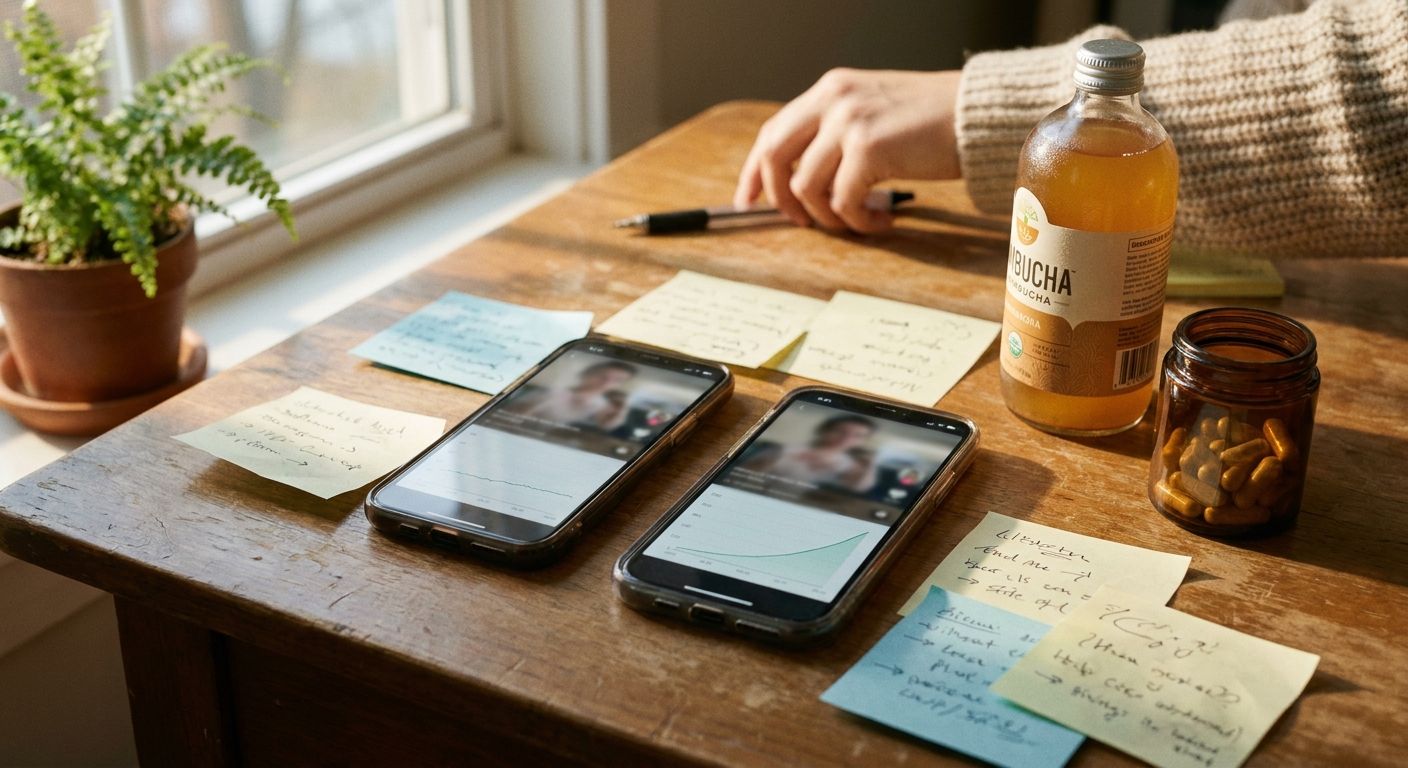
Why it works: Leads with the viewer's exact pain before they can scroll. @thestomachdoc used this pattern to anchor a stewed-apple video -- "if raw apples leave you bloated" -- which drove an unusually high save rate relative to views.
Loser pattern avoided: Opening with the food first, symptom buried in the caption.
2. The hidden mechanism
"Most people don't know that [food/ingredient] does [specific thing] to your gut lining."
Why it works: Creates an information gap the viewer needs to close. The mechanism (pectin structure, bile acid, etc.) adds credibility without requiring credentials.
Loser pattern avoided: Vague "supports gut health" claim with no explanation.
3. The counter-intuitive reframe
"[Healthy food everyone eats] might actually be making your bloating worse."
Why it works: Contradicts an assumption. Viewers pause to check whether they're doing it wrong. Works for fiber-heavy foods, raw vegetables, or common supplements.
Loser pattern avoided: Confirming what the audience already believes -- no tension, no watch-time.
4. The deficiency reveal
"A deficiency in [nutrient] can cause [gut symptom] -- here's the foods that fix it."
Why it works: @dr_eddmo built a strong comment/save ratio with a thiamine-deficiency angle -- viewers saved it to share with people they know who have that symptom. Medical-adjacent framing drives saves.
Loser pattern avoided: Leading with the nutrient name rather than the symptom outcome.
5. The duration claim
"I had [symptom] for [timeframe] -- this is the one thing that actually helped."
Why it works: First-person duration ("6 years of constipation") gives the viewer a hope anchor. The longer the timeframe, the more credible the eventual fix. @girltherapy5555 used this structure to drive strong engagement despite a smaller following.
Loser pattern avoided: Generic "this helped me" with no timeframe -- unquantified claims feel like filler.
6. The recipe minimum
"[Gut-supporting food], 3 ingredients, 5 minutes -- I make this every morning."
Why it works: Lowers the action threshold immediately. Short ingredient lists plus a daily habit signal equals saves. Show the prep on camera while saying it.
Loser pattern avoided: Listing 10+ ingredients upfront -- effort perception kills saves.
7. The "you're eating it wrong" hook
"You're probably eating [food] at the wrong time -- here's when it actually helps your gut."
Why it works: Combines mild shame with an easy fix. Timing claims (morning vs. night, before/after meals) are highly shareable because they require no new ingredient purchases.
Loser pattern avoided: Telling people to buy something new when a behavioral tweak performs better for saves and shares.
8. The before/after process
"Watch what happens to [food] when you cook it vs. eat it raw -- your gut notices the difference."
Why it works: Visible transformation (raw to cooked, whole to fermented) is one of the highest-retention visual patterns in food content. The gut health angle gives the visuals purpose.
Loser pattern avoided: Showing the finished dish only -- no process means no reason to watch through.
9. The list tease
"5 foods gastroenterologists eat every week for their gut -- most people miss #3."
Why it works: The numbered list signals a complete, saveable reference. "Most people miss #3" forces watch-through to a specific moment.
Loser pattern avoided: A list with no ranking tension -- every item treated equally means no urgency.
10. The gut-brain bridge
"Why your anxiety might actually be a gut problem -- the connection no one explains clearly."
Why it works: Pulls in viewers beyond dedicated gut health followers -- anyone experiencing mood issues qualifies. High share rate because it reframes a common experience.
Loser pattern avoided: Staying inside the "gut health" silo -- broader symptom framing reaches a wider cold audience.
Workflow: one source video to 3-5 posts
- Pick one mechanism -- choose the single biological or nutritional claim at the center of the source video (e.g., pectin's prebiotic effect).
- Extract 3 angles -- symptom flip, deficiency reveal, recipe minimum. Each becomes its own short post with a different hook template from this list.
- Swap the visual format -- one post shows the raw ingredient, one shows the cooking process, one goes direct-to-camera explaining the mechanism.
- Test the counter-intuitive version -- take your main claim and write the version that contradicts common advice. Post it as a separate hook.
- Track saves, not views -- saves are the signal metric for gut health content. A post that saves heavily but doesn't go wide is still a strong performer worth repeating with variation.
An agent like GEN can monitor which hook pattern from your last 30 posts is driving saves vs. shares, then automatically generate the next variation -- so you're not manually A/B testing hook templates one post at a time.
Frequently asked questions
Which hook type drives the most saves in gut health content?
Symptom-led hooks (templates 1, 5, 4) consistently drive saves because viewers bookmark them to reference later or share with someone who has that symptom. Recipe minimums (template 6) are a close second -- short ingredient lists feel immediately actionable.
Do I need medical credentials to use the deficiency or mechanism hooks?
No, but framing matters. "Here's what I learned about how pectin affects digestion" performs differently than "pectin cures gut problems." Creators without clinical titles do well by framing mechanisms as learnings, not diagnoses. The comment and share behavior from @dr_eddmo's posts shows that credential-signaling in the username helps, but isn't the only driver.
How often should I rotate hook templates?
Run each template at least 3 times before judging it -- one post is too noisy a signal. After 6-8 posts, you'll have a clearer read on which patterns your specific audience saves and shares. GEN's pattern-tracking can surface this faster by comparing save rates across hook types automatically.
Is green-screen ever worth it for gut health content?
Rarely as the primary format. Green-screen works when you're overlaying a food label, a microbiome diagram, or a before/after that can't be filmed live. But direct-to-camera while demoing a recipe or showing a process consistently outperforms static text overlays in this niche -- the viewer needs to see the food.
Takeaway: Pick two templates from this list, write three variations of each, and track saves over the next two weeks. The hook that converts a cold viewer into a saver is the one worth doubling down on -- not the one that gets the biggest one-time spike.