Top 10 Hooks to Try for Language Learning Content (With Templates)


Your hook is where most language learning content dies
The niche is crowded -- Spanish, French, Japanese, Mandarin -- and every creator is teaching "5 words you need to know." The difference between a video that gets saved and one that gets scrolled is almost always the first three seconds. Get the hook wrong and the lesson never lands.
Below: 10 hook templates built for language learning creators, with the mechanism behind each, how to adapt it, and the weak pattern it replaces. Use these as a starting library, then batch variations to find what your audience responds to.
From hook to high-performing post
Choose from the 10 below based on your content type: mistake, level-test, curiosity gap, etc.
The hook must point to something learners actually get wrong or wonder about -- not a generic "learn X words" premise.
Show the word, phrase, correction, or level-up moment on screen -- don't describe it, display it.
Saves signal genuine utility; comments signal engagement. Run 3-5 variations per hook type before judging it.
Winners vs. losers in language learning hooks
- Winner: Opens with a specific, relatable mistake or surprising gap -- viewer immediately self-identifies and stays to learn the fix
- Winner: Shows the language on screen (text overlay, whiteboard, real context) within the first 2 seconds
- Winner: Promises a test, a level, a comparison -- something that lets the viewer measure themselves
- Loser: "Today I'm going to teach you 5 Spanish words" -- no tension, no reason to stay
- Loser: Generic motivational opener ("Learning a language changes your life") before any payoff signal
- Loser: Hook is all text on screen, no face, no energy -- loses the personality advantage in a personality-driven niche
Creators like @mydailyspanish consistently use level-diagnostic frames ("when did you stop understanding me?") that force self-assessment. Creators like @studywith.olgi and @henrikjordal lean into absurd or surprising premises that make learners feel like they're in on something. Both beat the generic vocab list because they create an emotional stake before the lesson starts.
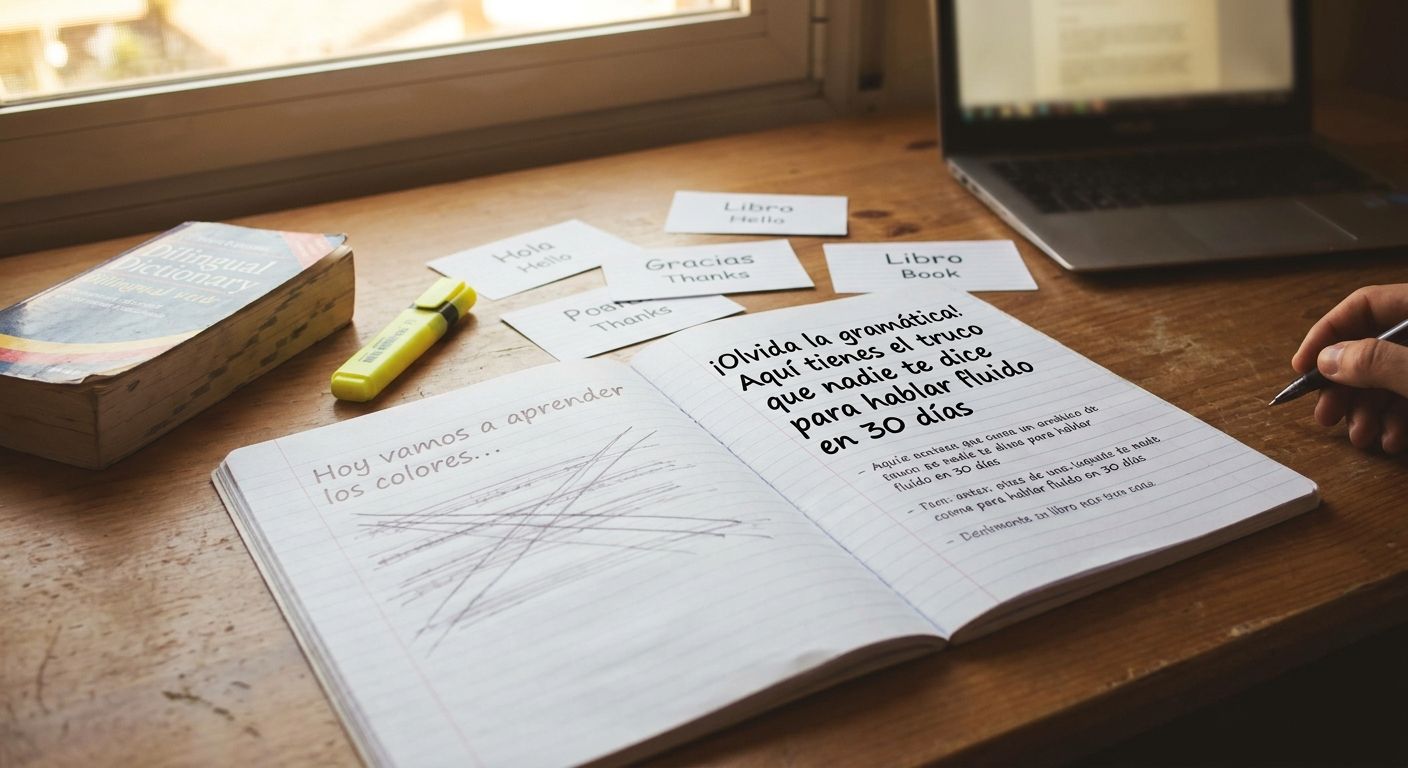
10 hook templates for language learning creators
1. The level-test drop
Template: "A1 to C2 -- stop me when you get lost."

Why it works: Turns passive viewers into active participants. Everyone wants to know where they stand, and the save rate is high because learners come back to re-test.
Loser pattern it replaces: Static vocabulary list with no stakes.
2. The native slip-up
Template: "This is the mistake every [nationality] person notices when you speak [language]."
Why it works: Nobody wants to embarrass themselves in front of a native speaker. That social stakes drive saves.
Loser pattern it replaces: "Common mistakes in Spanish" (too vague, no identity hook).
3. The surprising cognate
Template: "You already speak [X] words of [language] and you don't know it."
Why it works: Flips the learner's self-image from "I know nothing" to "I already started." Optimism is shareable.
Loser pattern it replaces: "French is hard but you can do it." (Motivation without mechanism.)
4. The embarrassing translation
Template: "If you said this in [country], here's what actually happened." [play the clip/context]
Why it works: Story-driven, slightly chaotic, generates comment debate. Works best direct-to-camera with a genuine reaction.
Loser pattern it replaces: Text-only "false friends" list with no narrative.
5. The speed comparison
Template: "Watch me say this as a beginner vs. after 90 days." [side-by-side or cut]
Why it works: Before/after is universally compelling. Learners can benchmark their own progress, and the format encourages follows to track the journey.
Loser pattern it replaces: Talking about improvement without showing it.
6. The "you're saying it wrong" callout
Template: "Every English speaker says [word] wrong in [language] -- including you, probably."
Why it works: Pulls in even confident learners. "Probably" softens it enough to avoid alienation while keeping the scroll-stop friction.
Loser pattern it replaces: "How to pronounce [word]" (zero emotional pull).
7. The untranslatable word reveal
Template: "[Language] has a word for [specific feeling] that English doesn't. Here it is."
Why it works: High shareability -- people tag friends who relate to the feeling. Strong comment magnet ("we need this word in English").
Loser pattern it replaces: "Cool words in German" (no specific emotional anchor).
8. The immersion challenge frame
Template: "I spoke only [language] for [X days]. Here's what broke first."
Why it works: The specific failure moment invites comment speculation before the reveal. Works best with direct-to-camera storytelling.
Loser pattern it replaces: "Why immersion works" -- argument without experience.
9. The "easiest language for [your native language]" premise
Template: "If you speak English, [language] might be easier than you think -- here's the proof."
Why it works: Removes the biggest objection (time/difficulty) in the first sentence. Creators like @henrikjordal have built entire high-performing formats on this premise.
Loser pattern it replaces: "Why you should learn [language]" (no specificity on difficulty).
10. The real-world test
Template: "I walked up to a [native speaker] and said [phrase]. Here's what happened."
Why it works: The outcome is unknown, the camera captures an authentic reaction, and viewers get the social proof of watching someone else take the risk.
Loser pattern it replaces: Classroom-style explanation of when to use a phrase.
Workflow: one source idea to 3-5 posts
- Identify the core insight. Example: a word that sounds offensive in one dialect but is neutral in another.
- Map it to hook types: embarrassing translation (#4), "you're saying it wrong" (#6), native slip-up (#2).
- Record a direct-to-camera anchor clip with the full explanation -- this is your raw material.
- Cut three openings from the same session: one reactive, one challenge-style, one cultural reveal. Three different hooks, same underlying lesson.
- Post sequentially, 24-48 hours apart, and track which hook drives saves vs. comments. Saves = utility signal. Comments = engagement signal. Optimize toward whichever metric matters for your growth stage.
If you're running this at volume, an agent like GEN can pattern-match which hook type is performing across your library and auto-generate script variations for the next batch -- cutting the ideation loop from hours to minutes.
Frequently asked questions
Should I always show my face in language learning hooks?
For hooks that rely on reaction, authenticity, or storytelling (templates 4, 8, 10), direct-to-camera outperforms text-only almost every time. For level-test or vocabulary formats (#1, #7), on-screen text can carry the hook if the premise is strong enough. Default to face-forward -- it's harder to fake genuine enthusiasm with just slides.
How many hook variations should I test before concluding one doesn't work?
Three to five posts minimum per hook type, posted to a consistent audience. One bad result can come down to timing, topic relevance, or execution -- not the hook format itself. Judge the pattern, not the single data point.
Do these hooks work for less-common languages, or only Spanish and French?
Every template above is language-agnostic. The "untranslatable word" hook (#7) tends to perform better in less-common languages because the cultural novelty is higher. The level-test hook (#1) works best where there's a large audience of learners -- Spanish, Mandarin, French, Japanese, Korean, and Arabic all qualify.
How do I avoid the hook feeling clickbait-y?
The payoff has to fully deliver on the premise within the video. If your hook says "this word will embarrass you," the word needs to be genuinely surprising -- not something learners already know. Hooks that over-promise and under-deliver tank watch time and tank your next video's distribution.
Bottom line: Pick one hook template, record three variations this week, and track saves as your primary signal. The creators in this niche who grow consistently aren't posting more -- they're testing hook mechanics more systematically.