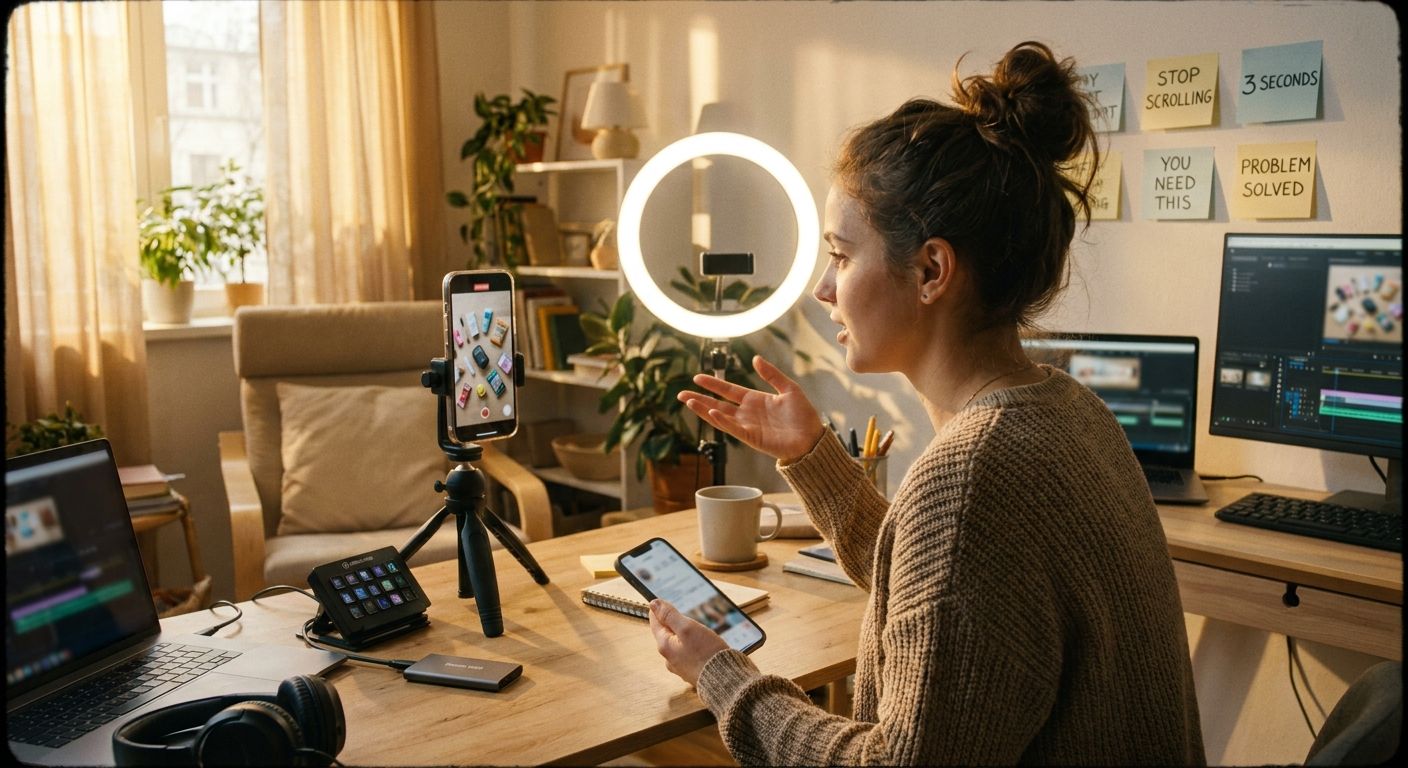
Top 10 Hooks to Try for Side Hustles (And Why Each One Works)


The viewer decides in under two seconds. Here's how to win that window.
Most side hustle content fails at the hook—not because the creator lacks knowledge, but because the opening line buries the payoff. The viewer has no reason to stay. These 10 hook templates fix that. Each one is built around a real psychological trigger, adapted for the side hustle niche, and paired with the weak pattern it replaces.
How a great hook converts scroll to watch
The first line tells the viewer this content is specifically for them—their situation, their constraint, their goal.
Tease the payoff without delivering it. The viewer stays because leaving feels like missing out.
The body answers the question before the viewer expects it. This triggers saves and shares, not just watch time.
End on something the viewer wants to send to a friend: a surprise, a shortcut, a call-out. Shares beat reach hacks every time.
Winners vs. losers: what actually separates high-performing side hustle posts
- Winners open with a specific outcome or tension the viewer already feels, then prove it fast
- Winners make the process or result visible on screen, not just described in voiceover
- Winners sound genuinely enthusiastic without scripted hype—enthusiasm is contagious, performance is not
- Losers lead with "so today I'm going to talk about..."—the viewer is already gone
- Losers hide the payoff until the final seconds as a retention trick—viewers recognize it and feel manipulated
- Losers lean on hashtag volume or post length as the primary growth lever—neither substitutes for a strong opening line
- Losers open with a discount or CTA before earning any trust
Creators like @rissasidehustle and @sophiie_victoria consistently use an "adaptable opening premise"—a first line that frames a specific situation the viewer is already in, rather than a generic "here are my side hustles" intro. That framing pulls saves and shares. The content volume underneath matters less.
The top 10 hooks to try for side hustles
1. The specific constraint opener
Template: "If you have [X hours / X dollars / no experience], this side hustle actually works."

Why it works: Immediately filters the audience to people who self-identify with the constraint. Everyone else still watches out of curiosity.
Adapt it: Swap the constraint for your viewer's real bottleneck: no startup capital, a 9-to-5, a phone and nothing else.
Loser pattern it avoids: The vague "best side hustles for 2026" opener that talks to nobody specific.
2. The insider reveal
Template: "Nobody tells you [uncomfortable truth] about [side hustle]—so I will."
Why it works: Positions you as the honest voice in a space full of hype. Trust converts better than enthusiasm alone.
Adapt it: Use a real friction point you hit—slow first months, platform bans, refund headaches—not a manufactured controversy.
Loser pattern it avoids: The aspirational montage with no useful information.
3. The mistake/correction hook
Template: "I was doing [X] wrong for [time period]. Here's what I changed."
Why it works: Self-deprecation signals authenticity. It also frames the viewer as someone who might be making the same mistake, which makes it feel personally relevant.
Adapt it: Make the mistake concrete and relatable, not a humble brag about almost failing big. Creator @_haleyvemealone uses a real, raw personal situation as the hook—that directness drives comments and replays.
Loser pattern it avoids: The generic "tips and tricks" opener that signals nothing about what's at stake.
4. The forwarding hook
Template: "Send this to a friend who keeps saying they're broke."
Why it works: Primes the share behavior before the viewer finishes watching. Thinking "who would I send this to?" pulls them deeper into the content itself.
Adapt it: Make the recipient specific—a broke college student, a stay-at-home parent, a 9-to-5 worker who hates their commute.
Loser pattern it avoids: The end-of-video "follow for more" CTA that no one acts on.
5. The income-source counter
Template: "I have [number] income streams. Here's the one I'd start with zero experience."
Why it works: The number signals credibility. The qualifier "zero experience" opens it to everyone watching.
Adapt it: Keep the number real. A credible small number beats a fabricated large one.
Loser pattern it avoids: The "passive income" fantasy hook with no actionable entry point.
6. The fast-disqualifier hook
Template: "This side hustle is NOT for you if [condition]."
Why it works: Counterintuitive exclusion creates desire. The viewer immediately wants to qualify—and keeps watching to find out if they do.
Adapt it: Use a real disqualifier, not an aspirational one. "Not for you if you need results this week" is honest and useful.
Loser pattern it avoids: "Anyone can do this!"—a promise that signals low credibility.
7. The silent-majority call-out
Template: "Most people watching this already have everything they need. They just don't know it yet."
Why it works: Creates immediate personal relevance. The viewer wonders what they're missing, and attention is secured.
Adapt it: Follow it immediately with something concrete. Leave it vague and you've burned the trust the hook built.
Loser pattern it avoids: Opening with your credentials before the viewer has any reason to care.
8. The comparison frame
Template: "I tried [popular side hustle] and [less-known side hustle]. Here's which one I'd actually tell a friend to do."
Why it works: Viewers are already overwhelmed by options. This promises to cut through that—decision fatigue relief is a real draw.
Adapt it: Only compare things you've genuinely tested. Fake comparisons are detectable and kill authority.
Loser pattern it avoids: The standalone "here's a side hustle you can start today" with no differentiation.
9. The timeline anchor
Template: "In [realistic timeframe], here's what's actually possible with [side hustle]—and what isn't."
Why it works: Managing expectations honestly makes the promise more believable, not less. Skeptical viewers respond to realism.
Adapt it: Use a timeframe you can back up from experience. "90 days" beats "overnight" for credibility.
Loser pattern it avoids: "I made [large number] in my first week"—a claim that reads as unverifiable even when true.
10. The audience-flip hook
Template: "You're not lazy. You just haven't found the side hustle that fits how your brain works."
Why it works: Reframes a negative self-perception as an information problem, not a character flaw. Viewers who feel seen stay and share.
Adapt it: Pair it with a genuine categorization: visual vs. analytical, social vs. solo, high-upfront vs. zero-cost. The taxonomy has to be real.
Loser pattern it avoids: Motivation-only content with no actionable path forward.
Turn one source video into 3-5 original posts
- Identify the core mechanism — What is the single insight in the video that makes the viewer's situation easier? Strip everything else.
- Reframe for a different constraint — Take the same insight and reopen it with Hook #1 or #6, targeting a different specific constraint (time, capital, skill level).
- Flip the angle — Turn the "here's how to do it" into "here's why most people fail at it" using Hook #2 or #3.
- Extract one step as its own post — The best-performing sub-topics in a listicle often outperform the listicle itself. Isolate step 3 or 4 and build a standalone piece around it with Hook #7 or #9.
- Build the forwarding version — Restructure for sharing: shorter, punchier, Hook #4 as the opener. This is the version GEN's autonomous agent can draft and schedule as a variation the moment the source post goes live, testing which framing actually drives saves without manual reformatting.
Frequently asked questions
Which of these hooks works best for brand-new accounts with no audience?
Hooks #4 (forwarding), #1 (specific constraint), and #10 (audience-flip) tend to outperform on cold accounts because they rely on emotional resonance rather than established credibility. You don't need a track record to tell someone their situation is solvable.
Should I use the same hook format every post to build pattern recognition?
Not exclusively. Rotating between two or three hook types prevents audience fatigue while still giving your content a recognizable tone. Think of it as a signature voice, not a signature format.
How do I know which hook is working if I'm posting across multiple platforms?
Track saves and shares per post, not just views. Saves signal that the viewer found the content actionable enough to return to; shares signal the forwarding hook did its job. An autonomous agent like GEN can watch those signals across platforms and flag which hook variation is pulling the right behavior, so you're not manually comparing spreadsheets.
Can these hooks work for side hustle content that isn't income-focused, like building a skill or starting a creative project?
Yes. Swap the income outcome for the relevant payoff: creative freedom, flexible schedule, a portfolio project. Hooks #6, #8, and #9 are outcome-agnostic—the psychological mechanism transfers directly.
The fastest upgrade you can make right now: take your last post, read the first sentence out loud, and ask whether a stranger would know within two seconds why this is relevant to their life. If the answer is no, rewrite just that line using one of the 10 templates above. The rest of the content usually doesn't need to change.