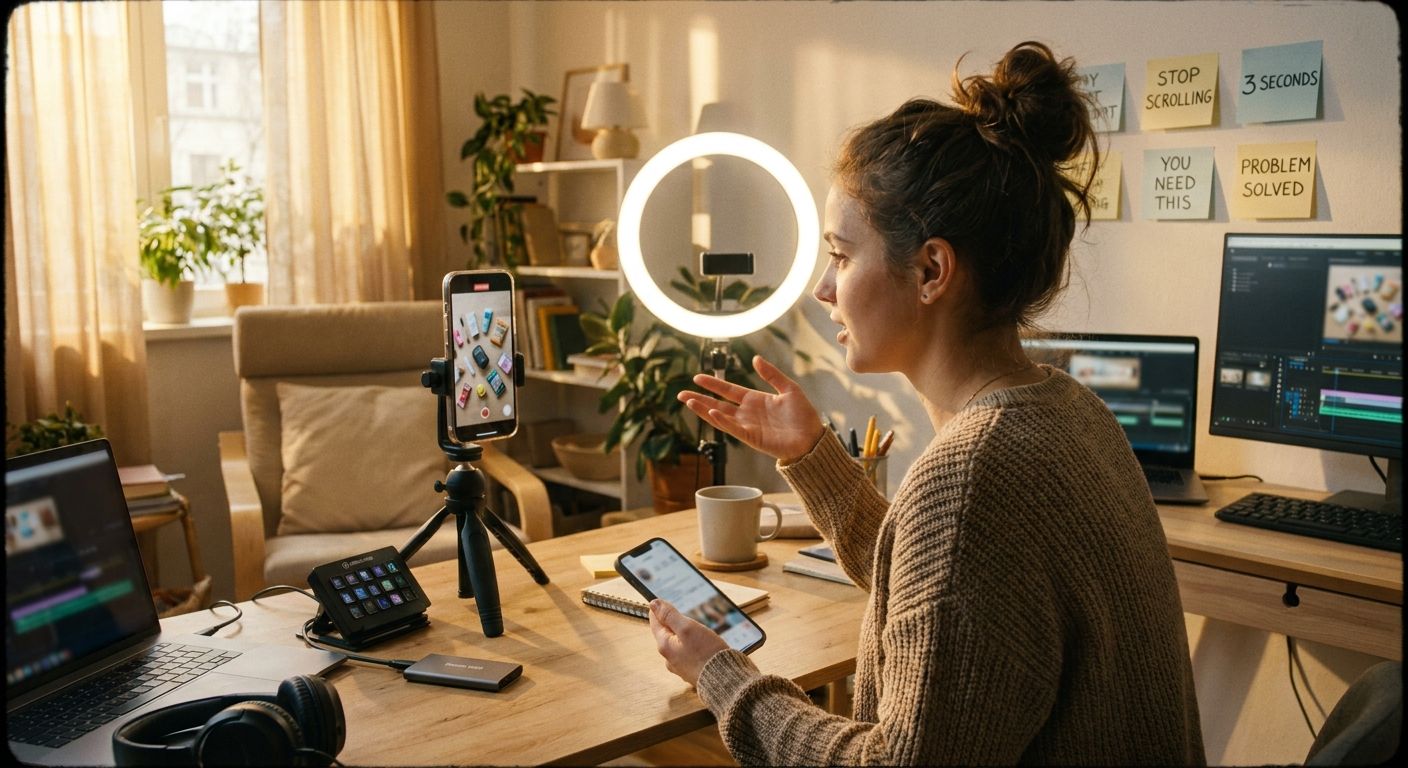
Top 10 Hooks to Try for Small Business (With Templates)


Your hook is your entire funnel -- here are 10 that actually work
Most small business posts die in the first two seconds -- not because the product is wrong, but because the opening gives the viewer no reason to stay. The fix is mechanical: a strong hook creates an information gap, signals a specific result, or triggers immediate recognition. These 10 templates are built for that job.
From Hook to High-Performing Post
Create an information gap or recognition moment -- viewer decides to stay or scroll right here.
Deliver on the hook's implicit promise -- demo, before/after, or numbered steps. No filler.
A cliffhanger, a reframe, or a direct question pulls the algorithm signal (replays, comments) that amplifies reach.
The body rarely kills performance -- the hook does. Rotate hook variants before changing the core content.
Winners vs. losers: the one real difference
- Winners make the viewer understand the result or tension within two seconds, show the product or process on camera, and bring enthusiasm that feels specific rather than performed.
- Losers open with a generic setup ("Hey guys, today I'm going to..."), bury the payoff past the 20-second mark, lean on a discount CTA instead of a content reason to watch, or treat hashtag volume as a distribution strategy.
- The @salemkinging pattern uses a simple reframe question ("What business are you really in?") that makes viewers immediately uncertain of their own answer -- and therefore compelled to stay.
- The @nancy.musefunnel pattern frames a small brand's story as a cultural lesson, not a promotional piece. The hook is the rebellion premise, not the brand name.
Reach is not conversion. A hook that pulls saves and comments will outperform a hook that chases views on a thin premise.
10 hook templates for small business
-
"What [your industry] won't tell you about [common belief]"
Why it works: Positions you as the insider correcting a gap -- creates trust and pattern-interrupts at once.
Small business adapt: "What handmade candle brands won't tell you about scent throw."
Loser pattern it avoids: Generic "tips for small business owners" with no POV. -
"I tried [X] for [timeframe] -- here's what nobody mentions"
Why it works: First-person experiment framing signals honest, specific experience -- not a sales pitch.
Small business adapt: "I sold at farmers markets for 3 months -- here's what nobody mentions about booth placement."
Loser pattern it avoids: "5 reasons you should sell at farmers markets" (advisory without authority). -
"The question that changed how I think about my business"
Why it works: Mirrors the @salemkinging reframe model -- makes the viewer ask themselves the same question before you've even answered it.
Small business adapt: Any founder inflection point: pricing, niche, audience clarity.
Loser pattern it avoids: Motivational opener with no actual payoff for the viewer. -
"[Number] things I wish I knew before [milestone]"
Why it works: Numbered lists set a completion contract -- the viewer knows exactly what they're committing to watching.
Small business adapt: "3 things I wish I knew before opening my Etsy store." Keep the number low (3-5) for short-form.
Loser pattern it avoids: Vague "lessons from my journey" with no scannable structure. -
"Stop doing [common tactic] if you want [result]"
Why it works: Contrarian hooks spike curiosity and saves -- the viewer wants to know if they're doing the wrong thing.
Small business adapt: "Stop leading with discounts if you want loyal customers."
Loser pattern it avoids: Positive-only advice that doesn't create urgency. -
"Watch me [process] start to finish"
Why it works: Process transparency builds trust in a way competitors rarely offer -- the viewer becomes an insider.
Small business adapt: Packing an order, making a product batch, setting up a market stall. Direct-to-camera with tight close-ups on hands and product wins here.
Loser pattern it avoids: Text-only or green-screen that hides the actual making. -
"How [small brand] built [specific outcome] without [expected resource]"
Why it works: The @nancy.musefunnel model -- frames a real brand's story as a lesson in constraint-driven creativity, not a brand feature.
Small business adapt: Tell your own origin story with the constraint front-loaded: "How I built a waitlist without paid ads."
Loser pattern it avoids: Brand story told chronologically with the interesting part buried at the end. -
"The [single decision] that [changed/fixed/broke] everything for my business"
Why it works: One specific decision is more compelling than a list of lessons -- it promises a singular, transferable insight.
Small business adapt: Pricing anchor, packaging choice, platform pivot, first wholesale account.
Loser pattern it avoids: "My business journey" videos with no single narrative thread. -
"Before you buy [product category], watch this"
Why it works: Intercepts purchase-intent viewers at the exact moment they're in decision mode -- high save rate.
Small business adapt: Ideal for product creators competing on quality: "Before you buy a handmade leather wallet, watch this."
Loser pattern it avoids: "Why our product is great" framing that reads as an ad. -
"Most [your category] accounts get this wrong -- here's the fix"
Why it works: Sets up a clear contrast structure (wrong then right) that the viewer can immediately apply.
Small business adapt: "Most small bakery accounts get their pricing content wrong -- here's the fix." Be specific about the category.
Loser pattern it avoids: Generic critique with no actionable correction delivered in the same video.
Workflow: one source video -> 3-5 posts
- Identify the core insight -- strip the source video to a single sentence: the tension, the reframe, or the result.
- Write 3 hook variants -- one contrarian, one numbered, one process-reveal. Each points to the same body content.
- Cut a short-form version -- hook + proof + loop ending. No intro, no outro.
- Pull a text-overlay clip -- one striking quote or data point from the body, no voiceover needed, captions only.
- Write a carousel or caption -- expand the numbered version into a sequential slide or long-form caption for platforms that reward depth.
An agent like GEN can run steps 2-5 autonomously: it watches which hook variant earns saves and watch-through, then prioritizes that pattern in the next batch -- so you're testing hooks systematically rather than guessing.
Frequently asked questions
How long should a small business hook actually be?
Two to three seconds on short-form video, one sentence in a caption. The hook is not the intro -- it's the first signal. If it takes five seconds to set up, you've already lost part of the audience.
Should I change the hook or the whole video if it underperforms?
Change the hook first, always. The body and process content are usually solid -- the opening line is the variable that kills retention before the viewer sees any of it. Run at least two hook variants on the same underlying content before scrapping the post.
Do these hooks work across TikTok, Instagram Reels, and YouTube Shorts?
The templates work on any short-form surface -- the phrasing is platform-agnostic. What changes is delivery: direct-to-camera with tight product close-ups tends to outperform text-overlay formats on Reels, while conversational reframe hooks (like the "what business are you really in?" model) travel well on all three.
How many hooks should I test per week?
If you're posting daily, rotate at least two to three distinct hook patterns per week. If you're posting three times a week, try one new hook template per post. The goal is a feedback loop short enough that you learn within a week, not a month.
The bottom line: Pick two hook templates from this list, write three variants each, and deploy them against the same content this week. One of those six openings will signal clearly. That's the one worth scaling -- and the pattern worth handing to an autonomous agent to keep testing while you focus on the product.