Top 10 Hooks to Try for Yoga Content (With Templates)
Your yoga content is good. Your first three seconds aren't.
Most yoga creators lose viewers before the first pose lands. The problem is rarely the content itself -- it's a hook that assumes the viewer already cares. These 10 templates fix that by making the payoff obvious before curiosity wears off.
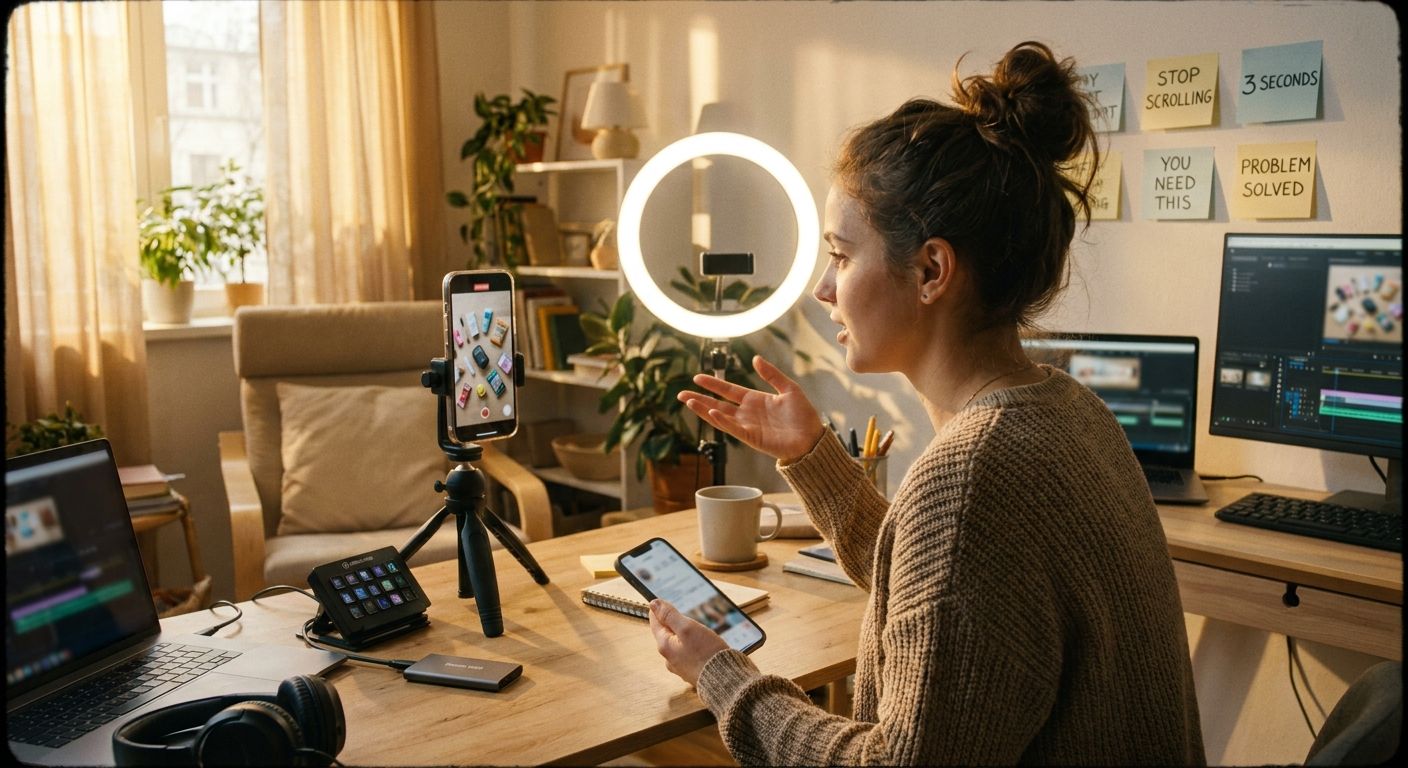
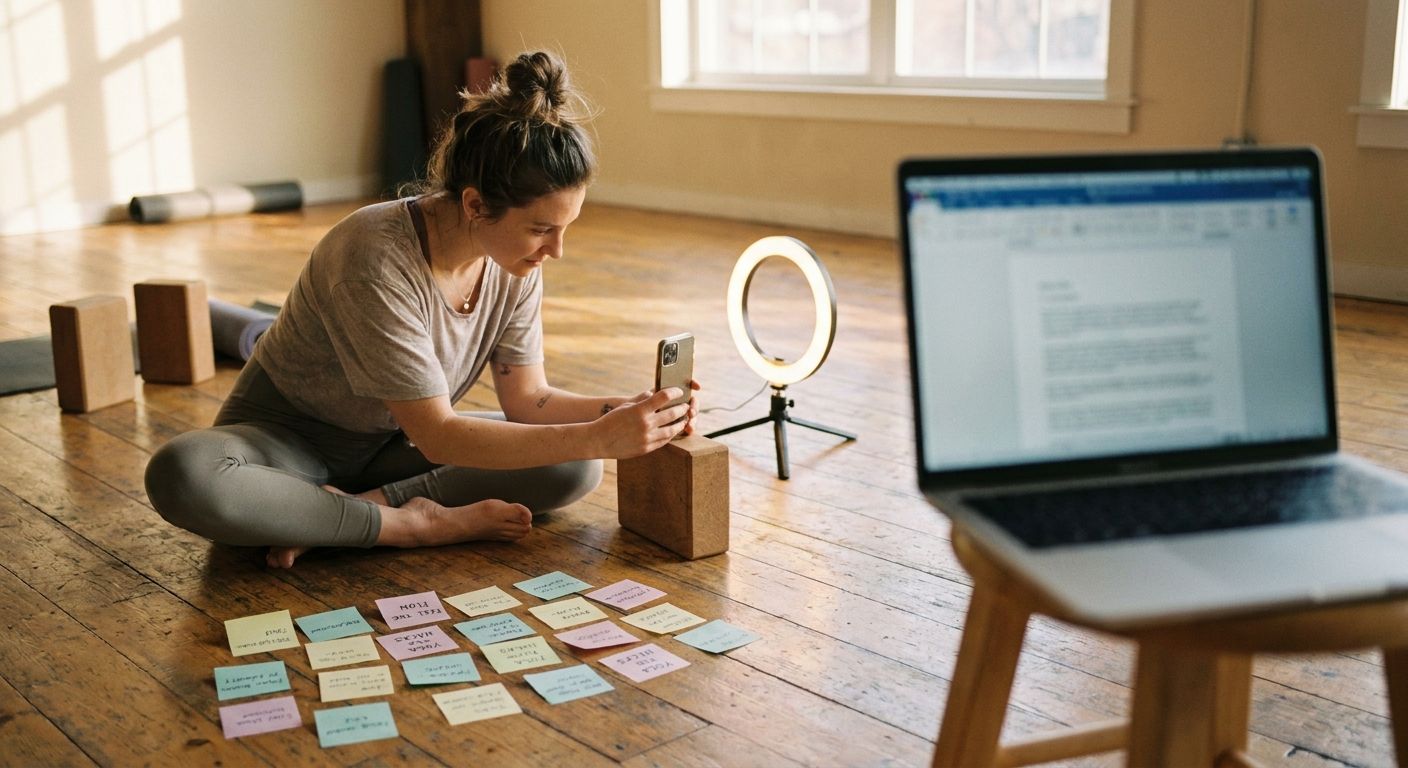
From hook to high-performing yoga post
Lead with what the viewer wants to fix or feel -- tight hips, morning stiffness, stress -- not what you're about to teach.
Flash the end state (a deep fold, a mobile spine, a calmer face) or tease an unexpected mechanism before the explanation.
Number the moves, name each pose, cue the breath -- concrete structure keeps watch time high because the viewer tracks progress.
End on a cue that makes saving feel logical -- 'bookmark this for your morning' beats a generic 'follow for more'.
Winners vs. losers in yoga hooks
- Winner: Opens with the viewer's body state or goal -> Loser: Opens with your credentials or studio name
- Winner: Numbers the moves so the viewer tracks progress -> Loser: Flows through poses with no structure or count
- Winner: Shows a visible result (deeper fold, relaxed face) early -> Loser: Keeps the payoff hidden until the last five seconds
- Winner: Speaks to a specific body part or daily situation -> Loser: Leads with 'yoga is amazing' or a generic wellness platitude
- Winner: Creates a save-worthy reason (daily practice, quick fix) -> Loser: Ends with only a follow CTA and no utility signal
Creators like @nikita_harivansh and @vinyasawithval consistently open on a specific body outcome or relatable starting point -- not on the pose name. That's the structural difference between high-save and low-save content.
Top 10 hooks to try for yoga
1. The numbered daily fix
Template: "Try these [#] movements every day to [specific result]."

Why it works: A count creates a progress contract -- the viewer stays to collect all the items. @nikita_harivansh uses this pattern to strong effect with organ-health framing that feels medical and specific.
Loser pattern it avoids: Unlabeled flows where viewers don't know if they're halfway through or at the end.
2. The beginner re-entry premise
Template: "If you were just starting yoga, I'd tell you to try [this specific flow/pose]."
Why it works: Aspirational for beginners, validating for anyone who feels stuck. @vinyasawithval's casual, peer-to-peer version drives strong saves because it sounds like advice, not instruction.
Loser pattern it avoids: Assuming the viewer is already a practitioner and skipping the entry ramp.
3. The body-part pain hook
Template: "If your [body part] is always tight/stiff/sore, do this."
Why it works: Specificity beats generality. "Tight hips" pulls the exact person who searches that term and converts passive scrollers into engaged viewers because they feel called out.
Loser pattern it avoids: "Full body stretch routine" -- too vague to stop the scroll.
4. The time-constraint opener
Template: "You don't need an hour. [#] minutes of [specific practice] changes [outcome]."
Why it works: It kills the most common objection before the viewer forms it. Works especially well for morning and office desk content.
Loser pattern it avoids: Leading with video length rather than the viewer's time constraint.
5. The counter-intuitive claim
Template: "Most people stretch [X] wrong -- here's what actually works."
Why it works: Creates a curiosity gap and positions you as the corrective authority. Works for hamstring, hip flexor, and shoulder content where common cues are genuinely counterproductive.
Loser pattern it avoids: Presenting correct technique without explaining what to stop doing first.
6. The internal-organ / non-obvious benefit angle
Template: "Your [organ/system] needs movement too -- try this."
Why it works: Reframes yoga beyond aesthetics or flexibility. Visceral health framing (digestion, lymphatic flow, breathing capacity) pulls audiences who don't identify as "yoga people" but care about longevity.
Loser pattern it avoids: The same flexibility-focused angle every yoga account already runs.
7. The before-bed / morning ritual hook
Template: "Do this [before bed / when you wake up] and notice the difference by [timeframe]."
Why it works: Anchors the content to a daily behavior slot, which increases save rate -- the viewer knows exactly when they'll use it.
Loser pattern it avoids: Generic "evening yoga" with no specific cue for when or why.
8. The 'I wish someone told me' hook
Template: "I wish someone had told me [non-obvious insight] when I started."
Why it works: First-person regret framing is credible and shareable. It signals real earned experience rather than aesthetic content.
Loser pattern it avoids: Generic "tips for beginners" framing that reads like a listicle caption.
9. The pose-payoff hook
Template: "Can't do [difficult pose]? One drill fixes it."
Why it works: Goal-based framing for aspirational poses (splits, wheel, crow) creates a clear before/after arc. The viewer has a defined destination, so they watch to find out if the drill applies to them.
Loser pattern it avoids: Demonstrating an advanced pose with no bridge for the viewer who can't do it yet.
10. The stress / nervous system hook
Template: "When you're overwhelmed, do this [#]-minute reset -- not a full practice, just this."
Why it works: Emotional specificity ("overwhelmed" beats "stressed") plus permission to do less is a combination that drives shares. This angle performs in comments as viewers tag people they know are struggling.
Loser pattern it avoids: Positioning every video as a "full practice" that requires commitment most viewers won't make in the moment.
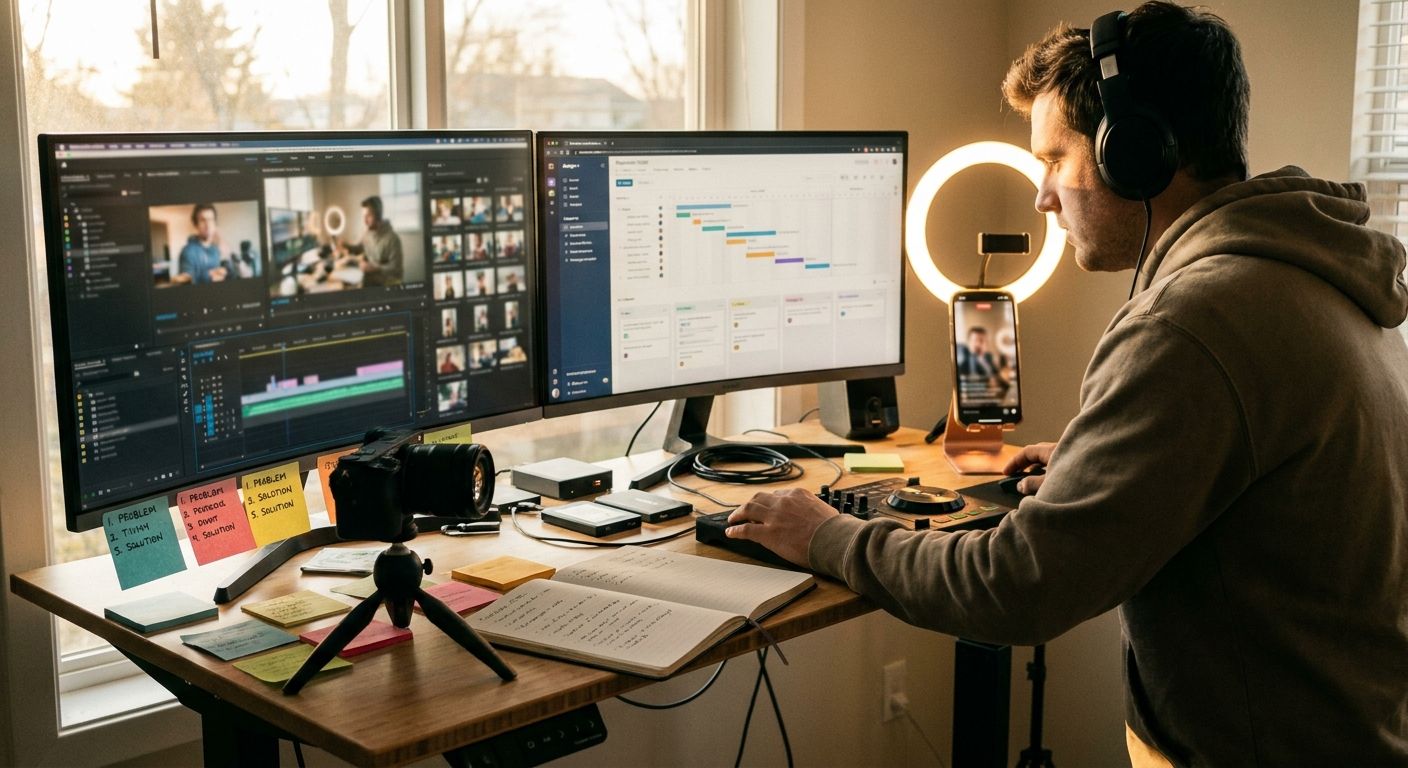
One-source-to-five-posts workflow
- Record one 4-move sequence with clear, close-up form shots and a single cohesive theme (e.g. hip mobility).
- Post 1 -- Numbered list hook: All 4 moves with on-screen count. Hook: "4 hip openers your body needs daily."
- Post 2 -- Single deep-dive: Pull move #2 out, explain the non-obvious cue. Hook: "Most people do pigeon pose wrong -- here's the fix."
- Post 3 -- Time-constraint cut: Edit to the fastest move only. Hook: "90 seconds if you sit all day."
- Post 4 -- Benefit reframe: Revoice over the same footage with an organ/system angle. Hook: "Your hip flexors affect your digestion -- try this."
- Post 5 -- Aspirational payoff: Use the deepest range-of-motion moment as a visual hook. Hook: "This is what 30 days of daily hip work looks like."
An autonomous agent like GEN can scan which of those five angles is trending in your niche on a given week, generate the script variants, and queue them for publication -- so you're not deciding from scratch each time which hook to lead with.
Frequently asked questions
Do these hooks work across TikTok and Instagram Reels equally?
Yes, because the psychology is the same on both platforms: a viewer decides to keep watching within the first two to three seconds based on whether the content is relevant to them. The templates above are platform-agnostic; what changes is pacing and caption length, not hook structure.
How often should I rotate hook types?
Don't rotate mechanically. Test two or three hooks in the same week on similar content and watch which drives saves and shares -- those signals indicate genuine utility, not just curiosity clicks. Once you find a strong pattern for your audience, lean into it for a month before introducing a new variant.
Is it better to speak the hook or put it on screen as text?
For yoga specifically, lead with both: on-screen text captures silent scrollers while your voice reinforces the hook for people already watching with sound. The text hook should appear in the first two seconds, before any pose demonstration begins.
Can I use the same hook template more than once?
Yes -- changing the body part, pose, or benefit angle creates a new post even with the same structure. "If your lower back is always tight, do this" and "If your shoulders are always tight, do this" reach different viewers despite identical scaffolding.
Start here: Pick hooks 1, 3, and 10, record a single sequence this week, and run the five-post workflow above. Three hook types, one filming session, five distinct posts -- that's the operating model.