Top 10 Hooks to Try for Anti-Aging Content (And Why Each One Works)

The real reason your anti-aging content stalls in the first two seconds
The anti-aging niche is saturated with before/afters, ingredient deep-dives, and routine walkthroughs. The content that breaks through isn't necessarily better--it opens better. A viewer decides whether to stay within the first two seconds, and most creators lose them with a generic setup like "Hey guys, today I'm sharing my skincare routine." The hooks below are built to stop that scroll and keep the viewer committed to the payoff.
Why a strong hook changes the entire post's fate
Viewer sees a specific result, tension, or identity trigger--not a preamble. They pause.
The hook creates a question the viewer needs answered--they watch to close the loop.
Demo, result, or insight lands visually--tight close-up, direct-to-camera, or visible process.
Viewer saves for later or sends to a friend--the highest-intent signals the algorithm rewards.
Winners vs. losers in anti-aging hooks
- Winner: Opens with a visible result or a specific named problem ("my neck crepey skin at 52")
- Winner: Shows the product or process in frame within the first three seconds
- Winner: Uses genuine enthusiasm--sounds like a person, not a press release
- Loser: Starts with "Hey guys, so today I wanted to talk about..."
- Loser: Leads with price, discount code, or a generic CTA before establishing any value
- Loser: Relies on text-only overlays without a face or demo on screen
- Loser: Hides the payoff ("watch to the end!") without giving a credible preview of why it's worth it
Creators like @bellehassan and @momieplanetpro run the adaptable-premise approach well: they open with a relatable moment or a simple remedy shown in frame before the viewer has any reason to scroll away. That visual-first habit is what separates high-performing posts from mid-tier ones in this niche.
10 hooks to try for anti-aging content
-
"I stopped doing [common habit] and my skin aged backwards."
Why it works: Reversal framing. The viewer has probably been doing that habit and needs to know if they're wrong.
Anti-aging adaptation: Fill the blank with something specific--sleeping on cotton pillowcases, using hot water, over-exfoliating.
Pattern avoided: Generic "here's my routine" openings that bury the insight. -
"Nobody told me [ingredient/technique] was doing THIS to my collagen."
Why it works: Information asymmetry. The viewer feels they've been missing something.
Anti-aging adaptation: Name a real ingredient--retinol timing, glycolic acid over-use, niacinamide stacking.
Pattern avoided: Vague "you need to know this" without a named subject in frame. -
"The anti-aging pyramid nobody talks about."
Why it works: Framework promise. Viewers save framework content for reference, and saves compound reach. This mirrors one of the strongest observed patterns in this niche (@user1931052145650's "Anti-Aging Pyramid" post generated exceptional save volume).
Anti-aging adaptation: Layer the pyramid visually on screen while you explain each tier direct-to-camera.
Pattern avoided: Dumping ten tips in a list with no organizing logic. -
"I'm [age] and this is the only thing I actually kept in my routine."
Why it works: Age identity trigger. Viewers who share your age immediately self-select in.
Anti-aging adaptation: Be specific--"I'm 47 and dropped everything except this one step." Tight close-up of face mandatory.
Pattern avoided: Age-agnostic advice that speaks to nobody in particular. -
"Dermatologists hate when you DIY this--here's why I did it anyway."
Why it works: Controlled controversy. The tension between professional authority and personal agency lands hard in the skincare space.
Anti-aging adaptation: Use for home microneedling, DIY peptide serums, or at-home red-light device reviews.
Pattern avoided: Pure opinion without any demonstration on screen. -
"Watch what happens to my [specific area] after 30 days of [product/habit]."
Why it works: Process commitment hook. The viewer invests in watching because you've already committed to a result window.
Anti-aging adaptation: Name a specific zone--undereye hollows, nasolabial folds, neck skin, forehead lines. Open with the before shot in the first two seconds.
Pattern avoided: Vague before/after with no time frame or specific target area. -
"This $[low price] ingredient outperformed my $[high price] serum."
Why it works: Price contrast creates immediate tension. Anti-aging buyers are acutely price-aware because they've already spent heavily.
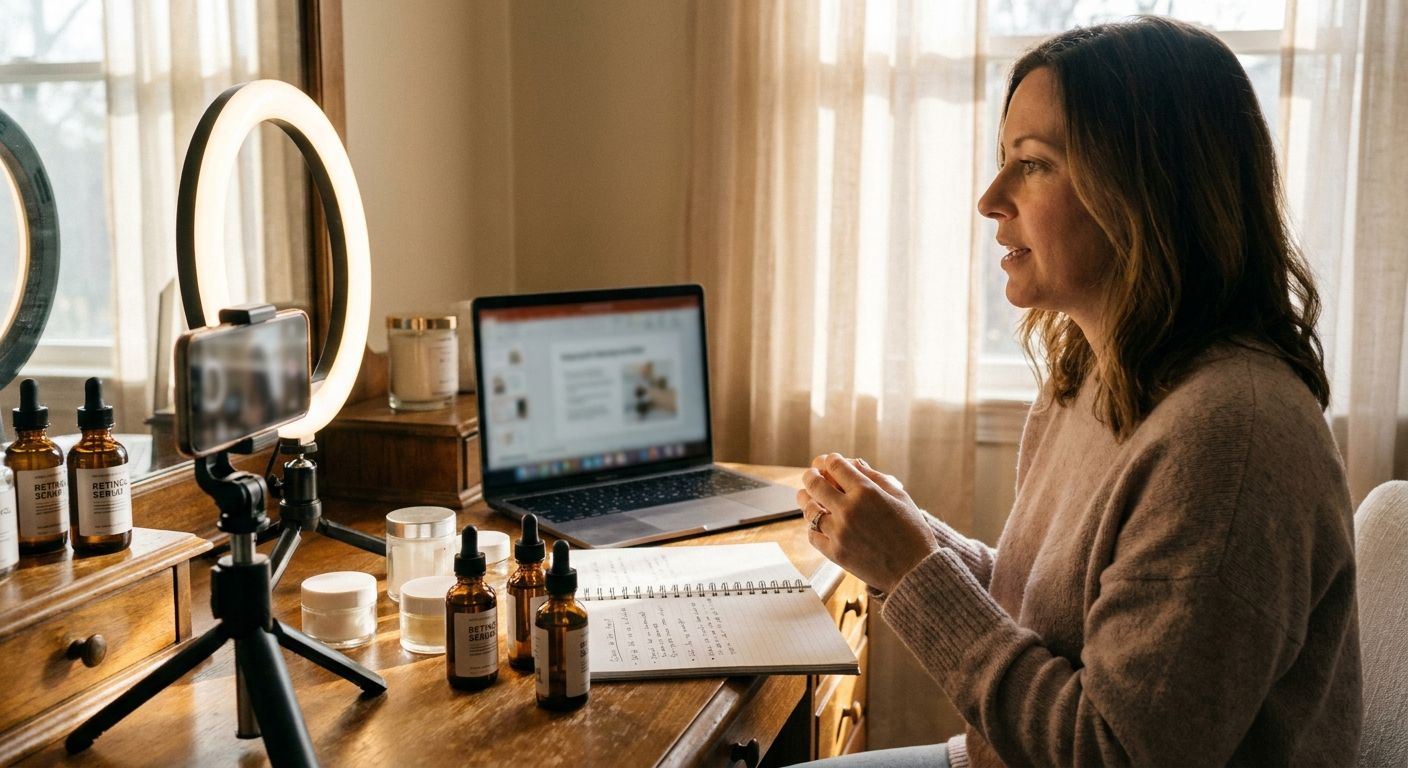
Anti-aging adaptation: Use real products in frame. Hold both bottles. The visual contrast matters as much as the claim.
Pattern avoided: Affiliate-first framing that leads with the link before the proof. -
"Most people apply [product] wrong. This is how it actually works."
Why it works: Correction hook. It flatters the viewer for watching ("you're the kind of person who wants to get it right") while implying they've been wasting money.
Anti-aging adaptation: Retinol application order, SPF amount, and vitamin C oxidation are all high-friction topics that land well here.
Pattern avoided: Educational content that doesn't open with a clear stakes statement. -
"My mom is 68 and people think she's 50. Her one rule."
Why it works: Third-party proof via a relatable real person--more credible than a creator claiming their own results.
Anti-aging adaptation: Feature the actual person on camera, even briefly. The face does the convincing.
Pattern avoided: Text-only "my aunt swears by this" posts with no visual evidence. -
"I tested the alum/[ingredient] remedy everyone's making. Honest result."
Why it works: Trend audit. The viewer has already seen the trend and wants a trusted voice to validate or debunk it. @momieplanetpro runs a clean version of this format with DIY remedy demonstrations in tight close-up--adaptable to almost any trending ingredient.
Anti-aging adaptation: Show the mixing or application process clearly; the process itself is the hook's visual proof.
Pattern avoided: Riding a trend with a talking-head review and no actual demo.
Turn one source video into 3-5 posts
- Identify the core claim. Strip the video to one sentence: "Alum mixed with rose water reduced visible pores after 2 weeks." That's your nucleus.
- Write five hook variations from the list above. Apply hooks #1, #6, #8, #10, and #4 to the same nucleus--each becomes a distinct post with a different opening angle.
- Match format to hook type. Framework hooks (#3): text overlay plus voiceover. Result hooks (#6, #7): direct-to-camera demo with close-up. Correction hooks (#8): split screen or side-by-side.
- Shoot in one session. Record five 30-second clips back-to-back while the product is out. Only the opening line changes.
- Stagger publish timing. Space the five variants across different days and watch which hook type pulls the strongest save-to-view ratio--that tells you more than raw views.
An autonomous agent like GEN can scan which hook patterns are trending in the anti-aging niche right now, generate five script variations from your source content automatically, and flag which version is gaining traction after the first 24 hours--so you're not manually tracking variants across three platforms.

Frequently asked questions
How long should the hook itself be?
One sentence, delivered in under three seconds. The hook is not the intro--it's the first thing out of your mouth or on screen. Everything else is body content.
Should I use the same hook on TikTok and Instagram Reels?
The hook template transfers directly. What changes is the visual framing: Reels audiences respond well to slightly higher production on the open frame, while TikTok rewards raw immediacy. Keep the words the same; adjust the shot composition.
Which hook type drives the most saves in the anti-aging niche?
Framework hooks (#3) and process-commitment hooks (#6) consistently generate high save rates because they're reference content--viewers want to return to them. Saves compound reach more durably than views alone.
How often should I rotate hook types?
If you're posting daily or near-daily, rotate hook types every two to three posts. Repeating the same opening pattern trains your audience to skip the open because they know what's coming--novelty in the first two seconds is a structural advantage, not a vanity choice.
One move to make today: Pick the hook type farthest from your current default, apply it to a piece of content you've already made, and ship it. The gap between your existing hook habit and this list is where your next high-performing post lives.