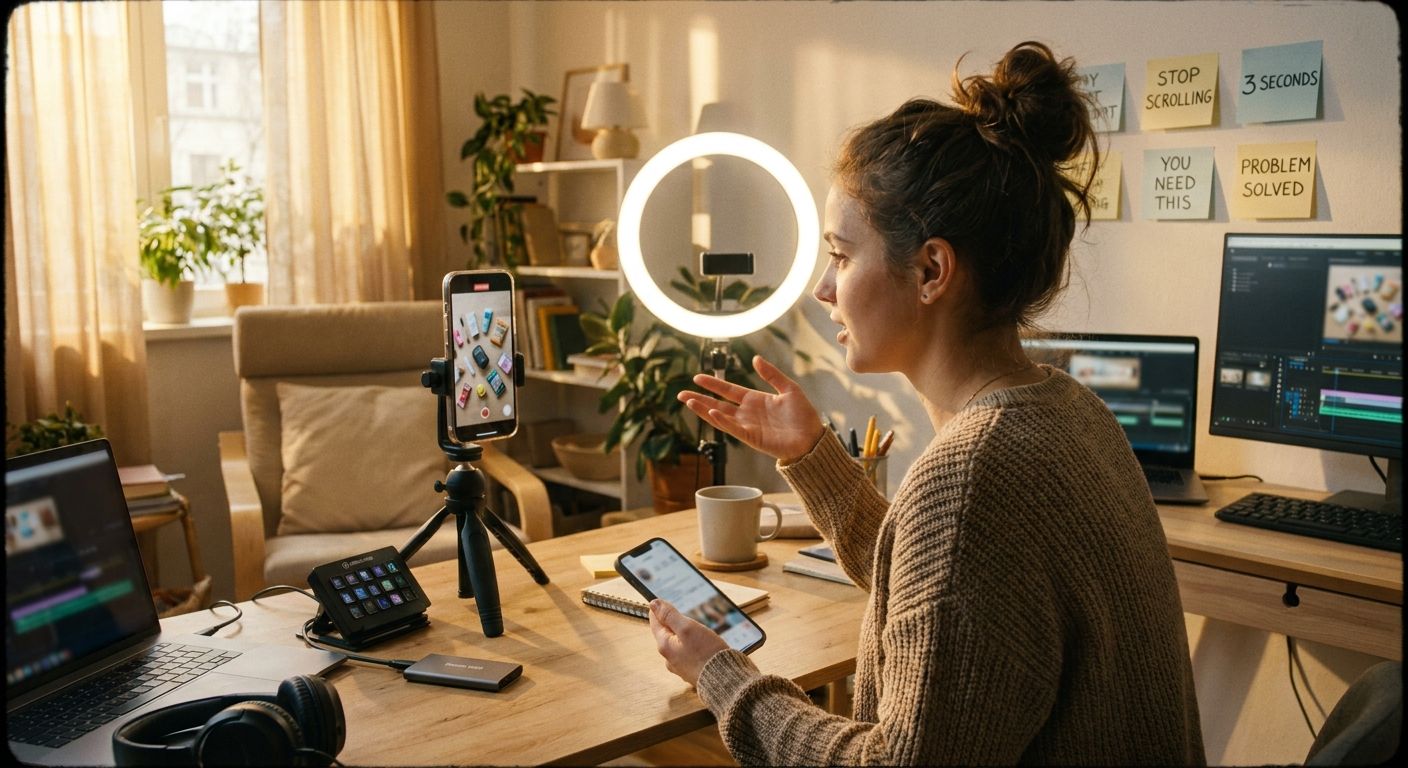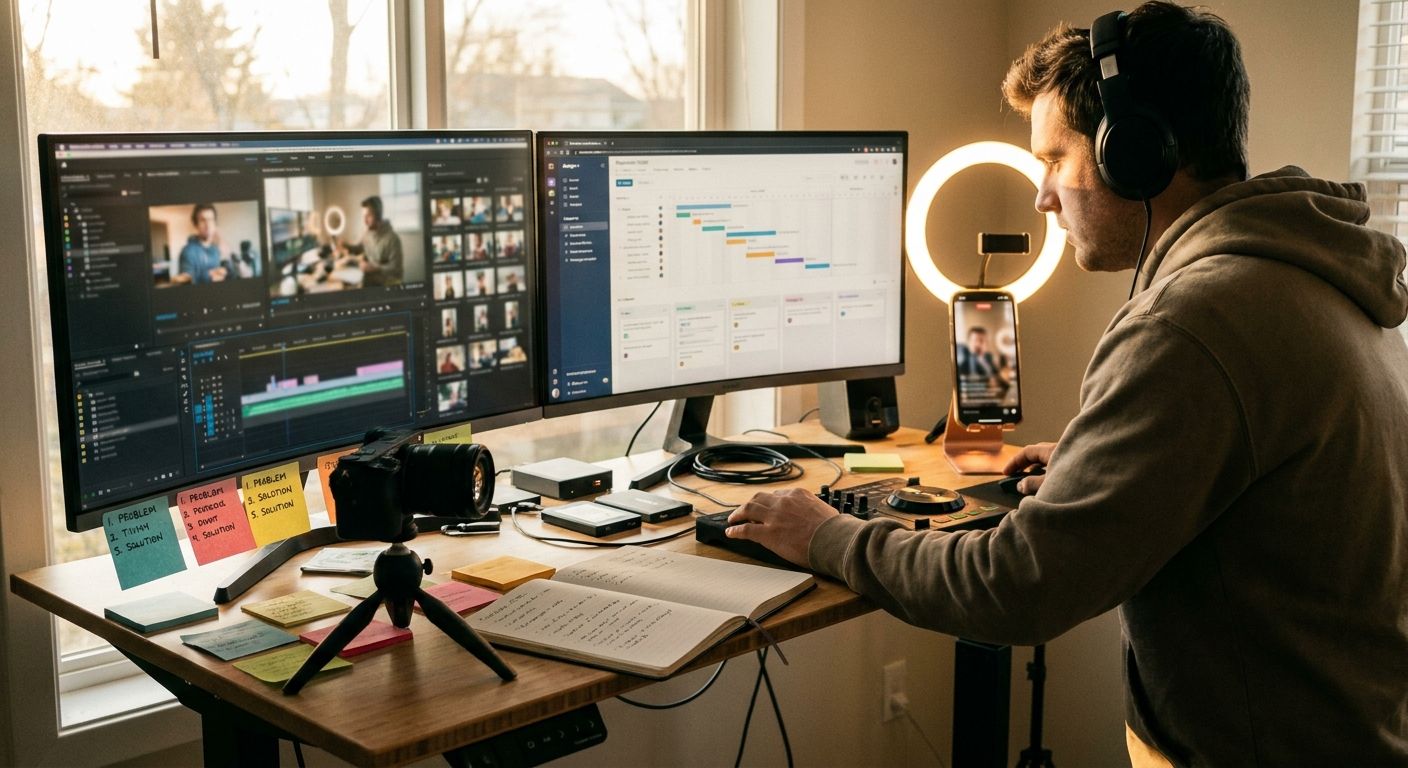
Top 10 Hooks to Try for Branding (With Templates)
Your hook is your brand's first impression -- and most creators blow it in the first two seconds
The hook isn't just a retention mechanic. For branding content, it signals authority, filters the right audience, and tells a viewer whether your account is worth a follow. A weak opening doesn't just lose a view -- it loses a potential community member. Here are 10 hook structures that work for branding content, each with a template you can use today.
How a strong hook compounds into brand growth
The first 2 seconds frame who you are and who the content is for -- wrong frame, wrong audience.
A specific hook attracts the right audience; a generic hook inflates views while killing follow-rate.
The body must pay off the hook immediately -- any delay reads as bait-and-switch and tanks saves/shares.
Repeat viewers who found you through a precise hook become the highest-LTV part of your audience.
Winners vs. losers: what separates high-performing branding content
- Winners -- state the outcome or tension in the first breath, show the process visibly (not just tell), and sound like a real person who's lived the insight
- Winners -- give the viewer an immediate reason to keep watching ("here's the part most people skip")
- Losers -- open with generic setup ("branding is so important...") before getting to the point
- Losers -- hide the payoff until the end, hoping retention does the work the hook should do
- Losers -- lead with follower counts, credentials, or self-introduction instead of value
- Losers -- use text-only or green-screen without a strong visual reason, which reads as thin on credibility for branding topics
Creators like @imdrebrown and @hollyhayesss consistently open with a personal premise or a tight how-to promise. Both earn saves at a high rate relative to views, which is the metric that signals genuine brand-building value.
10 hook templates for branding content
-
The "one tip that changed my account" opener
Template: "Just one thing shifted my [brand/following/content] -- here's what it was."
Why it works: Personal specificity beats generic advice. It signals real experience and makes a low-friction promise -- one thing, not ten. @imdrebrown's "just a little tip that worked for me" pattern earned a high save-to-view ratio precisely because it feels earned, not manufactured.
Loser pattern avoided: "Here are 10 branding tips!" -- overwhelming and non-committal.
-
The compressed how-to promise
Template: "How to build a [specific brand element] in [tight time frame]."
Why it works: Time compression signals efficiency. @hollyhayesss's "10/10 personal brand in 30 seconds" creates urgency and specificity at once. The viewer knows exactly what they're trading watch-time for.
Loser pattern avoided: "How to build your brand" -- too vague to earn a watch.
-
The bio/profile audit hook
Template: "Your [bio/profile/link] is sending people away -- here's the fix."
Why it works: It names a specific, fixable mistake. @esther_chinemerem's bio-focused content drove unusually high comment volume because it put words to a pain most creators feel but can't articulate. Diagnosis before prescription.
Loser pattern avoided: "Your profile should look professional" -- states the obvious, teaches nothing.
-
The contrarian correction
Template: "Everyone tells you to [common branding advice]. It's why your account isn't growing."
Why it works: It challenges the viewer's current model, forcing a reappraisal -- and earning the watch to find out where they went wrong.
Loser pattern avoided: Agreeing with consensus advice and adding no new angle.
-
The "nobody talks about this" reveal
Template: "The [branding thing] no one's talking about that's quietly killing your reach."
Why it works: It creates exclusivity. The viewer believes they're about to learn something off the mainstream map, which makes saving instinctive.
Loser pattern avoided: Repackaging the same five branding tips everyone has already seen.
-
The before/after identity hook
Template: "My account looked like [weak state]. Here's the single change that fixed it."
Why it works: Transformation framing is native to short video. The concrete before-state creates immediate identification for viewers in the same position.
Loser pattern avoided: Showing the after without the before -- removes tension and relatability.
-
The audience-filter call-out
Template: "If you're a [specific creator type] trying to [specific outcome], stop what you're doing."
Why it works: Precision beats reach in branding content. A hook that calls out a narrow, specific person attracts exactly the audience you want. Irrelevant viewers drop off fast -- that's a feature, not a bug.
Loser pattern avoided: "For anyone who wants to grow on social" -- addresses no one specifically.
-
The speed-stack list
Template: "Three things I'd change about my brand if I started over today: [start immediately with #1]."
Why it works: The list format sets a clear watch-time contract. Starting immediately with #1 -- no preamble -- signals respect for the viewer's attention and keeps completion rate high.
Loser pattern avoided: "I'm going to share three things..." -- four seconds of zero value before the list begins.
-
The direct-to-camera demonstration hook
Template: "Watch me [rebrand/rewrite/redesign] this [element] in real time."
Why it works: Showing the work -- rewriting a bio, redesigning a color palette, restructuring a content pillar -- is inherently more credible than talking about it. The camera sees what you're doing, not just what you're saying.
Loser pattern avoided: Talking-head commentary with no visible process or output.
-
The consequence-first hook
Template: "You're losing [follows/brand deals/trust] every day you keep doing [specific thing]."
Why it works: Loss aversion is a stronger motivator than gain. Naming the ongoing cost creates urgency without manufactured hype. The key is specificity -- "follows" or "brand deals," not just "growth."
Loser pattern avoided: "Do this and you'll grow!" -- gain framing is weaker and more generic.
Workflow: turn one source video into 3-5 branding posts
- Pick the core insight. Identify the single most actionable or surprising point in the source video -- that becomes Post 1's direct-to-camera hook.
- Flip the frame. Rewrite the same insight as a contrarian correction (Hook 4) for Post 2. Same idea, different entry point.
- Extract the process. If the source shows any visible action (rewriting, redesigning), isolate that clip and lead with the demonstration hook (Hook 9) for Post 3.
- Build the before/after. Use the source's weak-state example as the "before" and the corrected version as the "after" for Post 4 using Hook 6.
- Run the consequence version. Reframe the same lesson as what the viewer is currently losing by not knowing it (Hook 10) for Post 5.
An agent like GEN can spot which of these five frames is trending for your niche right now, generate scripts for each variant, and schedule them as a staggered test -- so you're running a structured experiment across the same core insight rather than guessing which hook resonates.
Frequently asked questions
Does the hook format matter more than the content itself?
For the first watch, yes -- a weak hook means the content never gets seen. But saves and shares (the metrics that compound into brand growth) require the body to actually deliver on the hook's promise. The hook earns the watch; the content earns the follow.
Should I use the same hook style every time to stay consistent?
No. Rotating across hook types -- especially alternating between personal-premise hooks and consequence-first hooks -- keeps your feed from feeling formulaic. Audiences pattern-match fast; if every video opens identically, retention drops on the later ones.
How specific does the hook need to be for personal branding vs. product branding?
More specific than you think, for both. Personal branding hooks that call out a precise creator type (Hook 7) consistently outperform general "for everyone" openers. Product branding hooks that name the visible problem before the solution outperform feature-first openers. The mechanism is the same: specificity creates identification.
Can I run these hooks on multiple platforms from the same script?
Yes, with one adjustment: visual delivery matters more on video platforms. A consequence-first hook lands well as a spoken opener on short video but works equally well as a bolded first line on a text-based platform. The core tension transfers; the delivery format adapts.
The move: Pick two hooks from this list that fit a piece of branding insight you already have, write both versions today, and post them 48 hours apart. The difference in saves will tell you more about your specific audience than any general advice -- including this article.