Top 10 Hooks to Try for Fashion Content (With Templates)

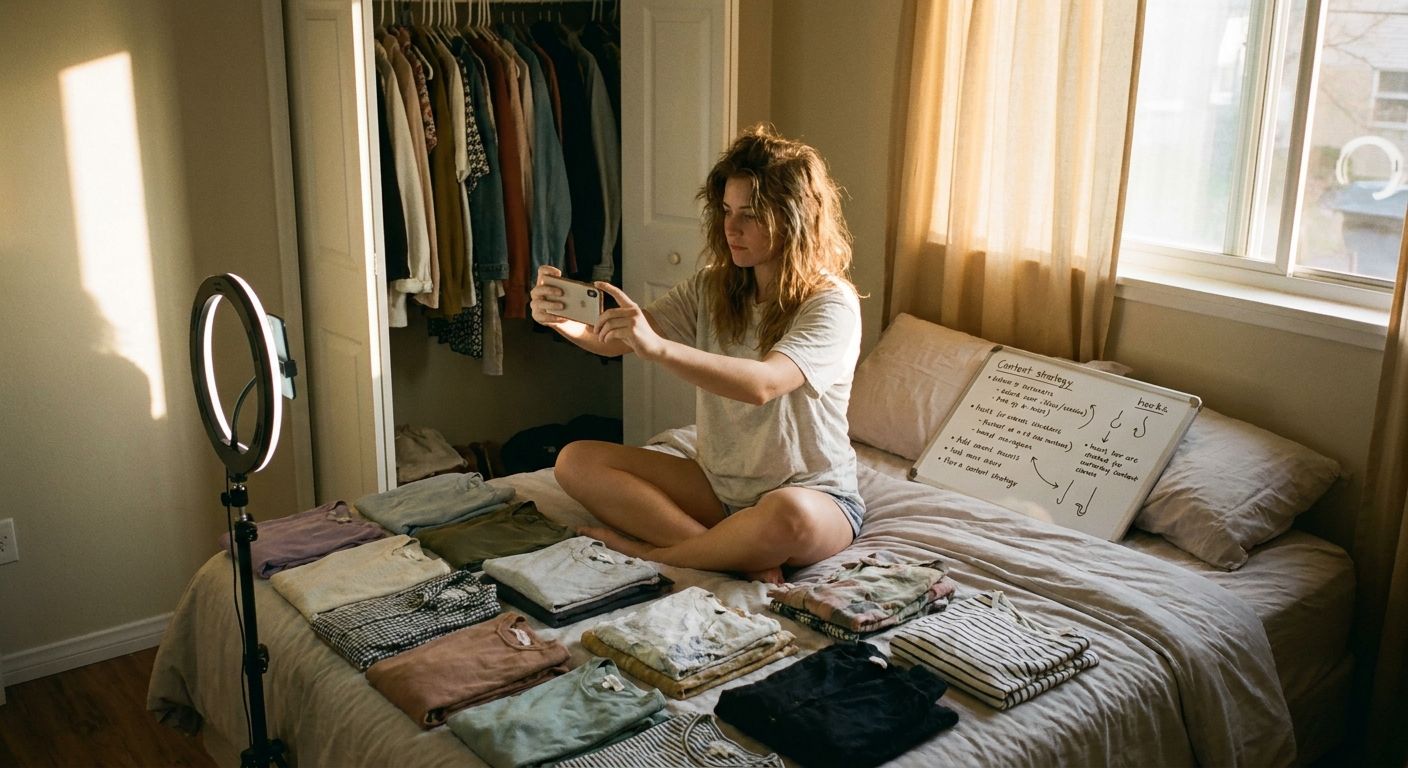
Your outfit is good. Your first two seconds aren't.
Most fashion posts lose viewers before the fit even registers. The problem is almost never the clothing -- it's the opening frame. A generic "OOTD for today" or a slow pan starting at the shoes gives the algorithm nothing to hold onto and the viewer no reason to stay. The hooks below are built around one principle: make the payoff visible before curiosity runs out.
How a winning fashion hook works
Show or say the most interesting thing first -- the transformation, the price contrast, the styling trick -- before any setup.
Introduce a tension the viewer needs resolved: a contrast, a question, or a claim that seems too good.
Fulfill the gap with a clear visual payoff: the full look, the before/after, the detail shot that proves the claim.
Close with a save-worthy detail, a styling tip, or a question that drives replays and comments.
Winners vs. losers at a glance
- Winners: open on the transformed look, name a specific styling constraint, demo the product in motion, sound genuinely excited about one detail
- Losers: slow pan from the floor up, generic "OOTD check," lead with the brand name before showing the fit, rely on hashtag volume to do the distribution work
- Winners: frame a tension ("everyone said this was too dressed up for brunch -- I wore it anyway")
- Losers: describe the outfit instead of making the viewer feel something about it
- The deciding factor: a viewer decides whether to watch in under two seconds. The hook has to earn the next eight.
10 hook templates for fashion creators
1. The outfit challenge
Template: "I only wore [constraint] for a week -- here's what actually worked."
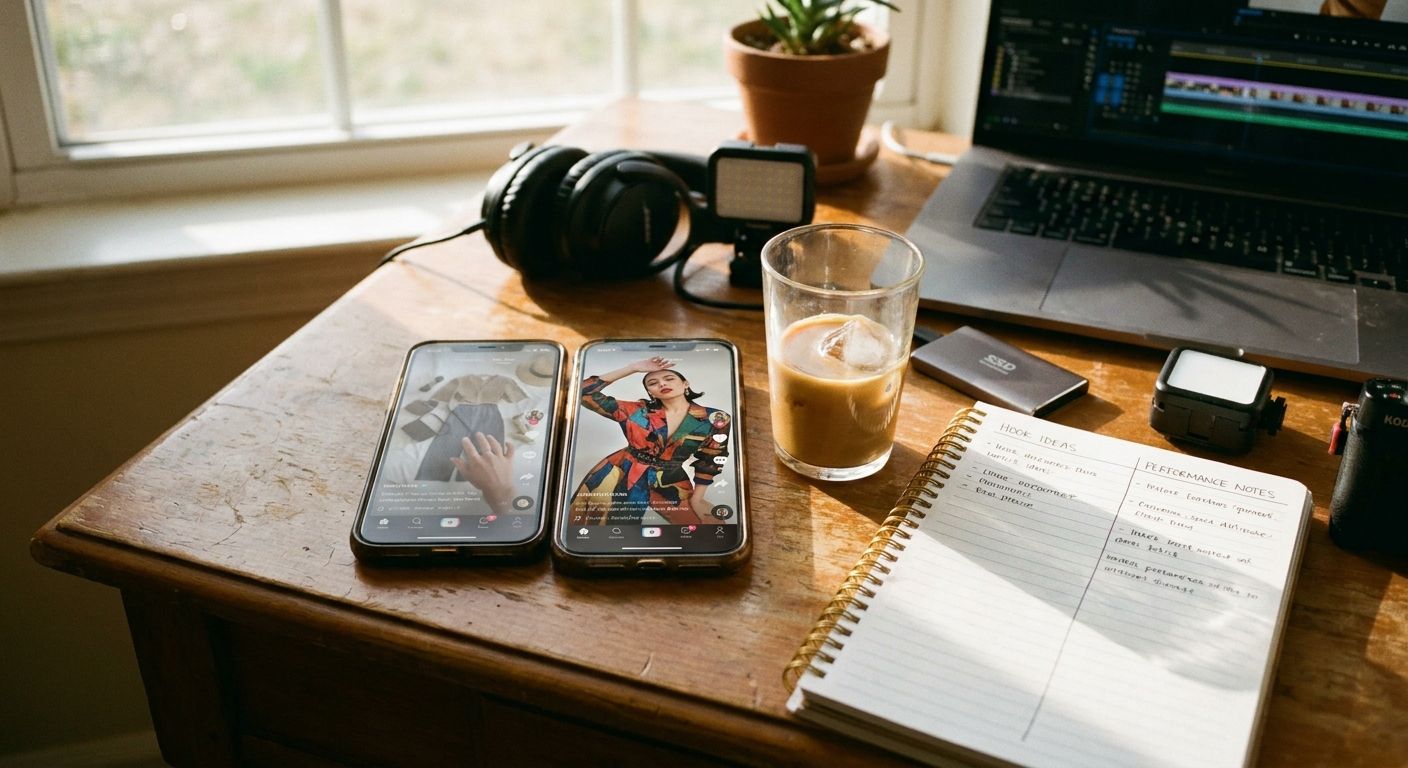
Why it works: Constraints create narrative stakes before the first outfit appears. Viewers stay to judge whether you solved the puzzle.
Fashion adaptation: Swap in budget cap, single color, one bag, thrift-only, or a weather constraint.
Loser pattern it avoids: The unconstrained haul that has no story -- just items and prices.
2. The unpopular opinion
Template: "Everyone is wearing [trend] wrong -- here's the fix."
Why it works: Contrarian framing stops the scroll the same way a comment section argument does. Viewers stay to agree or disagree.
Fashion adaptation: Works especially well for oversized silhouettes, ballet flats, or any trend that's visibly oversaturated right now.
Loser pattern it avoids: The neutral trend recap that takes no position and gives viewers nothing to react to.
3. The before/after flip
Template: Open on the "before" look (intentionally underdone), cut to the styled version in under three seconds.
Why it works: Visual transformation is the highest-retention format in fashion video because the payoff is immediate and undeniable.
Fashion adaptation: Use for capsule styling, thrift flips, or "how to make basics look expensive."
Loser pattern it avoids: Starting on the polished final look with no contrast -- there's nothing to prove.
4. The specific audience call-out
Template: "If you're [body type / lifestyle / aesthetic], this is the only formula you need."
Why it works: Specificity collapses the audience to people who feel directly spoken to, and those viewers save and share at much higher rates.
Fashion adaptation: Petite dressing, office-to-out, wide-shoulder builds, minimal wardrobe operators.
Loser pattern it avoids: "For everyone" content that resonates with nobody in particular.
5. The price contrast
Template: "This outfit looks like [high-end brand]. It cost [fraction of expected price]."
Why it works: The gap between perceived value and actual cost is inherently shareable, and it positions the creator as a sourcing expert rather than just a model.
Fashion adaptation: Lead with the polished look first, reveal the price breakdown mid-video to reward viewers who stayed.
Loser pattern it avoids: Leading with the budget, which signals "cheap" before the aesthetic lands.
6. The rule break
Template: "You're not supposed to mix [X] and [Y] -- I did it anyway."
Why it works: Styling rules are a shared cultural reference. Breaking one with visible confidence is a genuine content event.
Fashion adaptation: Pattern mixing, formal-casual hybrid, seasonal rule breaks (white in winter, etc.).
Loser pattern it avoids: The "anything goes" aesthetic post that offers no point of view.
7. The process reveal
Template: "I get dressed in [tight timeframe] -- watch how I make decisions."
Why it works: Real-time decision-making is educational and voyeuristic at once. It surfaces the creator's taste logic, which builds genuine authority over time.
Fashion adaptation: Real-time mirror moments, packing light, or packing for a specific trip or event.
Loser pattern it avoids: The curated lookbook that shows results but teaches nothing.
8. The myth bust
Template: "Stop buying [popular item]. Here's what actually does the same job better."
Why it works: It saves viewers money or frustration, so they'll forward it. The negative framing ("stop") grabs attention faster than "try this instead."
Fashion adaptation: Overhyped basics, trending accessories that don't hold up in real life, trend pieces with a better dupe.
Loser pattern it avoids: Pure recommendation content that never creates tension or earns its authority.
9. The identity mirror
Template: "How I dress when I want people to know [thing about me] without saying it."
Why it works: Framing a look as intentional communication gives viewers language to describe their own style goals, and they'll save this for reference.
Fashion adaptation: "I want to look creative but not try-hard," "I want to look expensive without looking unapproachable."
Loser pattern it avoids: The aesthetic post that looks great but carries no meaning the viewer can borrow.
10. The hyper-specific occasion
Template: "What I'm wearing to [precise situation most stylists won't address]."
Why it works: Generic occasions are over-indexed. The narrower the occasion, the fewer competitors and the more grateful the viewer. It stays discoverable via search long after posting.
Fashion adaptation: "Wedding guest at a summer barn venue," "First day at a creative agency," "Museum date where you'll be photographed a lot."
Loser pattern it avoids: The "what to wear to a wedding" post that every creator has already made.
Turn one outfit into 3-5 posts
- Source video: Film the full get-ready or styling session in one continuous take. This is your raw asset.
- Post 1 -- Before/After: Cut the plain-clothes opening and the final reveal. Hook #3.
- Post 2 -- Process reveal: Clip the decision-making moments mid-session. Hook #7.
- Post 3 -- Specific occasion: Reframe the same outfit with a hyper-specific caption ("for the creative agency interview"). Hook #10.
- Post 4 -- Identity mirror: Add a direct-to-camera line at the end of the original shoot explaining the intention. Hook #9.
- Post 5 -- Price contrast: If the cost story is strong, cut a standalone price-reveal clip. Hook #5.
An agent like GEN can monitor which of these cut patterns is driving retention across your account, surface the hook formula that's working, and generate script variations for the next batch -- so you're not manually guessing which angle to run next.
Frequently asked questions
Do these hooks work for Reels and TikTok, or just one platform?
The hook mechanics work anywhere a viewer can scroll away in under two seconds. The visual execution differs: Reels often reward slightly more polished framing, while TikTok has more tolerance for raw, real-time energy. The template logic is the same either way.
How often should I rotate these hook types?
Don't repeat the same hook format in back-to-back posts. Returning viewers will pattern-match and mentally skip the opener if it feels familiar. Run at least three different hook types per week and track which format drives the most saves -- that's your audience-specific signal.
Can I combine two hooks in one post?
Yes, and often the strongest posts do. Price contrast (#5) inside an occasion-specific frame (#10) is a natural combination. Just lead with one clear hook in the first two seconds -- opening with two tensions simultaneously dilutes both.
What if I don't want to talk on camera?
Hooks 3 (Before/After) and 7 (Process Reveal) work purely visually. Use text overlays to deliver the hook copy instead of voice. The principle -- signal payoff fast, create a gap, resolve it visually -- applies regardless of format. Direct-to-camera generally outperforms text-only for fashion because enthusiasm is visible, but solid visual storytelling beats a flat talking head every time.
The move: Pick two hooks from this list you haven't used this week, film the same outfit through both lenses, and let the retention data tell you which one your audience responds to. Gut feel is a starting point; the pattern over 10 posts is the real signal.