Top 10 Hooks to Try for Fitness Content (With Templates)

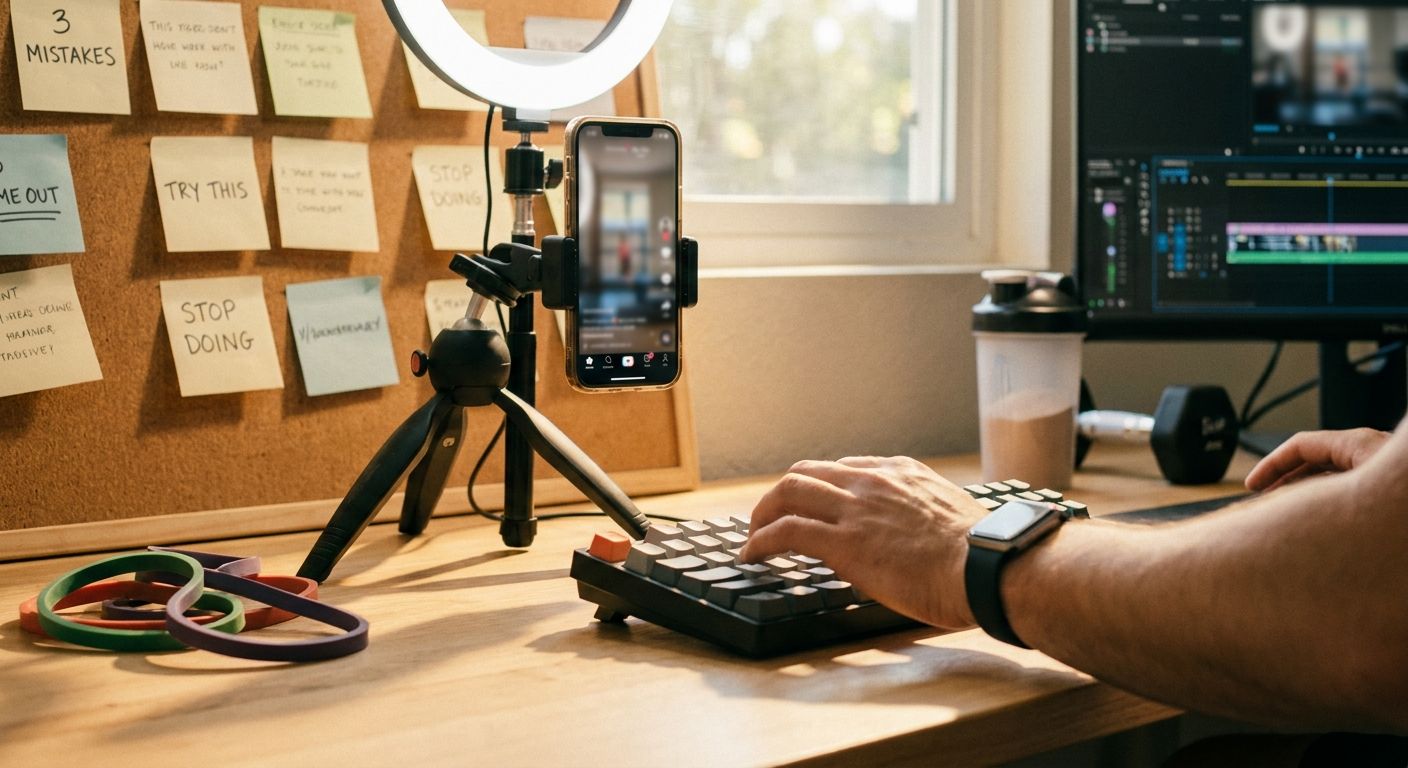
The hook is the entire bet in fitness content
Fitness feeds are saturated. A viewer decides to keep watching or scroll within the first two seconds--before your form is visible, before your transformation shows, before your expertise lands. The hook isn't the intro to your video. It is the video's survival mechanism.
Below are ten hooks that consistently drive strong watch time in fitness content, each built around a specific psychological trigger. Every template includes why it works, how to adapt it, and the weak pattern it replaces.
How a winning fitness hook works
The viewer needs to know what they'll get in the next 30-60 seconds before they commit to watching.
Introduce a contradiction, a counter-intuitive fact, or a journey mid-progress to make leaving feel costly.
Show the movement, the body, the number, or the before--something concrete that validates the hook's promise.
Give the viewer a reason to save--a checklist, a plan, a sequence they'll want to revisit later.
Winners vs. losers: the real gap in fitness hooks
- Winners surface the result or conflict in the first spoken word or on-screen text. The viewer immediately knows what they're trading their time for.
- Winners use specific language: a day number, a muscle group, a named mistake. "Day 22 of switching from lifting to bodyweight" (as seen on @tinytank__) beats "my fitness journey update."
- Winners show visible proof early--form footage, a side-by-side, direct-to-camera with genuine energy.
- Losers open with "Hey guys, so today I wanted to talk about..." before anything specific is on screen.
- Losers hide the payoff until the last 10 seconds, forcing retention they haven't earned.
- Losers lead with a generic pump-up intro that could belong to any creator on any topic.
10 hooks to try for fitness content
1. The day-count journey
Template: "Day [X] of [specific switch or challenge]."
Why it works: Serializes your content, creates accountability, and drops the viewer into something mid-progress--which is more compelling than a clean start.
Fitness adaptation: @tinytank__ used "Day 22/180 of switching from lifting heavy to mastering my own bodyweight" to signal both the transformation arc and the specific trade-off in one line.
Loser pattern avoided: The vague "my fitness journey" update with no progress marker.

2. The mistake confession
Template: "I hurt myself doing [exercise] because I ignored [specific form cue]--here's what changed."
Why it works: Vulnerability plus specificity. The viewer instantly wonders if they're making the same mistake. @mabelmei_ used exactly this pattern--acknowledging RDL form errors that led to injury--which makes the lesson land harder than any prescriptive tutorial.
Loser pattern avoided: Generic "don't make these mistakes" without owning a personal failure.
3. The contrarian claim
Template: "Stop doing [common exercise/approach]. Here's why [alternative] works better."
Why it works: Disrupts the default scroll pattern. The viewer who does that exercise feels a small threat to their routine--enough to pause.
Loser pattern avoided: "Here are my top tips for [muscle group]"--no tension, no reason to stay.
4. The specific result promise
Template: "This [time period] workout builds [specific outcome] without [common trade-off]."
Why it works: The viewer can immediately self-qualify. If the promise matches their goal, they're in.
Loser pattern avoided: Vague "great full-body workout" with no stated benefit or specificity.
5. The before-you-see-the-after
Template: Open on the "before" frame or awkward early form footage before cutting to current state.
Why it works: Visual proof of change without needing to say anything. The viewer stays to understand the gap.
Loser pattern avoided: Leading with the "after" only, which removes all narrative tension.
6. The honest admission
Template: "I'm actually laughing at myself, but [real observation about your progress or mistake]."
Why it works: Genuine self-awareness cuts through the polished fitness aesthetic. @mabelmei_ used this framing directly--it signals authenticity and makes the creator relatable without manufactured vulnerability.
Loser pattern avoided: Forced humility that still leads with a flex.
7. The protocol breakdown
Template: "Here's the exact [training/nutrition] protocol I used for [specific outcome]--step by step."
Why it works: "Exact" and "step by step" are save triggers. Viewers bookmark protocols.
Loser pattern avoided: Sharing a workout without framing it as replicable--viewers watch but don't act.
8. The common-belief flip
Template: "Everyone told me [common advice]. I did the opposite and [specific result]."
Why it works: Creates curiosity and positions you as someone who tested conventional wisdom rather than just repeated it.
Loser pattern avoided: "Controversial opinion" bait with no actual contrarian position.
9. The identity anchor
Template: "If you're a [specific person: beginner, former athlete, desk worker] trying to [goal], this is for you."
Why it works: Hyper-specific targeting makes the intended viewer feel seen and lets everyone else scroll--which is fine, because your saves and shares come from the right audience.
Loser pattern avoided: "For anyone trying to get fit"--no one feels personally addressed.
10. The process-in-progress
Template: "Watch me [verb: fix, rebuild, test, learn] [specific skill/movement] in real time."
Why it works: Learning-in-public creates a loop: the viewer watches the attempt, wants to see the outcome, and follows for the next episode. It also lowers the production bar--imperfection is the point.
Loser pattern avoided: Only posting polished results, which removes the journey viewers actually want to follow.
Workflow: one source video to 3-5 posts
- Extract the core insight. Identify the single most actionable or surprising thing your source video demonstrates--one sentence.
- Write the hook first. Choose one of the 10 templates above. Draft the opening line before you shoot anything.
- Build three angles from one shoot:
- The mistake version (Hook 2 or 6): what went wrong, what you learned
- The how-to version (Hook 7): the protocol, step by step
- The journey version (Hook 1 or 10): day count or real-time learning
- Clip, don't repost. Each cut should open on a different hook frame--same footage, different entry point and on-screen text.
- Test variations systematically. An agent like GEN can run hook variations automatically--tracking which opening line drives watch time, then feeding that signal back into the next script so you're not guessing manually each week.
Frequently asked questions
How long should a fitness hook actually be?
The spoken or on-screen hook should resolve its promise in under three seconds. That's roughly one punchy sentence or a clear visual frame. If your setup takes longer than that, the hook isn't sharp enough--cut it, don't extend it.
Should I use the same hook template repeatedly?
Rotate across at least three or four different hook types per month. Audiences habituate fast, and the algorithm rewards fresh patterns. Treat hook types as a rotation, not a formula to lock in.
Do on-screen text hooks work better than spoken ones?
The best-performing fitness hooks usually combine both: the text surfaces the claim instantly for muted viewers, and the spoken word reinforces it. Relying on text alone is a weaker pattern in fitness because the body and movement are your proof--keep the camera on them.
Can I use these hooks without showing my own body or face?
Yes, though the formats that tend to perform best in fitness--especially Hooks 2, 5, 6, and 10--rely heavily on visible proof. Faceless formats work better for protocol and how-to hooks (7 and 4) where demonstration footage or graphics carry the evidence. Know the trade-off before defaulting to faceless.
The immediate move: Take your next planned fitness post, write the hook as a standalone sentence before you film anything, and check it against the loser patterns above. If it could belong to any creator in any niche, rewrite it until it couldn't.