Top 10 Hooks to Try for Meal Prep Content (With Templates)

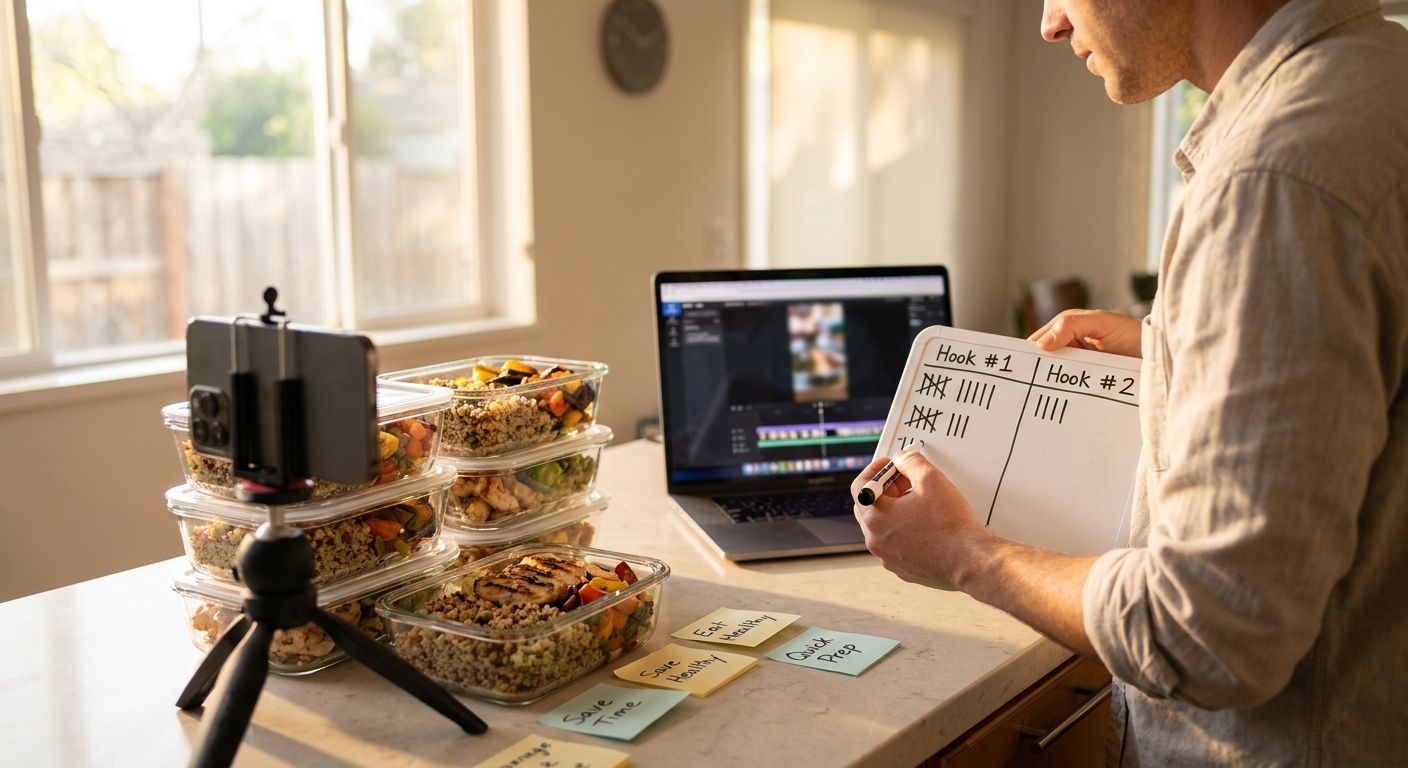
Most meal prep hooks lose the viewer in the first two seconds. Here's what wins instead.
The hook has one job: buying the next three seconds. In meal prep content, the creators gaining ground right now -- like @nutritionfromkay1 and @elnazhamai -- open on an immediate visual payoff or a bold premise, not a preamble. Generic openers ("today I'm going to show you my meal prep") are dead weight. Below are 10 hook templates you can plug in today, with the exact loser-pattern each one replaces.
Why Meal Prep Hooks Succeed or Fail
Open on the finished meals, the gadget in action, or the before/after -- never a talking-head intro.
Give the viewer a reason to stay: a surprising claim, a constraint ("only 20 minutes"), or a "you're doing it wrong" premise.
Every second of setup that delays the actual meal, process, or result bleeds watch time. Front-load the interesting part.
End with a detail worth bookmarking: the macro split, the container system, the tool name. Saves signal content-feed algorithms.
Winners vs. losers in meal prep hooks
- Winner: Opens on a visual result -- viewer knows what they're getting before they decide to stay
- Winner: States a specific constraint ("5 meals, one sheet pan, under $40") -- creates instant relevance
- Winner: Sounds genuinely excited or surprised, not scripted -- authenticity drives saves and shares
- Loser: "Hey guys, so today I'm going to walk you through my meal prep..." -- buried payoff, high skip rate
- Loser: Text-only overlay with no visible food or process -- low visual pull in a food-first niche
- Loser: Opens with a discount code or brand mention -- trust drop before value is established
- Loser: Vague premise like "healthy eating tips" -- no tension, no reason to stay
Top 10 hooks to try for meal prep
-
"I prepped [X] meals in [Y] minutes and here's exactly how"
Why it works: Time is the most universally relatable constraint. The viewer immediately benchmarks against their own Sunday prep time.
Adapt it: Be specific -- "7 lunches in 35 minutes" beats "a week of meals fast".
Loser-pattern avoided: Vague time claims ("quick and easy") that no longer register.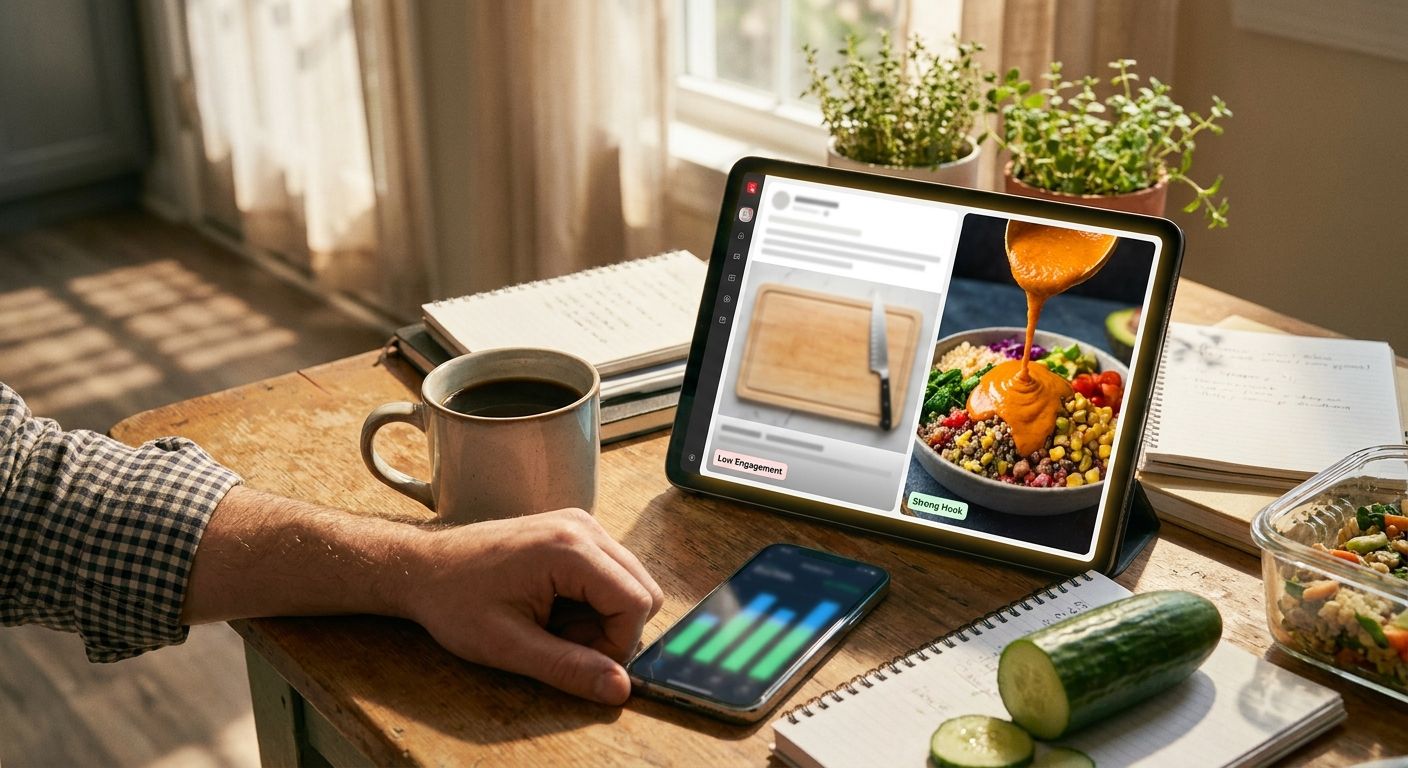
-
"I didn't know you could do this with [common ingredient/tool]"
Why it works: Curiosity gap plus the surprise of an everyday item doing something unexpected. @ohitsbigrick used this frame around a Costco find and it drove strong share numbers organically.
Adapt it: Works best with a gadget close-up or a pantry staple repurposed (e.g., using a burger patty press for uniform portions).
Loser-pattern avoided: Generic product showcase with no element of surprise. -
"A full week of [diet/goal] meals that don't suck"
Why it works: Directly addresses the most common complaint about healthy meal prep -- that it's boring. The casual language reads as genuine. @nutritionfromkay1 built a strong save rate on exactly this framing.
Adapt it: Swap in "high-protein," "under 500 calories," or "budget" for the diet/goal slot.
Loser-pattern avoided: Aspirational framing ("healthy living!") that reads as performative. -
"Stop prepping [common thing] -- do this instead"
Why it works: Contrarian premise forces a pause. The viewer needs to know if they're doing something wrong.
Adapt it: "Stop storing salads in zip bags -- do this instead" or "Stop meal prepping rice dry -- do this instead."
Loser-pattern avoided: Additive advice hooks ("here's another tip") with no stakes. -
"Here's what I actually eat in a week (honest version)"
Why it works: "Honest" and "actually" are trust signals. They imply the creator is cutting through the polished, performative version of meal prep.
Adapt it: Pair with unfiltered kitchen footage -- not a styled flat lay.
Loser-pattern avoided: Over-produced, aspirational meal prep content that triggers "I could never do this" disengagement. -
"This one tool changed my entire meal prep routine"
Why it works: Single-object focus is easy to follow and works with tight close-up visuals. Creates desire and urgency to see the reveal.
Adapt it: Lead with the tool in use, not the unboxing. @elnazhamai's burger patty maker post shows this -- the action shot does more work than any verbal intro.
Loser-pattern avoided: Multi-tool roundups where no single item gets enough screen time to register. -
"[Number] containers, [number] days, [budget] -- let's go"
Why it works: Three concrete constraints in one sentence. Viewers with specific meal prep goals (budget, container count, days of coverage) self-select in immediately.
Adapt it: Keep the budget real and modest -- $50 lands better than $30 if $30 isn't realistic for your market.
Loser-pattern avoided: Open-ended haul content with no defined outcome. -
"POV: you finally figured out Sunday meal prep"
Why it works: POV framing puts the viewer in the scenario rather than watching from outside. "Finally" implies a journey the viewer relates to.
Adapt it: Works best with first-person camera angles -- countertop POV, fridge stacking close-up.
Loser-pattern avoided: Third-person tutorial format that keeps emotional distance. -
"My [macro/goal] meal prep for the week -- [specific number]g protein total"
Why it works: Specific macro targets act as a filter -- high-protein and body-recomposition audiences stop scrolling for numbers that match their goal.
Adapt it: Lead with the number in bold on-screen text, not just spoken. Viewers scan before they listen.
Loser-pattern avoided: Generic "healthy meals" framing that appeals to no one in particular. -
"The meal prep mistake I kept making (and how I fixed it)"
Why it works: Failure-then-fix arc is one of the most durable story structures in short-form. It makes the creator relatable and the solution feel earned.
Adapt it: Be genuinely specific about the mistake ("I kept prepping chicken breast dry because I stored it wrong").
Loser-pattern avoided: Tip-list format with no narrative tension or personal stake.
Workflow: one source video -> 5 original posts
- Capture the core footage -- film your full prep session uninterrupted. One continuous source is easier to repurpose than fragmented clips.
- Extract the hook moment -- identify the 2-3 most visually interesting seconds (the reveal, the gadget in action, the finished containers). That's post #1: a quick "result first" cut.
- Pull one technique or tool -- isolate a single step that's non-obvious. Apply hook #2 or #6 from above. That's post #2.
- Reframe for a different constraint -- take the same footage and rewrite the hook around budget (hook #7) or macros (hook #9). Same video, different audience entry point. Posts #3 and #4.
- Add the honest commentary layer -- record a direct-to-camera reaction or voiceover over the footage using hook #5. That's post #5.
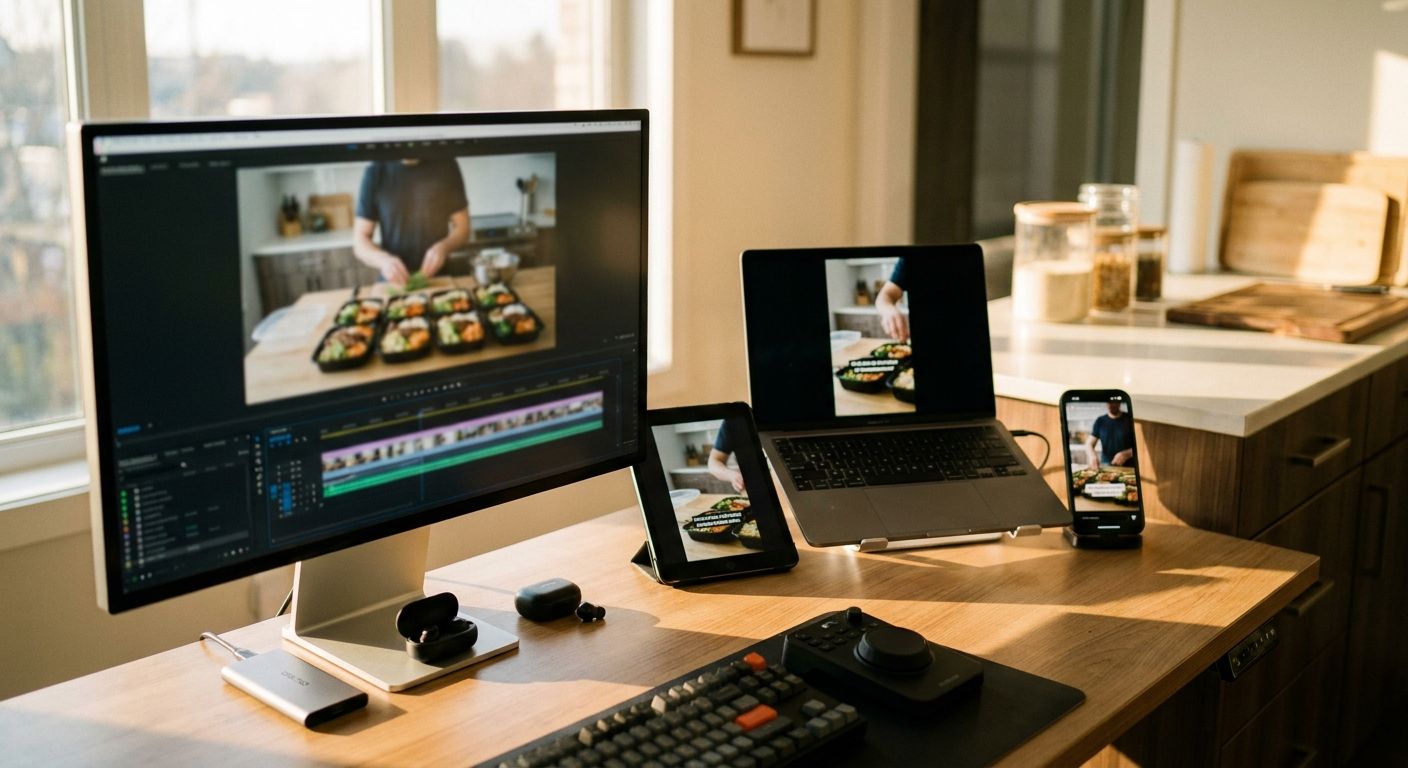
An agent like GEN can watch which of these five variants gets the strongest early engagement signal and automatically surface the next hook variation to test, instead of you manually tracking which frame outperformed which.
Frequently asked questions
How long should a meal prep hook actually be?
Under three seconds for the verbal or text hook; under one second for the visual one. If the viewer hasn't gotten a clear signal about what they're watching by second two, the skip decision is already made. Compress the hook and the first visual frame into the same moment when you can.
Should I film direct-to-camera or show the food?
Show the food (or the process) first. In a sensory niche like meal prep, the visual does more work than the verbal hook. Direct-to-camera works as a layer on top -- reaction, commentary, voiceover -- not as the opening shot.
How often should I rotate hooks?
Test a new hook pattern every 4-6 posts rather than running the same frame indefinitely. Hook fatigue is real for regular viewers. Rotating between the constraint frame (#7), the contrarian frame (#4), and the honest frame (#5) keeps your content feeling fresh without requiring a format overhaul.
What's the biggest signal that a hook failed?
Watch time drop-off in the first two seconds and a low save-to-view ratio. Saves indicate the viewer found it useful enough to return to; a high view count with minimal saves means the hook pulled curiosity but the content didn't deliver. Fix the premise-to-delivery match before testing another hook variation.
The single most useful thing you can do this week: take your last three posts, write down the first line of each one, and ask whether a stranger would know what they're about to get. If the answer is "not really" -- start there. Pick one hook from the list above, apply it to footage you already have, and ship it.