Top 10 Hooks to Try for Nails Content (and Why They Work)
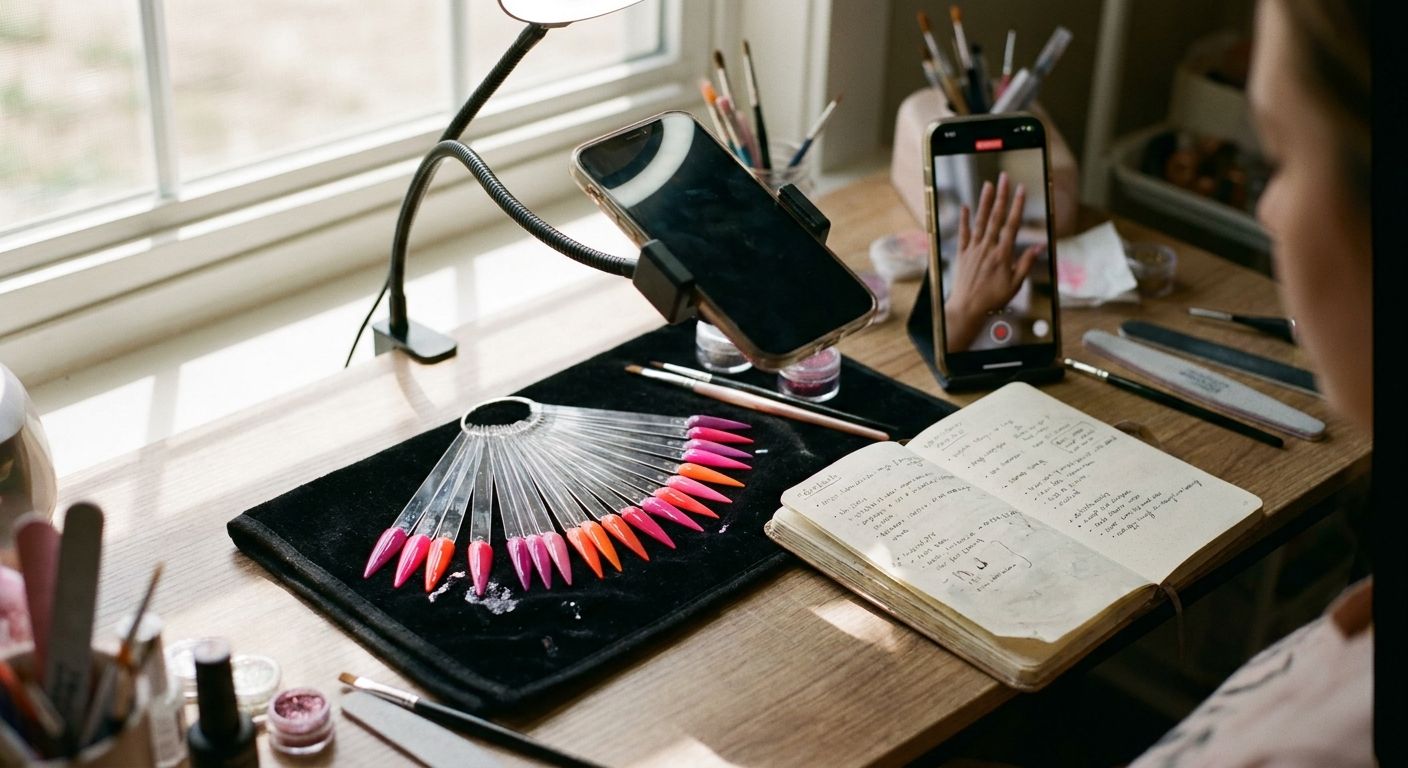
Most nail content dies in the first two seconds. Here's how to fix that.
The nail niche is visually saturated. A great set is table stakes -- the hook is the actual lever. If your opening frame doesn't create immediate tension, curiosity, or a visual payoff promise, the algorithm never gets a chance to work for you. These 10 hook templates are built specifically for nail content: tested against what's working, not recycled from generic creator advice.
How a strong hook compounds into reach
Creates tension, curiosity, or a visual promise -- forces the algorithm to keep serving the video while the viewer decides whether to scroll.
The process or reveal earns the time -- tight close-ups, visible transformation, or satisfying technique keep the finger off the scroll.
Saves signal intent-to-replicate -- the nail niche's strongest quality signal. Hooks that promise a result viewers can recreate drive disproportionate saves.
High saves + replays push the video to a second wave of distribution -- the hook is now doing double duty across new audiences.
Winners vs. losers in nail content hooks
- Winner: Opens on the finished nails or the most dramatic process moment -- the payoff is implied before the work is shown, which drives saves and rewatches
- Winner: Creates a "will it work?" or "wait, what happened?" loop in the first line -- viewers stay to resolve the tension
- Winner: Sounds like a real person talking, not a caption read aloud -- genuine enthusiasm breaks through a sea of monotone voiceovers
- Loser: Opens with "Hi guys, today I'm going to show you..." -- zero stakes, immediate scroll
- Loser: Leads with the brand name or discount code -- reads as an ad, not content
- Loser: Hides the finished look until the end with no promise of what's coming -- viewers leave before the reveal
- Loser: Text-only hook over a static thumbnail with no motion in the first 1-2 frames
Creators like @velora._.artistry (West Sydney nail tech) consistently lead with a named design concept -- "Tiger X Lotus" -- which front-loads curiosity and signals craft before a single second of footage plays. That naming pattern is a hook in itself.
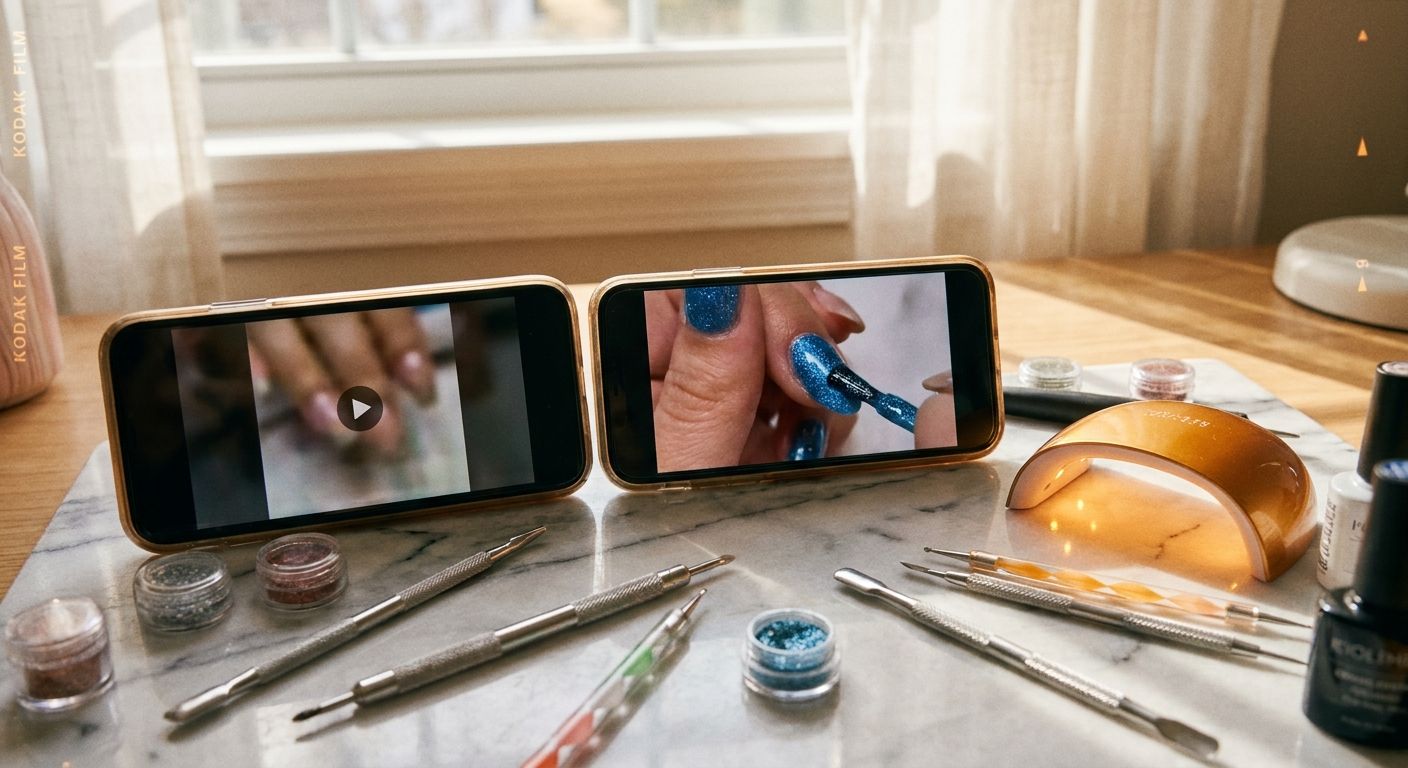
The top 10 hooks to try for nails
1. "Any guesses what I'm doing here?"
Template: Open on a confusing or mid-process close-up, say or caption: "Any guesses??"
Why it works: The brain wants to resolve ambiguity, so viewers stick around. @serenaneel used exactly this pattern on a DIY gel nails video that drove strong saves and shares.
Nail adaptation: Film the moment before the satisfying part -- a glob of gel, an odd colour combo, or a half-built nail extension.
Loser pattern avoided: The straight process video that starts with prepped nails and shows nothing strange.
2. "I tried [technique] so you don't have to"
Template: "I tried [method/tool/brand] so you don't have to -- here's what actually happened."
Why it works: Positions the creator as a filter and makes failure entertaining -- viewers stay for the verdict.
Nail adaptation: Apply it to a hyped nail product, a viral nail shape, or a DIY-gone-wrong moment.
Loser pattern avoided: Generic "product review" with no stakes or outcome promise.
3. The unexpected combo reveal
Template: "[Colour A] + [Colour B] = not what you'd expect." Name the pairing in the first frame.
Why it works: Viewers need to see if the prediction holds. @velora._.artistry's named design concepts (Tiger X Lotus) run on this premise.
Nail adaptation: Pair two seemingly clashing gel shades or aesthetics and let the reveal do the work.
Loser pattern avoided: Opening with a finished, already-beautiful nail set -- no tension left to resolve.
4. The mistake confession
Template: "I messed up my gel nails at home -- here's how I fixed it."
Why it works: Mistakes are relatable and searchable. The viewer self-inserts immediately.
Nail adaptation: Lifting, bubbling, over-filing, wrong cure time -- pick the most common DIY failure point.
Loser pattern avoided: Tutorial that only shows perfect technique and ignores the failure modes most viewers experience.
5. "Wait until the end" process tease
Template: Flash the final result in the first second, then cut to the raw starting point. "I can't believe this is the same nail."
Why it works: Showing the payoff upfront makes the process feel intentional. Saves spike when viewers can see the result is achievable.
Nail adaptation: Bare/damaged nail to intricate finished set. One second of the final product is enough.
Loser pattern avoided: Linear tutorial with the best shot buried at the end.
6. The strong opinion opener
Template: "Unpopular opinion: [common nail advice] is actually wrong."
Why it works: Disagreement drives retention and reply comments, and signals expertise at the same time.
Nail adaptation: Target advice that's widespread in the community -- shape trends, prep steps, cure time myths.
Loser pattern avoided: Neutral "here's how to do X" with no point of view.
7. The specific niche call-out
Template: "If you have [short nails / wide nail beds / bitten nails], this is for you."
Why it works: Hyper-targeted openers stop the scroll for exactly the right viewer. Watch time and saves both lift because the content feels made for them.
Nail adaptation: Nail shape, length, bed width, skin tone for shade matching -- any specific attribute works.
Loser pattern avoided: "This works for everyone!" -- which means it's optimised for no one.
8. The speed challenge frame
Template: "Full set in [X minutes] -- no extensions, no salon." Then deliver on the clock.
Why it works: Constraint plus specificity plus scepticism creates a built-in watch loop. Viewers stay to verify the claim.
Nail adaptation: Time-lapse with a visible timer, or a real-time challenge with commentary.
Loser pattern avoided: Slow, unanchored tutorial with no urgency or payoff promise.
9. The "things I wish I knew" retrospective
Template: "Three things I wish someone told me before I started doing my nails at home."
Why it works: Viewers bookmark these as reference. The format signals a knowledge gap they can close.
Nail adaptation: Prep mistakes, product order, cure distance, file direction -- pick the genuinely non-obvious ones.
Loser pattern avoided: Basic tips list with no first-hand framing.
10. The client reaction hook
Template: "She wanted [X]. I gave her [Y]. Here's her reaction." Or: "Client asked for something 'simple.'"
Why it works: Social proof plus narrative tension. The ambiguity of "simple" is its own hook, and salon creators build trust and aspirational pull at the same time.
Nail adaptation: Use real client brief language -- the gap between expectation and result is the story.
Loser pattern avoided: Before/after with no narrative -- just two images and a watermark.
Workflow: one source video to 3-5 posts
- Film one full nail process -- from bare nail to finished set, tight close-ups throughout, no skipping prep.
- Extract the mistake moment -- Hook #4 (mistake confession) or Hook #1 (any guesses?). This is usually a mid-process clip most creators discard.
- Cut a 3-second reveal flash -- Hook #5 (wait until the end tease). Use this as the Reel/Short cover frame.
- Pull the verbal commentary -- Rewrite as Hook #9 (things I wish I knew). Turn your live narration into a listicle-style script with no additional filming.
- Isolate one technique step -- Hook #8 (speed challenge). Clip the trickiest 60-second section, add a timer overlay, and publish standalone.
An agent like GEN can track pattern performance across all five variants -- which hook drove saves vs. shares vs. comments -- and generate the next round of hook variations from the data, without you manually reviewing analytics each week.
Frequently asked questions
Do nail hooks work differently on TikTok vs. Instagram?
The core tension mechanics are the same, but the delivery differs. TikTok rewards spoken/audio hooks in the first two seconds; Instagram Reels leans more on the cover frame and first visual. Run the same hook concept with a spoken version for TikTok and a strong close-up cover frame for Reels, rather than recutting entirely.
How often should I rotate hook types?
If one hook pattern is consistently driving saves, don't abandon it -- run it with new content. The mistake is dropping a working format because you're bored of it. Rotate when the watch-time signal drops, not on a fixed schedule.
Should I put the hook text on screen or say it?
Both. A significant share of viewers watch without sound, so captions cover them. But spoken hooks add authenticity and emotion that text alone can't. Lead with motion and text, then reinforce with voice.
What's the single fastest fix for a nail account that's stalled?
Audit your last 10 posts and look at the first frame of each. If they all look the same -- finished nails, studio angle, no tension -- you've found the problem. Introduce one "any guesses?" or mistake-confession hook this week and compare saves directly. One variable, one week.
The practical takeaway: Pick two hooks from this list that you've never tried, film the same process twice with different openers, and let the save rate tell you which one your specific audience rewards. That's a faster feedback loop than any strategy document.