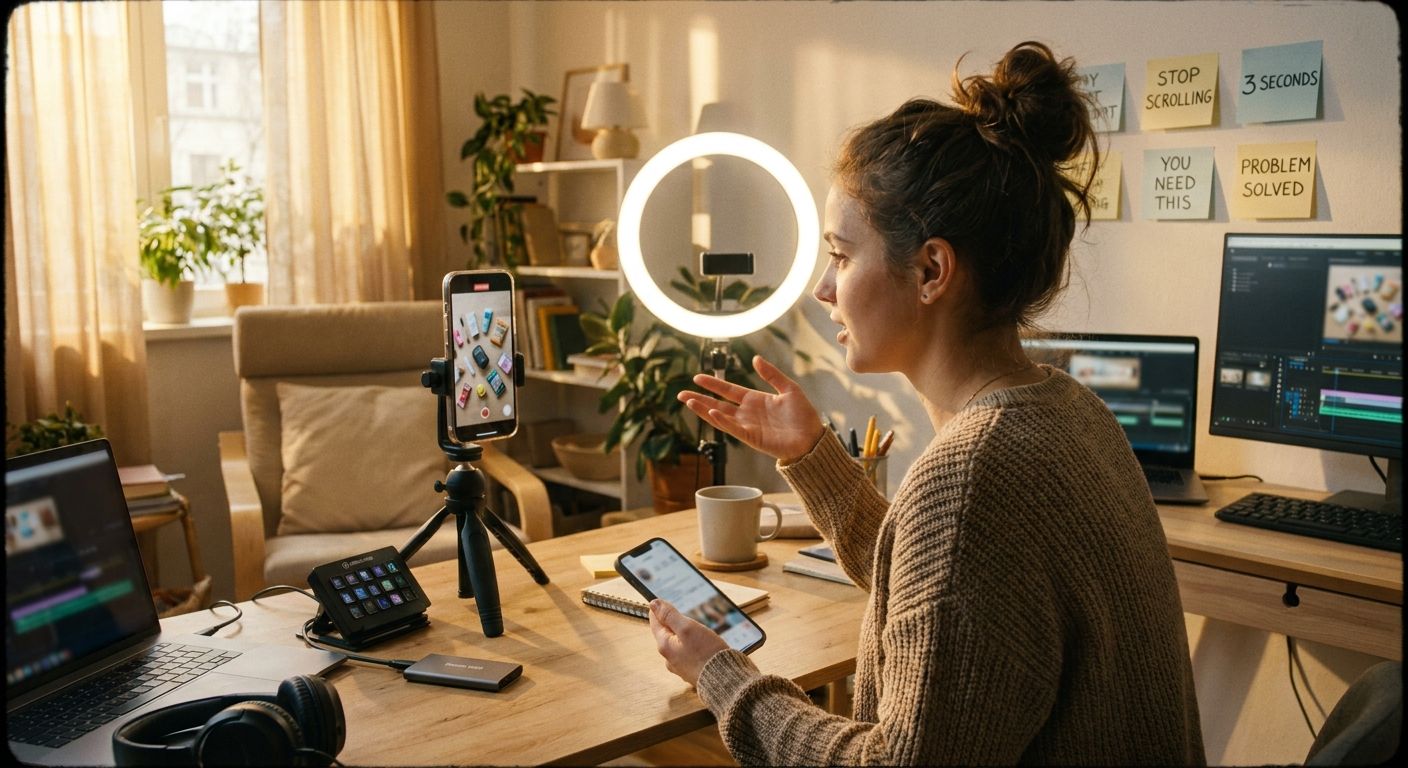
Top 10 Hooks to Try for Nutrition Content (With Templates)


Your nutrition content isn't underperforming because of hashtags or length — it's the first three seconds
Most nutrition creators lose the viewer before the value lands. The fix isn't a longer caption or a trending sound — it's a hook that makes the payoff obvious before the viewer has decided to stay. Below are ten hook templates that work specifically in the nutrition niche, why each one works mechanically, and the weak pattern each one replaces.
How a strong hook compounds account performance
First frame tells the viewer exactly what they'll gain — a number, a result, a myth bust — before they swipe.
Content matches what the hook set up — specific, visual, no filler — so completion rate stays high.
Practical, structured nutrition content gets saved — the highest-trust signal the algorithm reads.
Hook A vs Hook B on the same body copy — an agent like GEN can spot which opening pattern consistently drives saves and auto-generate the next batch.
Winners vs. losers in nutrition hooks
- Winner: opens with a specific, tangible result ("I dropped a jeans size eating more, not less") so the viewer immediately maps it to themselves
- Winner: shows the food, the plate, the label, or the body on screen rather than describing it
- Winner: uses a numbered or structured premise so the viewer knows exactly what they're getting
- Loser: generic wellness intro ("Hey guys, today I want to talk about nutrition...") — zero reason to stay
- Loser: leads with the disclaimer or backstory before the payoff
- Loser: uses a CTA or discount as the hook — reach is not conversion, and a transactional open repels organic viewers
- Loser: text-only or green-screen with no visible food or process — fine occasionally, weak as a default
10 hook templates for nutrition creators
-
"I lost/gained [result] doing [counterintuitive thing]"
Why it works: Result-first plus contradiction stops the scroll. @leila_layzell's 54321 method post led with the outcome (40 lbs) before explaining the system, which drove outsized saves.
Niche adaptation: "I gained energy eating twice as many carbs." Show the food on camera immediately.
Loser pattern avoided: Opening with your credentials or backstory before the result. -
"The [number] things I eat every single day"
Why it works: Numbered lists create a completion loop — viewers stay to hear all items. The 54321 framework from @leila_layzell is a clear example of this structure driving high saves.
Niche adaptation: Film yourself pulling each item from a fridge or grocery bag. Tactile and visual beats a graphic.
Loser pattern avoided: A vague "what I eat in a day" title with no number — no built-in reason to finish watching. -
"People think [common belief] — here's what actually changed everything"
Why it works: It surfaces a shared assumption, then promises to correct it. @margaret3190 uses this structure ("People think staying healthy after 60 has to be difficult") to hook an audience that feels personally addressed.
Niche adaptation: Target a specific segment: "People think eating enough protein as a vegetarian is impossible..."
Loser pattern avoided: "A lot of people don't know that..." — too passive and overused. -
"My [specific role] non-negotiables — no, this isn't what you think"
Why it works: Identity-specific hooks ("as a nurse," "as a mom of three," "as someone over 50") make the content feel targeted rather than generic. The pattern-interrupt "no, this isn't what you think" earns the watch.
Niche adaptation: Be specific about the constraint: "My non-negotiables eating on a $60/week grocery budget."
Loser pattern avoided: Generic "healthy habits" framing with no audience anchoring. -
"Watch me build a full week of meals from [single system or method]"
Why it works: "Watch me" signals process content, which satisfies both curiosity and utility. Structured methods (a ratio, a colour-plate rule, a macro framework) are more shareable than random meal ideas.
Niche adaptation: Show the actual prep, not just the finished plate. Tight close-ups of portioning outperform styled food photography.
Loser pattern avoided: Listing meal ideas as text on screen without any visible process. -
"I gave my kids [specific nutrition swap] for [time period] — here's what happened"
Why it works: Parent-audience nutrition content gets saved because the stakes feel personal. @mads86992's post about optimising kids' nutrition performed well precisely because the premise is specific to a role and outcome.
Niche adaptation: Lead with the specific swap ("swapped white rice for lentils in their favourite dishes"), not the intention.
Loser pattern avoided: "Healthy meal ideas for kids" — too broad, no tension, no reason to finish watching. -
"Stop [common nutrition habit]. Do this instead."
Why it works: A direct command triggers mild defensiveness — viewers stick around to find out if they're doing the wrong thing. "Do this instead" promises an immediate fix.
Niche adaptation: Pair the command with on-screen visual contrast: show the habit, then the replacement.
Loser pattern avoided: Framing the same insight as "here are some tips to improve your diet" — no urgency, no stakes. -
"Dietitians won't tell you this about [food/habit]"
Why it works: Authority tension. Works when the information genuinely surprises — don't use it for basic advice or you'll erode trust fast.
Niche adaptation: Keep the claim honest and specific: not "dietitians are lying," but "most dietitian content skips over how [X] actually behaves in the body at night."
Loser pattern avoided: Vague anti-establishment framing that doesn't deliver a real insight in the body of the video. -
"Grocery haul -> [specific outcome] — full breakdown"
Why it works: Grocery hauls are visually concrete and replicable. Naming the outcome in the hook ("5 high-protein lunches under £3 each") turns a passive watch into an active save.
Niche adaptation: Show price tags, quantities, and the meals they become. The shop-to-plate arc drives completion.
Loser pattern avoided: A haul video with no stated goal — just a shopping trip, not a system. -
"[Time period] of eating [method/principle] — honest update"
Why it works: Time-bound experiment framing reads as lived experience, not theory. "Honest update" signals the creator will acknowledge what didn't work, which draws comments and saves from sceptical viewers.
Niche adaptation: Be specific about what you measured: energy, digestion, body composition, mood — not just weight.
Loser pattern avoided: "My experience with [diet]" — vague, no time pressure, no honesty signal.
One source idea -> 3-5 posts: a repeatable workflow
- Pick a core insight — e.g. "eating more protein at breakfast reduces afternoon cravings." This is your source material.
- Hook 1 (result-led): "I stopped snacking at 3pm after one breakfast change — here's what I added." Direct camera, show the food.
- Hook 2 (numbered list): "3 high-protein breakfasts I make in under 10 minutes." Film the prep in real time.
- Hook 3 (myth-bust): "People think high-protein breakfasts mean eggs every day — here's what I actually eat." Grocery haul or fridge reveal.
- Hook 4 (time-bound experiment): "30 days of high-protein breakfasts — honest results." Direct camera, acknowledge the tradeoffs.
- Hook 5 (audience-specific): "My non-negotiable breakfast as someone who can't stomach food before 9am." Identity-anchor version of the same insight.
An agent like GEN can take that single insight, generate all five hook variants, schedule them across platforms, and flag which opening pattern is pulling the highest watch-time — so you're not guessing which hook to run next week.


Frequently asked questions
How long should a nutrition hook be?
Under three seconds on video; one sentence in a caption. The hook's job is to create a reason to stay — every word past that goal is friction. If you need two sentences to set up, you haven't found the sharp version of the hook yet.
Do these hooks work for both short-form video and static posts?
Yes, with one adaptation: static posts front-load the hook in the first line of the caption (before "more") and in the image or first slide. The result-led and numbered-list hooks tend to travel best across formats because they work visually and textually.
Should I use the same hook twice on the same audience?
Not the identical wording, but the same pattern repeatedly is fine — and often smart. If your audience responds to myth-bust hooks, running that pattern consistently trains the algorithm and sets audience expectations. Variation inside a pattern (different topic, same structure) beats switching patterns randomly.
How does GEN help with hook testing at scale?
GEN watches which hook patterns are driving saves and shares on your account, generates script variants against those patterns, and publishes them autonomously — so the feedback loop runs without you managing a spreadsheet.
The single most useful thing you can do today: take your best-performing nutrition post, identify which hook pattern it used, and write your next five posts using that same pattern structure with different topics. Pattern consistency compounds faster than format or hashtag experimentation.