Top 10 Hooks to Try for Running Content (With Templates)

Most running content dies in the first two seconds. Here's how to fix that.
The scroll decision happens before your viewer registers your face, your form, or your credentials. Running creators who grow fast share one thing: their first line does real work -- it names a pain, makes a promise, or breaks an assumption the viewer already holds. The ten hook templates below come from patterns that consistently surface in high-performing running content. Each one is ready to adapt, test, and rotate.
From raw idea to a hook that holds attention
Bad form, mental blocks, gear confusion, plateau -- pick one concrete problem your audience actually searches for.
Mistake hooks fit form/training errors. Contrast hooks fit gear and method debates. Challenge hooks fit mental toughness content.
Vary the opening word, the specificity level, and whether the hook is a statement or a question. Ship the clearest one first.
Save rate and share rate tell you if the hook delivered on its promise. A high save with low watch time means the hook over-promised.
Winners vs. losers in running content hooks
- Winner: Names a specific running problem in the first breath ("Your cadence is the reason your knees hurt")
- Winner: Shows the result or the process visually before explaining it
- Winner: Uses numbered lists to signal structure -- @marsha_du_ and @bellakatherinee both lean on this pattern with strong save-rate results
- Loser: Opens with "Hey guys, today I'm going to talk about..." -- zero compression, no reason to stay
- Loser: Buries the payoff behind a long personal anecdote the viewer didn't ask for
- Loser: Generic motivation ("running changed my life") with no concrete mechanism
- Loser: Relies on hashtag volume or video length to do the hook's job
Top 10 hooks to try for running content
-
"[X] drills that will fix your running form -- most runners skip all of them"
Why it works: Combines a numbered promise with a guilt trigger. Viewers assume they're in the majority doing it wrong.
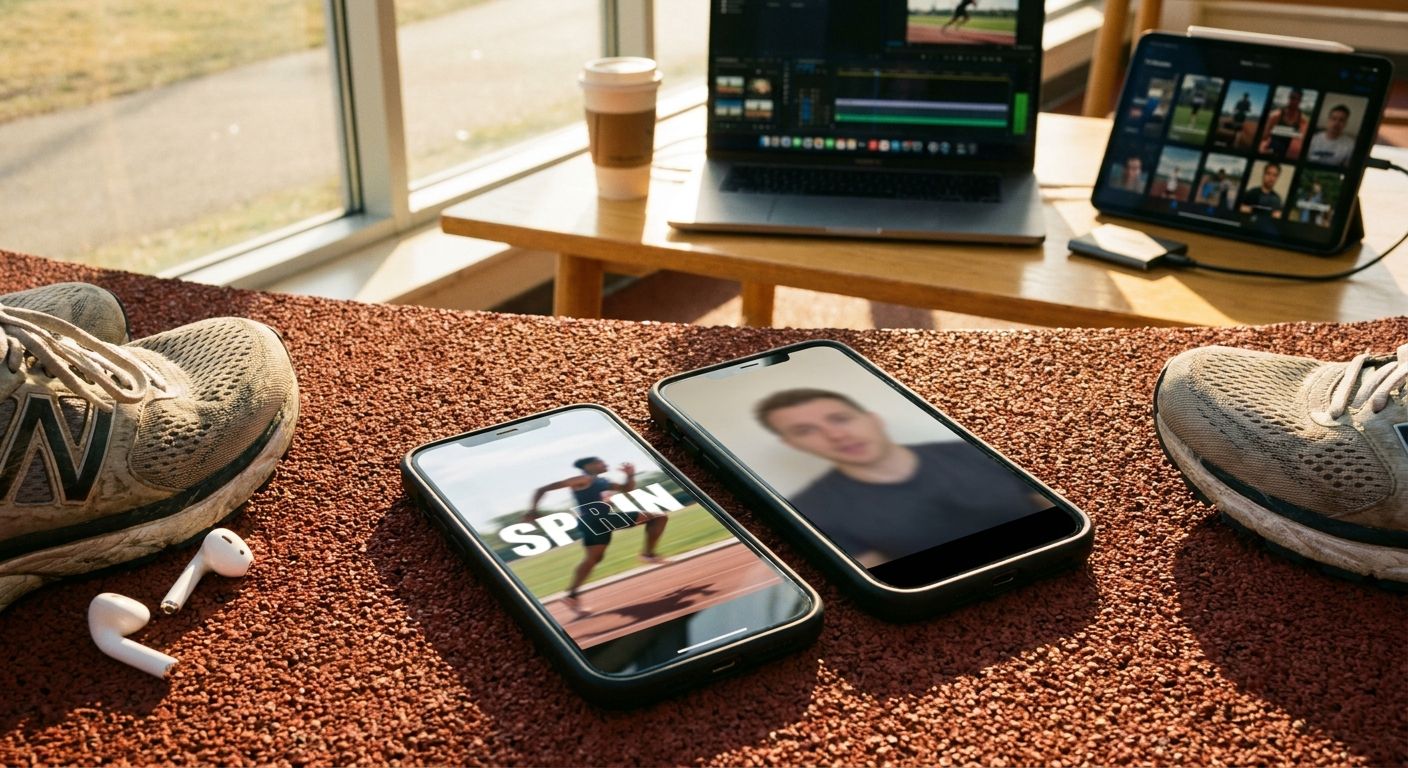
Adapt it: Sub in your specific drill -- A-skips, pogo jumps, straight-leg bounce. @marsha_du_ uses this structure and pulls a high save-to-view ratio because runners bookmark drills to revisit later.
Loser pattern avoided: "Here are some exercises" -- no stakes, no reason to watch past second three.
-
"Stop thinking about the total distance. Do this instead."
Why it works: Opens with an instruction that contradicts common behavior. The viewer is already doing the wrong thing -- now they need the fix.
Adapt it: Works for mental-game content. @bellakatherinee's landmark-chunking framework uses this premise -- breaking miles into "just get to that tree" chunks -- and earns disproportionate saves for its length.
Loser pattern avoided: "Running is mental, here's why" -- states the obvious instead of delivering the mechanism.
-
"The reason you slow down at mile [X] isn't fitness -- it's this."
Why it works: Reframes a common failure moment as a solvable problem with a non-obvious cause. Runners who hit a wall at a specific point feel directly addressed.
Adapt it: Fill in a specific mile marker your audience actually hits -- mile 2 for beginners, mile 18 for marathon runners. Name the real mechanism: breathing pattern, pace strategy, arm tension.
Loser pattern avoided: "How to run faster" -- too broad, no emotional specificity.
-
"I ran [X] days in a row. Here's the one thing I'd change."
Why it works: Personal experiment format with a built-in lesson. The number makes it feel earned; the "one thing" creates curiosity compression.
Adapt it: Works best as a direct-to-camera delivery with B-roll of the actual runs. Vague streaks feel like bragging; specific streaks feel like data.
Loser pattern avoided: "My running journey" -- no payoff promise, no reason to watch past the opener.
-
"Your running shoes are costing you time -- here's the fit mistake most people make."
Why it works: Gear content with a cost-framing hook. It implies the viewer is already losing something, which lands harder than a straight tips frame.
Adapt it: Works for shoe reviews, insole content, sock friction, lacing technique. Show the close-up of the shoe problem before explaining it -- visual proof before verbal payoff.
Loser pattern avoided: "My favorite running shoes" -- viewer benefit unclear, sounds like an ad.
-
"[X] things runners do that actually slow them down"
Why it works: Counter-intuitive list hooks outperform straight tips lists because they trigger mild defensiveness -- viewers want to know if they're guilty.
Adapt it: Keep each item specific and actionable: overstriding, checking pace every 30 seconds, running too fast on easy days. One item per cut keeps pacing tight.
Loser pattern avoided: "Tips to run faster" -- additive frame, no pattern interruption.
-
"Nobody tells beginner runners this -- and it's why most quit."
Why it works: Information-gap hook with implied insider status. "Nobody" positions the creator as a bridge between expert knowledge and the viewer's blind spot.
Adapt it: Commit to a genuinely non-obvious insight: that easy runs should feel embarrassingly slow, that breathing through the mouth is fine, that shin splints are a load management problem not a shoe problem.
Loser pattern avoided: "Tips for new runners" -- sounds like a beginner article, not a revelation.
-
"Watch my foot strike. Now watch it after [X] weeks of this drill."
Why it works: Before/after framing with a visual proof mechanism. Running is a movement sport -- showing the change is more compelling than describing it.
Adapt it: Use slow-motion side-by-side if you can. Works for cadence, posture, arm swing, heel-striking correction. The viewer should be able to spot the difference without your narration.
Loser pattern avoided: Talking-head explanation of form with no visual demonstration -- the highest-friction format for a movement topic.
-
"The 5-second trick that makes any hard run feel easier"
Why it works: "5 seconds" makes the promise feel achievable without diluting the payoff. Runners are always looking for cognitive shortcuts during discomfort.
Adapt it: Best for breathwork cues, mental reframes, or pacing micro-adjustments. The trick must be genuinely simple -- if it takes 30 seconds to explain, reframe the hook.
Loser pattern avoided: "How to push through the pain" -- generic, no mechanism, no time compression.
-
"POV: you finally understand why your easy runs should feel this slow"
Why it works: POV hooks create viewer-perspective immersion and frame the content as a realization rather than a lecture. Works well with polarizing but correct advice.
Adapt it: Strongest for content that contradicts popular behavior -- Zone 2 pacing, run/walk intervals, skipping speed work in base-building. The viewer needs to feel like the insight is landing in real time.
Loser pattern avoided: "Why you should run slower" -- declarative but cold, no viewer placement in the story.
One source video to 3-5 posts: a quick workflow
- Identify the core mechanism: Strip your source video to its single most useful idea (e.g., "landmark chunking beats pace-watching for mental endurance").
- Post 1 -- The mistake hook: "Stop checking your pace every 30 seconds -- here's what to do instead." Direct-to-camera, 30-45 seconds.
- Post 2 -- The numbered list: "5 mental tricks that make long runs feel shorter." Each point is one item from your original framework, delivered fast.
- Post 3 -- The POV reframe: "POV: you just discovered landmark running and your next long run will never feel the same." More narrative, same underlying advice.
- Post 4 -- The before/after: Film yourself applying the technique mid-run. Voiceover explains the shift. Visual proof carries the hook.
- Post 5 -- The comment reply: Pull a real comment from Post 1 asking "but what if I don't have landmarks?" and answer it as a new post. Community hooks perform well because they signal real engagement.
An agent like GEN can scan which hook framing from that batch earned the highest saves-per-view, then auto-generate the next round of variations weighted toward that pattern -- without you manually tracking it across posts.

Frequently asked questions
Should I use a question or a statement as my hook?
Statements with implied consequences ("Your cadence is costing you pace") tend to outperform open questions ("Do you know your cadence?") because they assume the viewer has the problem rather than asking them to self-diagnose. Use questions only when the answer is genuinely surprising.
How often should I rotate hook styles?
If you post daily, rotating through three or four distinct hook types per week prevents pattern fatigue -- regular viewers start to recognize your opening formula and tune it out. Treat your hook library like a playlist: cycle it, don't repeat the same opener back-to-back.
Does the hook need to match the thumbnail?
For short-form, the first spoken or on-screen text matters more than the thumbnail for watch time. For YouTube or long-form, thumbnail-hook alignment matters more. Mismatches -- where the thumbnail promises one thing and the hook delivers another -- kill retention faster than a weak hook alone.
What's the biggest hook mistake running creators make?
Leading with credentials before value: "Hi, I'm a certified run coach and today I want to share..." Your viewer doesn't care about your title in the first second. They care about whether you have something they need right now. Prove the value first; authority comes through the content itself.
Start with hook #3 or hook #6 if you're testing from scratch -- the reframe structure and counter-intuitive list format are the most flexible and work across beginner and advanced running audiences without requiring personal footage to land.