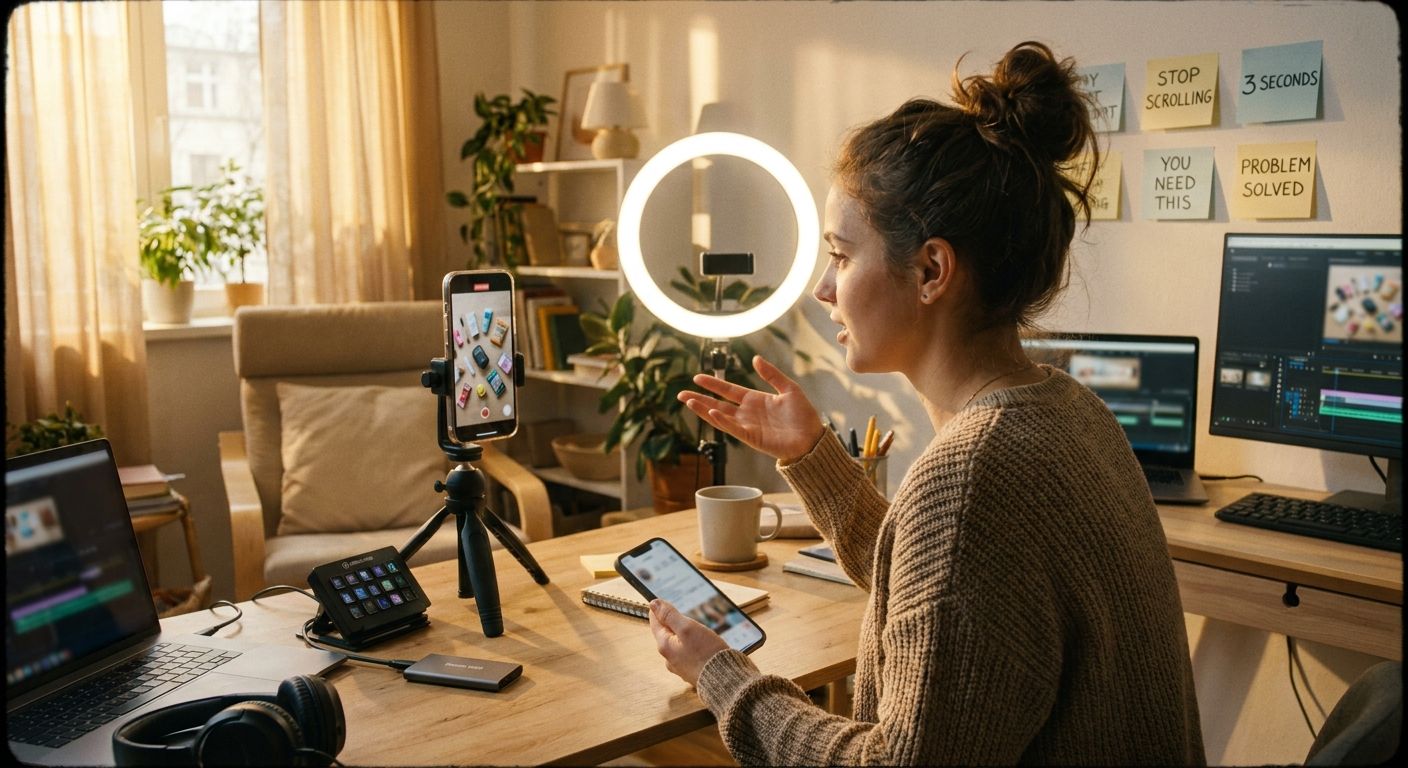
Top 10 Hooks to Try for Startups (With Templates That Actually Convert)


The hook is the entire game -- here are the 10 that work for startups
Most startup content fails in the first two seconds -- not because the product is weak, but because the opening line assumes the viewer already cares. They don't. These 10 hook templates follow one principle: make the payoff obvious before you ask for attention.
How a winning startup hook works
The viewer must know what they'll gain within the first sentence -- a result, a reveal, or a contrarian claim. No setup preamble.
Use specificity, contradiction, or an unusual format to break the scroll reflex -- a number, a confession, or an unexpected comparison.
After the hook lands, connect it to something the target viewer already feels -- the frustration, the aspiration, the missed opportunity.
Follow through on the hook's promise before asking for any action. Unmet promises kill saves and shares -- the real distribution engine.
Winners vs. losers: the pattern split
- Winners -- open with the result, the tension, or the contrarian claim. The viewer knows the payoff before they decide to watch.
- Losers -- open with "Hey guys, so today I wanted to talk about..." or a slow product tour that buries the value.
- Winners -- use specificity as credibility: a real number, a named mistake, a named customer type.
- Losers -- use vague superlatives: "revolutionary," "you need this."
- Winners -- earn attention before asking for a follow or a link click.
- Losers -- lead with the CTA, or scatter three CTAs across a 30-second clip.
The 10 hook templates for startup content
-
"We almost shut down because of [specific problem] -- here's what we changed."
Why it works: Admitting failure creates instant credibility. Founders trust founders who show the near-miss, not just the highlight reel.
Startup adaptation: Name the exact problem (churn, CAC, a bad hire) -- generic "struggles" land flat.
Loser pattern avoided: The polished founder montage that signals "this person has never lost." -
"Nobody told me [counter-intuitive truth] when I started building [category]."
Why it works: Triggers the "I didn't know that" reflex. The viewer immediately asks: do I know this?
Startup adaptation: The truth must be genuinely non-obvious -- not "product-market fit matters." Try "Nobody told me your first 10 customers should actively dislike the product."
Loser pattern avoided: Advice-from-authority hooks that feel like a lecture before the credibility is earned. -
"I built [thing] in [tight timeframe] -- here's the exact process."
Why it works: Compressed timelines create urgency and make the content feel replicable. "Exact process" promises a takeaway.
Startup adaptation: Show the actual build -- a Notion doc, a Figma screen, a Slack thread -- not just talking head.
Loser pattern avoided: Vague "here's how I did it" with no process shown. -
"Stop [common thing founders do]. Do this instead."
Why it works: "Stop" creates instant tension with anyone currently doing that thing.
Startup adaptation: The "common thing" must be something the viewer is actively doing -- cold outreach to strangers, posting without a CTA, hiring generalists first.
Loser pattern avoided: Permission-seeking openers that ask the viewer to keep watching rather than commanding it. -
"Here's what [well-known company] does that they never talk about publicly."
Why it works: "They never talk about" signals insider access.
Startup adaptation: Name a company your exact audience respects -- not always the biggest one. A SaaS founder cares more about Notion or Linear than about Apple.
Loser pattern avoided: Generic "lessons from [huge brand]" content that feels repurposed from a 2019 LinkedIn post. -
"The reason your [core startup metric] isn't moving is [specific, unexpected cause]."
Why it works: Diagnoses a pain the viewer already feels. The unexpected cause adds new information rather than restating the problem.
Startup adaptation: Be ruthlessly specific: "The reason your demo-to-close rate isn't moving is your deck's slide order, not your pricing."
Loser pattern avoided: "Here are 7 reasons your growth is slow" listicles that bury the diagnosis. -
"I got [desirable outcome] without [the thing everyone thinks you need]."
Why it works: Challenges the assumed prerequisite. If the viewer believes they need VC funding, a big team, or paid ads, this hook reframes what's possible.
Startup adaptation: The "thing everyone thinks you need" should be something your audience genuinely believes is required -- not a strawman.
Loser pattern avoided: Hustle-porn "you just need to work harder" content that offers no new information. -
"Watch me [do the thing] live -- no cuts."
Why it works: "No cuts" signals authenticity and makes the content feel higher-stakes. The viewer wants to catch the mistake.
Startup adaptation: Cold call a real prospect, write a real landing page headline, pitch a real investor question on camera -- the task must have genuine stakes.
Loser pattern avoided: Heavily edited "behind the scenes" content that removes all the friction and feels staged. -
"[Controversial opinion about your space] -- and here's the data I used to get there."
Why it works: Opinion alone is noise. Opinion plus evidence drives engagement -- comments will disagree, which is distribution.
Startup adaptation: The opinion must actually be controversial in your niche, not just contrarian-sounding. "SEO is dead" is stale. "Your landing page copy should lead with the problem, not the solution" is specific enough to generate real debate.
Loser pattern avoided: "Unpopular opinion:" with a completely safe opinion underneath. -
"Two [categories of people]: [Person A] does X. [Person B] does Y. Which one are you?"
Why it works: The binary creates instant self-identification. Viewers sort themselves and comment -- often to disagree with the category they've been put in.
Startup adaptation: "Two types of founders: ones who ship and iterate, ones who polish and delay. The market rewards the first type by a wide margin."
Loser pattern avoided: Poll-style content that asks for engagement before delivering any value.
Workflow: one source idea -> 3-5 posts
- Pick one founding moment or decision -- a pivot, a failed launch, a winning hire, a customer insight.
- Write the raw version as if you're explaining it to a smart friend over coffee. No polish yet.
- Extract the hook layer: map it to two or three templates above. The same story can work for Hook #1 (failure admission), Hook #6 (unexpected cause), and Hook #9 (controversial take).
- Produce three scripts, each with a different opening line but the same core story. Test them as short-form clips, a text post, and a carousel -- same content, different entry points.
- Let the pattern detector run: tools like GEN's autonomous agent can watch which hook variant retains viewers longest and generate the next iteration without a manual brief. The feedback loop closes in days instead of weeks.
Frequently asked questions
How long should a startup hook actually be?
One to two sentences maximum. If the hook needs three sentences to set up, it's a weak hook with too much premise -- cut to the provocative claim or the result and open from there.


Should startup founders use trending audio or hooks native to their niche?
Niche-native hooks consistently outperform trend-chasing for startup content because your audience is skimming for tactical information, not entertainment. A trending sound rarely signals "this will teach me something I can use Monday morning." Hook clarity beats platform virality mechanics for this intent type.
Can the same hook work across TikTok, Instagram Reels, and LinkedIn?
The underlying hook logic translates across platforms, but the delivery changes. On short-form video, the hook is spoken and on-screen text simultaneously. On LinkedIn, the hook is the first line before "...see more." The templates above work for both -- swap the format, not the opening premise.
How many hook variations should you test before moving on?
Run at least two variants of each hook before drawing conclusions -- one delivered straight-to-camera and one with process footage or screen-share. A single post is not a test. The pattern only becomes clear across a small cohort of related clips, which is exactly the kind of systematic variation an autonomous agent can run without creator burnout.
Bottom line: Pick two hooks from this list that match a story you already have, write the scripts this week, and post them back-to-back. The fastest way to find your highest-performing hook pattern is structured variation -- not a single polished post you waited three weeks to publish.