How to Create Testimonial / Review Ad Video Ads: The 1-Claim Test That Makes AI UGC Believable

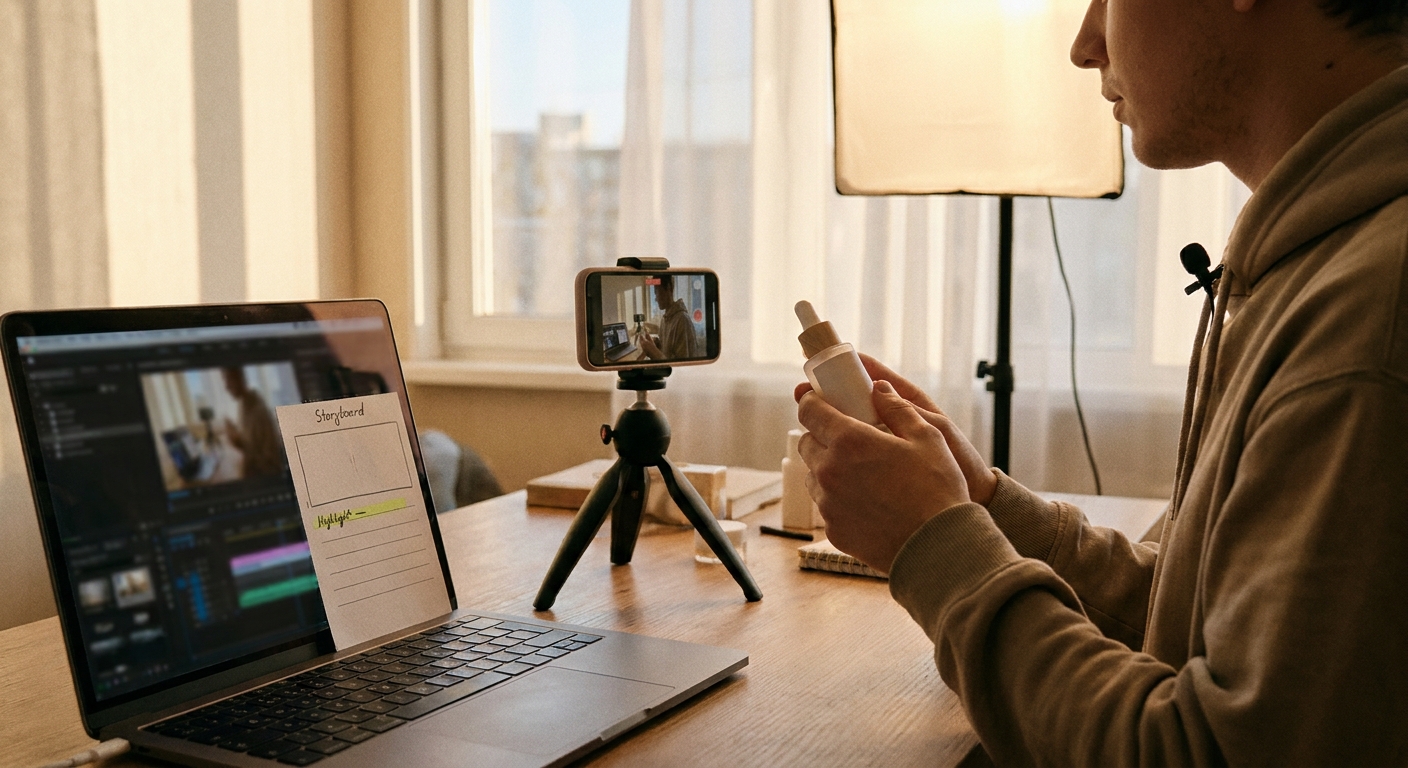
How to create testimonial / review ad video ads that don’t feel like fake praise
The best testimonial ad is not "a happy customer talking." It is one specific claim, put under pressure on camera, with enough friction for the verdict to feel earned. If you want to create testimonial / review ad video ads that survive the first three seconds, stop scripting praise and start scripting proof.
The review ad credibility loop
Say one measurable or observable promise in the first three seconds.
Give the viewer a reason not to believe you yet.
Show the product under pressure: side-by-side, first use, wear test, screen proof, or replacement test.
End with a qualified recommendation, not universal praise.
- Manual praise -> weak signal: "I love this" says almost nothing.
- One claim -> sharper retention: the viewer knows what they are judging.
- Visible test -> lower skepticism: proof beats adjective-heavy scripts.
- Real limitation -> higher trust: a credible caveat makes the positive verdict easier to believe.
- AI batching -> faster iteration: use tools like GEN Vidsheets to turn review angles into multiple platform-ready variants.
Why testimonial and review ads are still expanding in 2026
The format works because it matches how buyers evaluate products: they distrust the seller, borrow the reviewer’s eyes, and look for evidence that could prove the claim wrong. A good review ad gives them that process in 15-45 seconds.
The late-2026 version is tighter than old UGC. It is less "creator monologue" and more "micro-demonstration with a verdict." Beauty, AI software, gadgets, supplements, courses, and local services all use the same grammar: claim, doubt, test, result.
Watch how the best examples behave. A P. Louise advent calendar unboxing works because the product creates a sequence: drawer, reveal, swatch, reaction, repeat. A Kimi K2.5 AI review works because the reviewer stacks interface proof, comparisons to ChatGPT and Gemini, and a fast explanation of why the model matters. An IT Cosmetics face balm review works because the creator starts from distrust, "I don’t trust tinted balms," then lets the product fight its way to a verdict.
The non-obvious rule: the testimonial is not the asset. The test is the asset. The person is credible only if the viewer can see how they changed their mind.
The production spec: what a strong review ad needs
For most paid social placements, build the base cut around 30 seconds. Shorter than 15 seconds usually cannot earn a verdict. Longer than 45 seconds starts behaving more like organic content unless the product has a naturally satisfying sequence.
| Element | Working range | Operator note |
|---|---|---|
| Opening claim | 0-3 seconds | Say it aloud and put it on screen. No warm-up. |
| Visual change | Every 2-4 seconds | Cut between face, product, result, screen, hand demo, caption. |
| Script density | Roughly 3 words per second | Fast enough for momentum, not so fast that proof disappears. |
| Core proof | 1 test only | Multiple claims dilute believability. Make sequels instead. |
| Verdict | Final 3-5 seconds | Use a qualified recommendation: "best if you..." |
Four review ad series engines that actually compound
1. "I expected to hate this"
This is the most useful review frame when the category feels tired: tinted balms, AI tools, meal kits, productivity apps, posture correctors. Start with the buyer’s objection, not the brand’s promise.
- Hook: "I usually hate products like this, so I tried to prove this one wrong."
- Test: use the product in the exact failure condition buyers worry about.
- Verdict: "I’d use it for X, but not Y."
2. "Replacing my current solution"
Side-by-side review ads work because they make the alternative visible. The viewer does not need category education. They need a reason to switch.
- For software: old workflow screen recording -> new workflow screen recording.
- For beauty: one side of face vs the other.
- For household products: usual method vs product method under the same condition.
3. "Unbox, use, verdict"
The P. Louise advent calendar style works because the product creates retention loops on its own. Every drawer or reveal is a mini-cliffhanger. For ads, compress the loop: show only the three reveals that affect the buying decision.
4. "The 7-day or 30-day receipt"
Long-term testimonial ads beat first-impression ads when the purchase carries anxiety: skincare, fitness, coaching, B2B software, habit tools. The point is not to claim transformation. Show continuity: day one baseline, mid-point friction, final verdict.
5. "AI tool pressure test"
For AI products, do not review the homepage. Review the output under a concrete constraint. The Kimi K2.5-style review format works because it moves quickly from claim to interface proof to comparison. Apply that to any AI product: prompt, output, failure mode, useful verdict.
A practical workflow for creating testimonial / review ad video ads
- Pick the claim you are willing to prove. Not "better skin." Try "covers redness without looking heavy by noon." Not "saves time." Try "turns one raw clip into three platform-specific posts."
- Write the doubt before the praise. If there is no objection, the ad will feel pre-sold. Use the category’s real resistance: price, texture, setup time, learning curve, taste, durability, accuracy.
- Design one visible test. A testimonial without a test is just copy performed by a person. Use side-by-side, live use, before/after, screen recording, timed setup, wear test, or replacement test.
- Capture proof beats separately. Film face-to-camera, hands, product close-up, result, and one mistake or limitation. The limitation often anchors the trust.
- Cut for decision speed. The viewer should understand the buying implication of every shot. If a shot does not advance claim, doubt, test, or verdict, remove it.
- Generate variants by angle, not by synonym. One edit can become "skeptic test," "side-by-side," "for busy founders," "for sensitive skin," or "replaces my old workflow." That is useful variation. Five rewritten captions are not.
This is where AI UGC production changes the cost structure. With AI UGC workflows, teams can keep the proof structure fixed while changing persona, objection, pacing, opening text, and platform format. Tools like HeyGen and Arcads help create AI presenters and ad-style clips; GEN sits one layer higher as an autonomous AI social-media agent that watches trend patterns, creates the content plan, produces variants through GEN Vidsheets, and publishes across TikTok, Instagram, and X.

The distinction: do not automate the thinking out of the ad. Automate the repetitive assembly so your team can spend more time choosing sharper claims and better tests.
Channel architecture: make every review feel related, not repetitive
If you are building a channel around review ads, use a small set of repeatable visual signatures. The audience should recognize the format within one second without feeling like they are watching the same ad again.
- Signature opener: product in hand, claim text on screen, immediate objection.
- Proof rhythm: face -> product -> test -> result -> face.
- Caption system: use verbs, not labels: "testing," "swatching," "replacing," "checking," "comparing."
- Verdict language: avoid universal claims. Use fit-based conclusions: "worth it if...," "skip if...," "best for...".
- Series naming: keep it structural, such as "Skeptic Test," "Replaced My Usual," or "One-Week Verdict."
Manual clipping creates slow feedback loops. A daily review channel can burn several hours a week on formatting, captioning, resizing, scheduling, and version management alone. An autonomous agent like GEN helps when those repetitive steps are the bottleneck: it can monitor which review structures are gaining traction, create post variants, and publish without waiting for a human to rebuild the same asset for every platform.
Common mistakes that make review ads feel fake
- Too many claims: "hydrating, lightweight, clean, affordable, long-lasting" sounds like a product page. Pick one.
- No visible resistance: if the reviewer never questions the product, the viewer will do it for them.
- Perfect scripts: over-polished phrasing kills the review texture. Keep one human aside or minor caveat.
- Proof after the CTA: the test must happen before the ask. Otherwise the ad demands trust it has not earned.
- AI avatars with generic praise: AI presenters can work, but only when the script contains specific proof and realistic constraints.
Frequently asked questions
How long should a testimonial / review ad video be?
Use 15-45 seconds for most paid social tests, with 30 seconds as a practical default. Go shorter when the proof is visual and immediate. Go longer only when the product needs a sequence, like an unboxing, setup, or multi-day verdict.
Can AI-generated UGC testimonials be used in ads?
Yes, but the ad still needs clear, truthful substantiation and appropriate disclosure based on your platform, market, and claim type. The safer creative route is to make the AI presenter demonstrate product facts or structured scenarios, not pretend to be a real customer with fabricated personal experience.
What is the best hook for a review ad?
The strongest hook is usually a conflict: "I didn’t think this would work for X." It gives the viewer a reason to stay because the ad has tension to resolve, not just a benefit to announce.
How many testimonial ad variants should I make?
Create variants around different objections and tests, not cosmetic copy changes. Three strong angles, skeptic test, side-by-side replacement, and long-term verdict, are more useful than ten versions of the same praise line.
The takeaway: if you want to create testimonial / review ad video ads that convert attention into trust, build every script around one provable claim, one honest doubt, one visible test, and one qualified verdict. Everything else is editing.