
The 5-Stage AI Reel Generator Workflow That Actually Compounds


The 5-stage AI reel generator workflow that actually compounds
An AI reel generator earns its keep when it shortens the path from a live market signal to a published asset. The expensive part is rarely the render. It is choosing the angle, fitting it to your brand, posting while the trend still has life, and learning before the next post.
The reel system that beats one-off generation
Find patterns early enough to act, not after every account has copied them.
Turn the trend mechanic into a brand-native premise instead of copying the surface format.
Produce several distinct openings, edits, and captions before choosing the strongest path.
Adapt caption, thumbnail, and pacing to each platform instead of dumping one export everywhere.
Use saves, rewatches, comments, and drop-off clues to shape the next generation.
- Manual clipping -> slow feedback loops: you spend your energy exporting instead of learning what the audience rewards.
- One-click generation -> generic output: the video exists, but it has no timing, tension, or point of view.
- Autonomous generation -> compounding: trend watch, creative production, publishing, and performance feedback work as one system.
What operators actually need from an AI reel generator
Most tools in this category sell the visible step: script to video, prompt to avatar, long video to clips, image to motion. Useful, but incomplete.
If you post daily across Instagram Reels, TikTok, and YouTube Shorts, the mechanical work alone can eat several hours a week: resizing, captioning, choosing covers, rewriting descriptions, moving files between tools, and checking whether each version posted correctly. That is before strategy.
The sharper question is not, "Can AI make me a Reel?" It is, "Can AI keep my account moving without making my brand sound like a content farm?"
The hidden failure mode: AI makes the asset, not the decision
A weak AI reel generator treats every input as a production request. You give it a prompt, it gives you a video. That works for volume, but it does not solve the operator problem.
The decision layer matters more than the render layer:
- Which trend is still early enough? TikTok and Reels formats can peak quickly; late adoption often looks like imitation.
- Which part of the trend is reusable? Usually it is the contrast, reveal, pacing, or comment-bait mechanic, not the exact audio or visual style.
- Which brand constraint cannot break? A B2B founder, ecommerce brand, and faceless education account need different levels of polish, humor, and risk.
- Which performance signal changes tomorrow's post? Views are noisy. Replays, saves, shares, and comment quality are more useful for creative iteration.
This is where autonomous agents like GEN differ from simple generation tools. GEN handles the loop: watching what is moving, creating content, publishing across channels, and using the response to shape the next move. The point is not "AI made a Reel." The point is fewer stalled handoffs between signal and shipping.
A practical workflow for using an AI reel generator without producing slop
- Start with a content job, not a prompt. Define whether the Reel should explain, provoke, demonstrate, compare, or convert. If you skip this, AI will default to a smooth but forgettable explainer.
- Extract the mechanic from the trend. If a format is working, identify the engine: before/after reveal, contrarian opener, visual transformation, rapid teardown, "mistake you are making," or proof sequence.
- Generate three opening paths. Ask for one direct, one contrarian, and one curiosity-driven version. Most mediocre Reels fail in the first two seconds, so spend your variation budget there.
- Lock the brand constants. Voice, banned claims, visual density, logo usage, product language, and acceptable humor should be reusable instructions, not rewritten every time.
- Create platform-specific exports. The same core idea can work across Reels, TikTok, Shorts, and X, but captions and pacing should not be identical by default.
- Review the first-hour signals, but do not overreact. Early performance can mislead. Look for directional clues: comments asking the same question, saves on tactical content, drop-off after a weak transition.
- Turn winners into templates. A winning Reel is rarely a one-off. Save the structure: opener, proof, sequence length, CTA type, and visual rhythm.
Where real creators expose the real problem
A useful example comes from @eman_mohamedyt, who has posted about AI image generation and the recurring issue of faces changing between outputs. The lesson transfers directly to AI Reels: many "tool problems" are actually instruction and consistency problems.
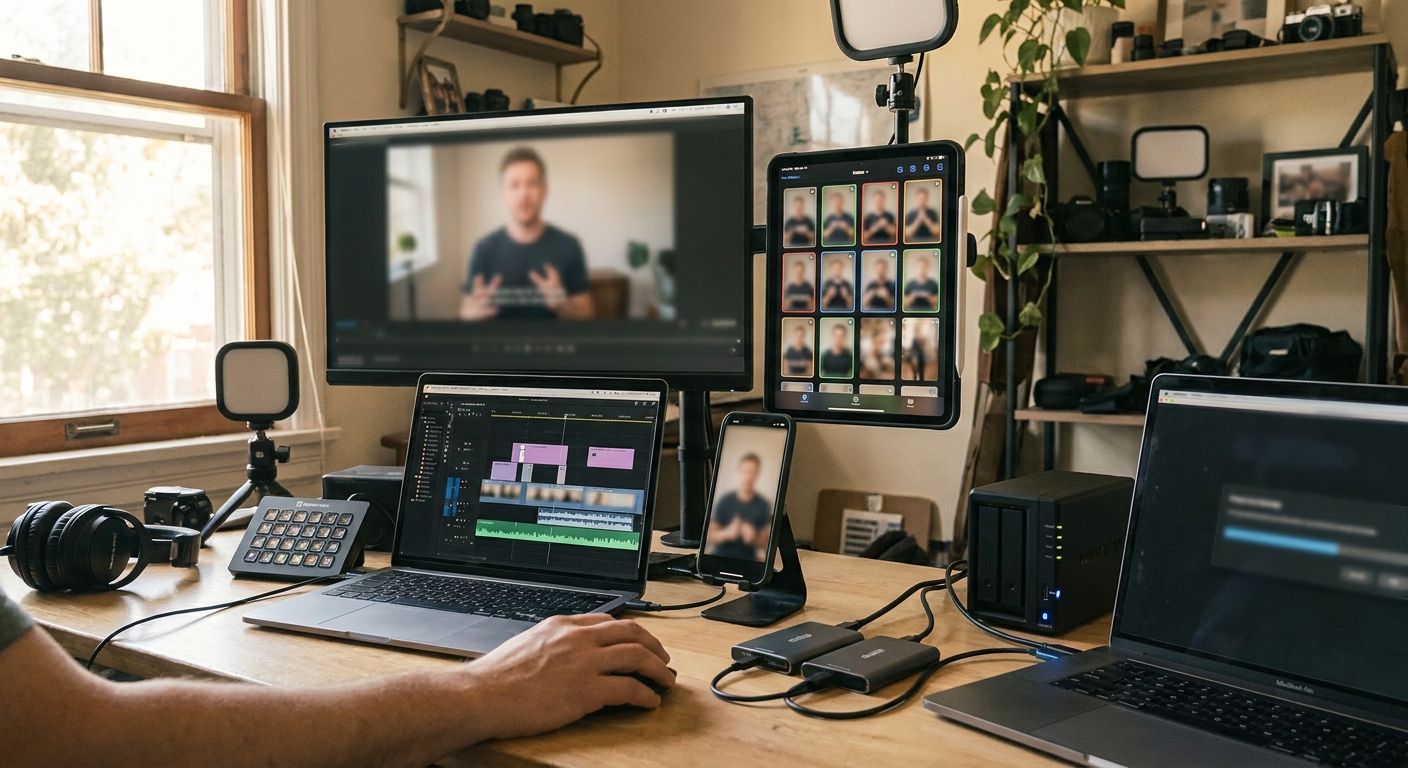
If your AI-generated videos feel off-brand, the issue may not be the model. It may be that your prompt lacks persistent identity rules: face reference, product framing, color system, tone boundaries, or scene continuity.
For creators using avatar or UGC-style tools like HeyGen or Arcads, this matters even more. The output can look polished while still feeling strategically wrong. A believable avatar delivering a weak premise is still a weak Reel.
Comparison: generator, editor, or autonomous agent?
| Approach | Best for | Where it breaks |
|---|---|---|
| Basic AI reel generator | Turning a prompt, script, or asset into a short video | No trend judgment, weak brand memory, limited publishing loop |
| AI video editor | Cutting podcasts, webinars, product demos, and talking-head footage | Still depends on humans to choose angles and distribute consistently |
| Autonomous social-media agent | Continuous trend response, generation, posting, and iteration | Requires clear brand rules and approval boundaries upfront |
If you already have strong long-form footage, an AI clipping tool may be enough. If you need net-new short-form output from trend signals, an autonomous system is closer to the real job.
For adjacent workflows, see AI video generator strategy and social media automation.
The operating constraints that separate good AI Reels from cheap ones
1. Consistency beats novelty after the first post
AI makes it tempting to reinvent the style every day. Resist that. Strong accounts usually repeat recognizable structures: the same visual grammar, recurring segment types, similar caption density, and predictable payoff rhythm.
2. The prompt should contain negative rules
Operators underuse constraints. "Do not use startup clichés," "avoid fake urgency," "no floating buzzwords," and "do not over-explain the setup" often improve output more than adding more positive instructions.
3. Variants should differ by thesis, not just wording
Five captions saying the same thing are not five creative tests. A better batch tests different beliefs: one educates, one challenges a false assumption, one dramatizes cost, one shows a process, one makes a comparison.
4. Publishing speed only matters if learning speed improves
Posting more can make your system smarter, but only if results come back into the next creative decision. Otherwise, automation just scales your blind spots.
How GEN fits into the stack
GEN is an autonomous AI social-media agent, not a standalone AI reel generator. It watches trends, creates content, and publishes automatically to TikTok, Instagram, and X to reduce the gap between market movement and account output.
That distinction matters for lean teams. A founder or agency does not need another blank canvas if the bottleneck is deciding what to post every day. They need an always-on loop that turns signals into publishable content with brand rules attached.
The right use case is not "replace all creative judgment." It is "stop wasting human judgment on repetitive formatting, scheduling, and first-draft assembly." Humans should set positioning, approve risky claims, and refine the angles that matter. The agent should handle the drag.
Buying checklist: what to ask before choosing an AI reel generator
- Does it remember brand rules? If every video starts from a blank prompt, quality will drift.
- Can it generate multiple strategic variants? You need different angles, not cosmetic rewrites.
- Does it publish, or only export? Export-only tools still leave operational friction.
- Can it adapt by platform? TikTok, Reels, Shorts, and X do not reward identical packaging.
- Does it close the feedback loop? The tool should help you learn what to repeat, not only what to render.
Frequently asked questions
What is the best AI reel generator for brands?
The best option depends on the bottleneck. If you only need video creation, a prompt-to-video or avatar tool may work. If the bottleneck is daily social execution, look for an autonomous agent like GEN that connects trend detection, creation, publishing, and iteration.
Can an AI reel generator replace a social media manager?
Not cleanly. It can replace a large amount of repetitive production and scheduling work, but strategy, taste, risk management, and brand judgment still need human ownership. The better model is manager plus agent, not manager versus agent.
How do I make AI-generated Reels feel less generic?
Use tighter constraints: recurring formats, negative rules, brand vocabulary, visual references, and clear content jobs. Also generate variants by angle, not just by wording. Generic input produces generic polish.
Should I post the same AI-generated Reel on every platform?
You can reuse the core idea, but do not assume the same packaging will work everywhere. Adjust captions, opening frame, length, CTA, and description for the platform's native behavior.
Specific takeaway
Do not judge an AI reel generator by how quickly it can make one video. Judge it by how much of the full loop it owns: signal detection, angle selection, generation, publishing, and feedback. That is where AI starts compounding instead of merely producing more files.